

The Controversy That Sparked National Outrage
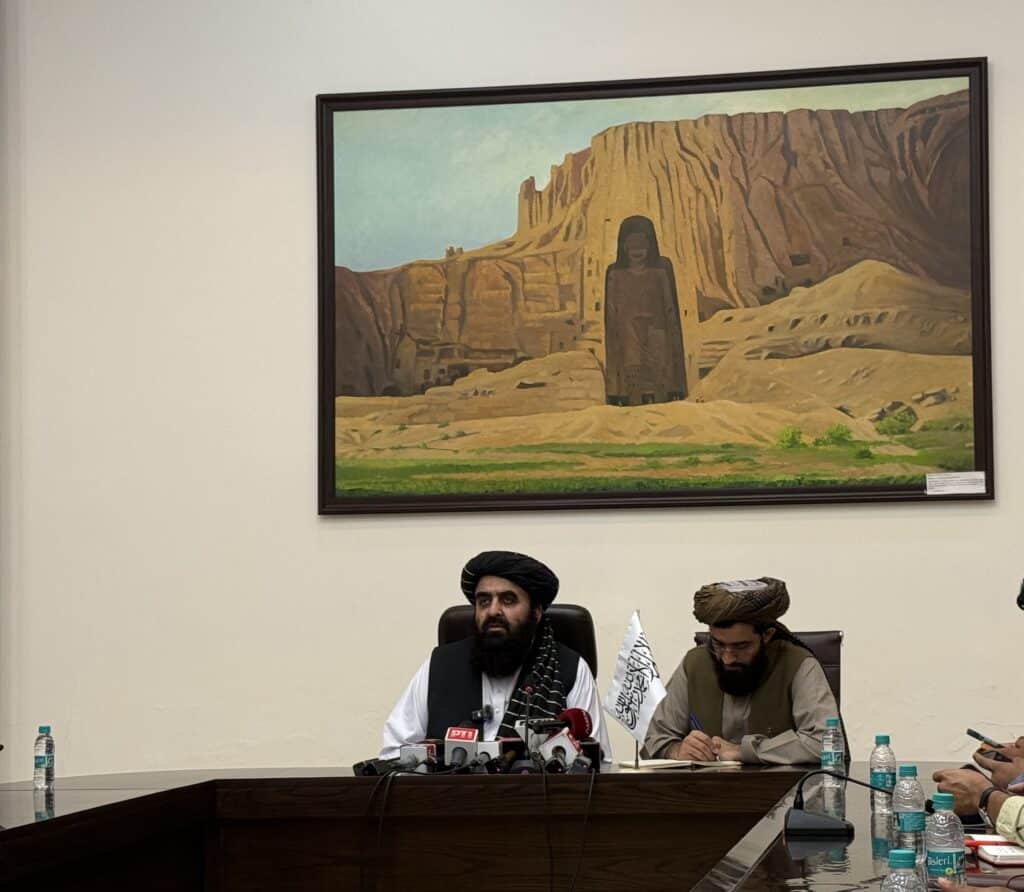
When Afghan Foreign Minister Amir Khan Muttaqi addressed the media inside the Afghan Embassy in New Delhi on October 10, not a single woman journalist was seen in the room. The absence triggered a national uproar, with critics accusing both the Taliban and the Indian government of tacitly endorsing gender exclusion on Indian soil.
Opposition leaders like Rahul Gandhi and Priyanka Gandhi Vadra condemned the incident as an affront to India’s democratic and gender-equal values. Social media erupted with outrage, calling it “Talibanization of diplomacy,” and women’s groups demanded answers.
The Indian Ministry of External Affairs (MEA) swiftly clarified that it had no role in the event’s organization. The press conference, the MEA said, was entirely handled by the Afghan Embassy and its consular staff — legally considered foreign territory under international law.
The Vienna Convention Defense
Defenders of the event quickly pointed out the embassy’s extraterritorial status under the Vienna Convention on Diplomatic Relations, arguing that India had no jurisdiction over who the Afghan mission allowed or denied entry.
However, this explanation did little to calm the backlash. Critics countered that, while diplomatic immunity protects embassies from host-country interference, it doesn’t justify discriminatory practices, especially in a country that champions press freedom and women’s rights.
Editorial bodies like the Editors Guild of India condemned the exclusion, saying that such gender-based restrictions violated both journalistic ethics and India’s global image as a pluralistic democracy.
“Technical Issue” or Symbolic Exclusion?
Taliban representatives tried to downplay the controversy, calling the absence of women a “technical issue.” They said limited space and time constraints meant not all media houses received invitations. But the optics were already disastrous — particularly given the Taliban’s notorious record on women’s rights in Afghanistan.
For Indian observers, the issue wasn’t whether women were stopped at the gates but whether they were systematically excluded from the start. That distinction, while subtle, mattered deeply. It spoke to a broader discomfort with allowing a regime that bars women from public life to stage a media spectacle in the heart of India’s capital.
The Follow-Up: Women Journalists Invited
Facing intense backlash across political, media, and public platforms, the Afghan mission swiftly moved to contain the damage.
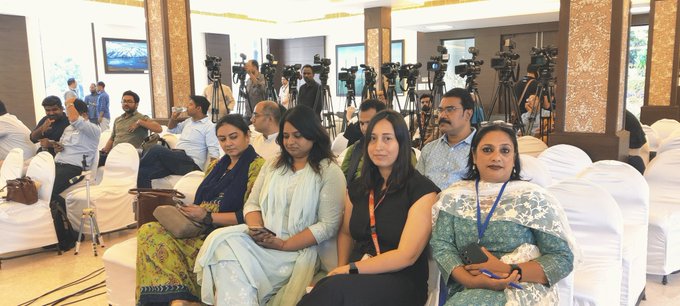
A follow-up press interaction was held where women journalists were invited, confirming that the earlier exclusion had not been absolute or irreversible. Reports by The Indian Express and other outlets said that Taliban officials scheduled another round of interaction, described as “inclusive,” to debunk claims that the omission was intentional or inevitable.
This rapid corrective move demonstrated the power of India’s vocal media and civil society. The Taliban, long criticized for gender apartheid back home, found itself pressured to project a different image — even if temporarily — when operating on Indian soil.
The Optics of Diplomacy and Accountability
Beyond the incident itself, the episode revealed how diplomacy, optics, and accountability intersect in the modern age.
- Diplomatic immunity may protect embassies legally, but not morally.
- Optics are no longer secondary — they shape perception and legitimacy.
- Public outrage, amplified by digital media, can alter diplomatic behavior faster than official negotiations.
The Afghan Embassy was within its rights to choose invitees, but India’s citizens were equally within theirs to question whether such an exclusion aligned with the spirit of Indian democracy.
What This Episode Means for India
India’s handling of the controversy showed a careful balance between respecting international law and responding to domestic outrage. The MEA’s quick distancing signaled that while diplomacy demands courtesy, public accountability still matters.
For the Taliban, the entire episode served as a lesson in optics: when you bring your politics abroad, you invite scrutiny, not submission.


