

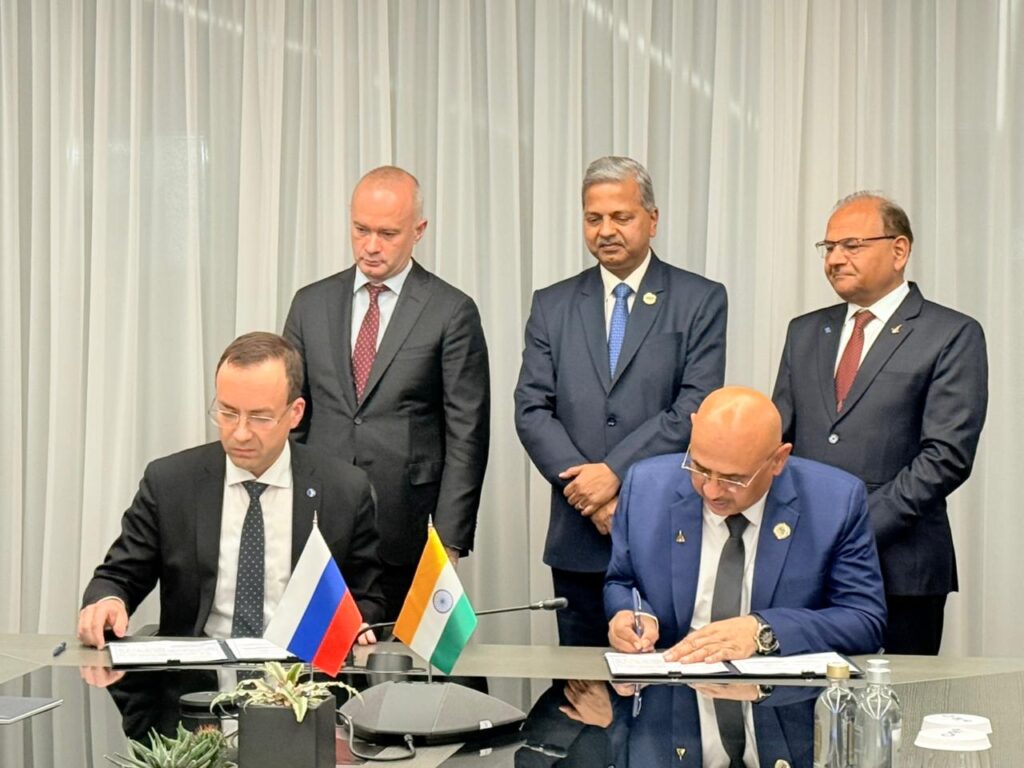
HAL SJ-100 marks a significant leap for India’s aviation industry as Hindustan Aeronautics Limited (HAL) and Russia’s United Aircraft Corporation (UAC) have inked a landmark Memorandum of Understanding (MoU) on October 27, 2025, in Moscow. The agreement grants HAL exclusive rights to manufacture and assemble the SJ-100 regional passenger jet in India under the government’s UDAN regional connectivity scheme.
This historic breakthrough represents more than a commercial deal — it’s a transformative milestone for India’s civil aviation, aligning seamlessly with the Make in India initiative and marking the revival of indigenous aircraft production after decades.
SJ-100: A Modern Jet Tailored for India’s Regional Needs
The SJ-100, also known as the Superjet 100, is a twin-engine regional airliner built to serve short- to medium-haul routes. With a capacity of 75 to 100 passengers and a range of up to 4,500 kilometers, the aircraft is perfectly suited for connecting India’s tier-2 and tier-3 cities under UDAN.
Powered by Russia’s indigenously developed PD-8 turbofan engines, the SJ-100 offers fuel efficiency, reduced maintenance costs, and low emissions, making it ideal for emerging airlines and budget carriers. Its performance and cost efficiency could redefine how regional aviation operates across India’s growing domestic network.
Reviving India’s Civil Aircraft Production
The HAL-UAC collaboration revives a dream India has pursued for decades — building its own passenger aircraft industry. The last major effort was the Avro HS-748, assembled in the 1960s, followed by the NAL Saras project, which struggled to reach mass production.
With this new partnership, HAL aims to create a state-of-the-art assembly line, build advanced testing facilities, and integrate modern avionics systems domestically. This move will not only reduce dependency on imports but also build a foundation for future homegrown aircraft projects.
Industry experts view this as a strategic diversification for HAL, traditionally known for defense production, into the civil aviation market, expanding its global footprint.
Make in India Push
The SJ-100 project is expected to create thousands of jobs directly and indirectly across India’s manufacturing and aviation ecosystem. From airframe assembly technicians and aerospace engineers to maintenance, repair, and overhaul (MRO) specialists, this initiative will stimulate employment and skill development across multiple sectors.
Moreover, technology transfer from Russia will empower Indian engineers with critical design and production expertise. This collaboration will strengthen India’s aerospace supply chain, enabling domestic production of key components like avionics, landing gear, and interior systems.
The ripple effect will spread across industrial clusters in Bengaluru, Nashik, and Hyderabad, boosting regional economies and reinforcing India’s position as an emerging aviation hub.
Certification and Localization
While the announcement has generated tremendous excitement, challenges remain. The SJ-100 must undergo certification by India’s Directorate General of Civil Aviation (DGCA) and comply with international aviation safety standards.
HAL and UAC will also need to finalize localization targets, defining how much of the aircraft will be manufactured domestically versus imported. Supply chain integration, spare parts support, and after-sales maintenance networks must be developed to ensure long-term operational success.
Experts suggest that public-private partnerships and collaboration with Indian MSMEs will be key to achieving production efficiency and cost competitiveness.
Strategic and Geopolitical Importance
Beyond manufacturing, this deal carries strong strategic significance. It reinforces the India-Russia aerospace relationship at a time when global partnerships are shifting. For Russia, it opens access to the Asian civil aviation market; for India, it represents technological empowerment and independence in aerospace manufacturing.
The SJ-100 will directly benefit the UDAN scheme, connecting smaller cities and boosting domestic air travel accessibility. Airlines could soon operate Made-in-India regional jets, reducing costs and expanding India’s aviation footprint across South Asia.
This partnership positions India as a credible civil aircraft producer, potentially enabling future exports to friendly nations in Asia, Africa, and the Middle East.
A New Flight Path for Indian Aerospace
The HAL-UAC SJ-100 breakthrough is more than a manufacturing deal — it’s a symbol of India’s self-reliance and innovation in aviation. If executed successfully, the project will reshape India’s aerospace sector, bridging the gap between defense expertise and civilian needs.
As the first Indian-assembled SJ-100 takes to the skies, it will carry more than passengers — it will carry India’s aspiration to soar as a global aviation power. This partnership could well be the launchpad for India’s next big leap in technology, industry, and international influence.


