

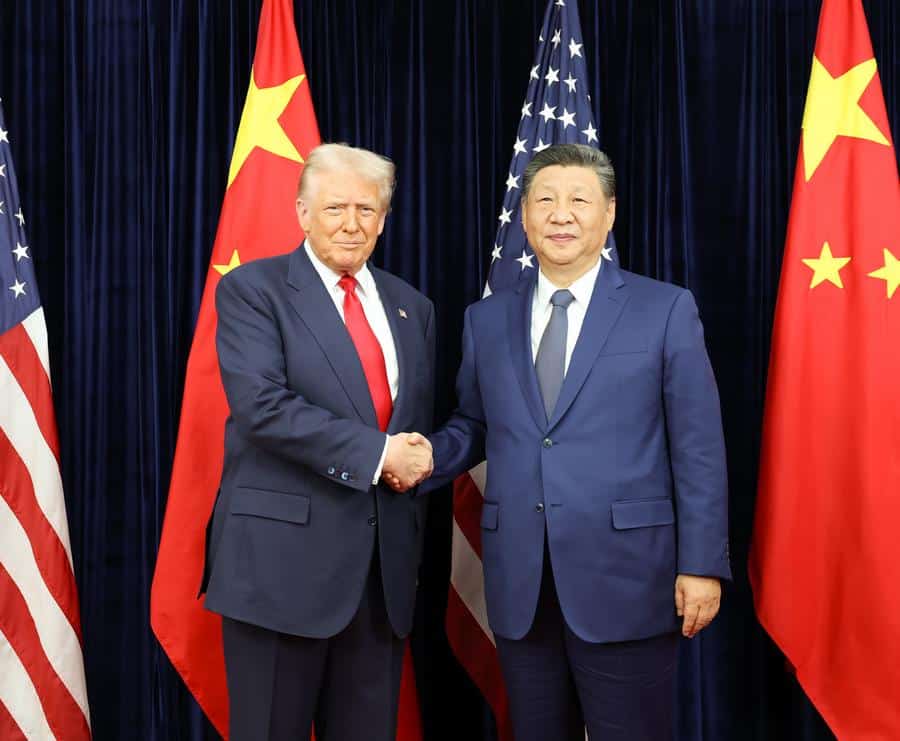
Trump-Xi Busan Summit 2025 has redefined the global diplomatic stage as U.S. President Donald Trump and Chinese President Xi Jinping met for the first time in six years on October 30, 2025, in Busan, South Korea. The high-stakes meeting produced tangible outcomes that could reshape trade balances, revive global supply chains, and signal a cautious thaw between the world’s two largest economies.
The headline-grabbing decision: the U.S. reduced tariffs on fentanyl-related Chinese imports from 20% to 10%, a move tied to Beijing’s pledge to curb precursor chemical exports fueling America’s opioid crisis. In return, China agreed to resume large-scale soybean purchases and grant one-year unrestricted access to rare-earth minerals, a vital concession in the ongoing tech and defense race.
Tariff Cut Sparks Diplomatic Momentum
At the heart of the Busan breakthrough is a pragmatic bargain. Trump framed the fentanyl tariff cut as “conditional cooperation,” hinging on China’s enforcement of chemical export controls. The political message is clear: Washington is willing to ease trade tensions if Beijing demonstrates genuine accountability.
The move offers Trump domestic leverage ahead of the 2026 midterms- addressing both the opioid crisis and trade inflation, While giving China diplomatic breathing space amid slowing growth. It’s a win-win optics deal that projects control without capitulation on either side.
Rare-Earth Pact: Securing Strategic Resources
Equally significant is the one-year rare-earth access agreement. Rare earths are indispensable for electric vehicles, semiconductors, and advanced defense systems. The temporary deal ensures uninterrupted U.S. supply, offering relief to tech and manufacturing sectors rattled by years of uncertainty.
However, the short duration reveals mutual caution. Analysts describe it as a “strategic pause” rather than a permanent truce. Beijing retains leverage to renegotiate, while Washington buys time to diversify supply chains. The deal underscores how economic interdependence still tempers political rivalry, a hallmark of modern great-power competition.
Soybean Trade: Political and Economic Reboot
Beijing’s decision to resume large-scale soybean imports from the U.S. carries deep symbolism. For Trump, it’s a political victory- reviving confidence in rural America and stabilizing agricultural markets hit by prior tariffs. For Xi, it’s a pragmatic response to domestic inflation and food security pressures.
The resumption of this once-lucrative trade channel signals that economic pragmatism is back on the table, even amid ideological differences. It marks a subtle but significant step toward normalizing trade relations in a fractured global economy.
Tech Diplomacy and the Chip Dilemma
While the summit didn’t deliver concrete policy reversals on chip technology, both leaders agreed to continue talks on export restrictions — an encouraging sign after years of decoupling rhetoric. The semiconductor issue remains the most sensitive fault line, blending national security with global market dominance.
Observers see Busan as an opening act in what could become a selective tech détente– where the U.S. and China cooperate in low-risk sectors while maintaining firm boundaries on advanced AI and defense-linked chips.
Geopolitical Calculus: A Tactical Power Reset
Beyond trade, the Busan summit radiates geopolitical significance. Trump leveraged the meeting to project global statesmanship, emphasizing peace talks on Ukraine and commitments to global stability. Xi, meanwhile, secured acknowledgment of China’s indispensability in global problem-solving.
The optics matter: the image of Trump and Xi shaking hands in South Korea sends a powerful signal that strategic rivalry doesn’t preclude strategic dialogue. Both leaders, aware of global fatigue from confrontation, appear to be recalibrating toward “managed competition” cooperation where possible, containment where necessary.
This shift comes amid renewed global instability- wars in Europe, economic fragmentation, and tech nationalism- making Busan a critical inflection point in 21st-century diplomacy.
The Road Ahead: Trump’s Beijing Visit 2026
The stage is set for the next chapter. Trump’s planned April 2026 visit to Beijing and Xi’s reciprocal trip to Washington later in the year will determine if this détente evolves into a sustainable realignment or fizzles under political pressure.
Until then, the Trump-Xi Busan Summit 2025 stands as a defining “breakthrough moment” — one that proves rivalry can coexist with realism. Whether it ushers in lasting peace or another tactical pause will shape the world’s balance of power for years to come!


