

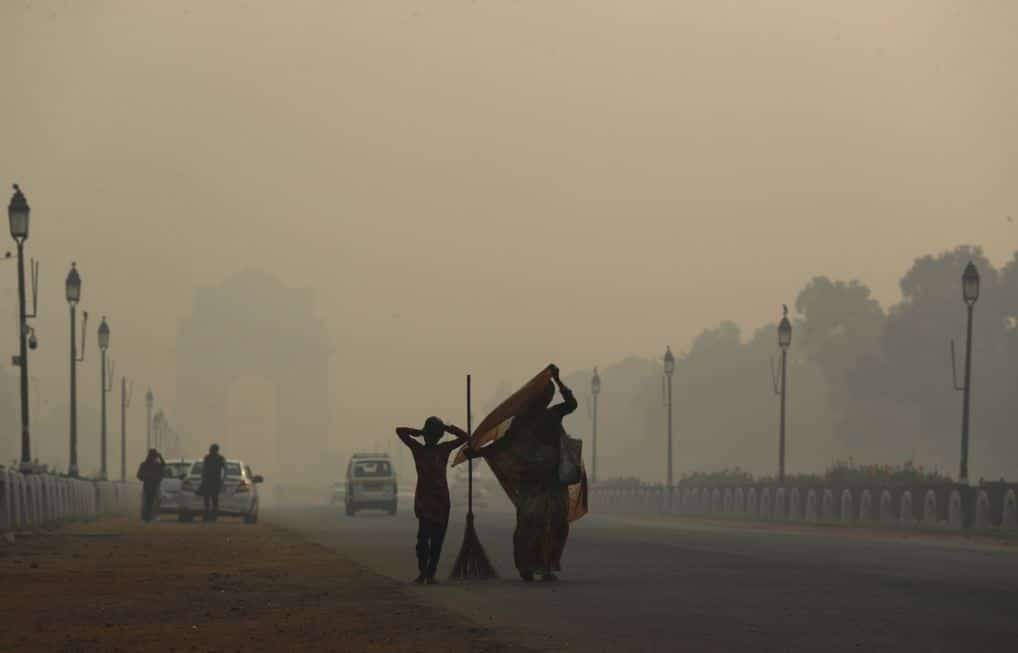
Delhi Pollution is no longer a seasonal tragedy- it’s a full-blown scandal of governance. Every winter, the capital of the world’s fourth-largest economy transforms into a gas chamber, yet officials promise blue skies with manipulated data and hollow “green” narratives. Behind the haze lies a toxic mix of political denial, selective enforcement, and scientific distortion– all of which have turned Delhi’s clean-air war into a theatre of deception.
The Firecracker Paradox: Politics over Public Health
Despite the Supreme Court’s repeated directions banning conventional firecrackers, Delhi’s skies lit up this Diwali. The government, eager to avoid appearing “anti-festival,” took a lenient stance, allowing a haze of hypocrisy to settle over the capital.
The result? AQI readings crossing 450 in multiple zones, with visibility dropping to near-zero. The Delhi Pollution Control Committee (DPCC) confirmed the post-Diwali spike but avoided attributing it to firecrackers- a classic case of political soft-pedalling dressed as environmental concern.
Experts say the government’s unwillingness to enforce its own ban reflects a dangerous trend: public sentiment over public safety. The same state that boasts electric buses and smog towers also silently permits thousands to choke every November.
The Green Cracker Myth: When “Eco” Becomes an Excuse
Officials often justify leniency by promoting so-called “green crackers” -a technology developed by CSIR-NEERI, claiming up to 40% less emissions. But the science tells a harsher truth: even green crackers release fine particulate matter (PM2.5), carbon monoxide, and toxic metals.
According to CSE and IIT-Kanpur, even if only green crackers were used, Delhi’s PM2.5 would still triple overnight. Why? Because “less toxic” is not “non-toxic.”
What makes it worse:
- A majority of “green crackers” sold are fake, illegally using CSIR’s label.
- Authorities lack testing mechanisms to distinguish genuine ones.
- During winter inversion, pollutants don’t disperse, rendering even cleaner fireworks dangerous.
The Supreme Court itself noted in 2023 that enforcement of “green” rules is “largely symbolic.”
In effect, green crackers became the government’s fig leaf– a way to claim progress while allowing pollution to rage on.
“Delhi doesn’t need greener crackers. It needs cleaner politics!”
Watering the Numbers: The Jahangirpuri Data Manipulation Expose
Perhaps the most damning revelation comes from the Jahangirpuri AQI station.
An investigation by Peek TV filmed anti-smog tankers watering only the few meters around the monitoring equipment, creating an illusion of cleanliness without affecting real air quality.
Experts warn that this selective watering cannot clean the air but can temporarily reduce dust near the sensor, artificially lowering readings.
Environmental scientist Dr. Nandini Rao puts it bluntly:
“You can’t water Delhi into clean air. You can only water down the data.”
The Delhi Environment Department defended the act as “routine maintenance,” but analysts have flagged a pattern of AQI manipulation — including offline monitors during smog peaks, delayed data uploads, and inconsistent readings between CPCB and independent stations.
If verified, these tactics amount to a betrayal of public trust, where data becomes a tool for political comfort rather than environmental reform.
Blame Games and the Smog of Accountability
Each year, Delhi’s pollution crisis sparks a familiar shouting match. The Delhi government blames Punjab’s stubble burning, while the Centre blames Delhi’s vehicles, waste, and construction dust. In the crossfire, citizens gasp for air — trapped between policy paralysis and political propaganda.
Public-health experts estimate that breathing Delhi’s air today is equivalent to smoking 15–20 cigarettes daily. The Lancet attributes nearly 2 million premature deaths annually in India to air pollution, while the World Bank says the nation loses 8.5% of GDP due to pollution-related damage. Yet, both state and central leaderships are busy cleaning their image, not the air.
Image Management as Policy
Delhi’s smog isn’t just an environmental failure; it’s a mirror to India’s governance style, where perception often replaces performance.
The government rolls out “smog towers” for photo-ops, sprays roads before VIP visits, and markets token “green” campaigns, all while AQI levels remain at “severe” for weeks.
In a country vying for global investment and superpower status, its capital is suffocating under its own spin. The optics of progress- electric vehicles, green crackers, and data dashboards can’t hide the bitter truth: Delhi’s air has become the price of political theatre!
The Air We Breathe Is the Policy We Keep
Delhi’s pollution crisis is no longer about meteorology or crop burning. It’s about governance by narrative — where clean-air policies are watered down, both literally and politically.
Until accountability replaces optics, the capital of the world’s fourth-largest economy will remain a monument to managed data, ignored science, and gasping citizens.
The tragedy isn’t that Delhi is polluted, it’s that Delhi’s pollution is now politically convenient!


