

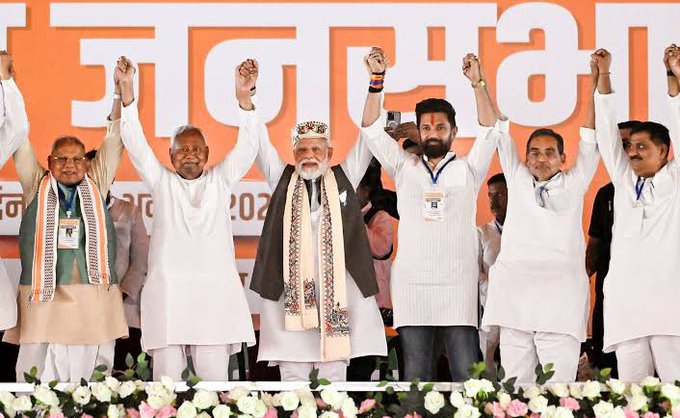
NDA Secures Over 200 Seats in Bihar Assembly Elections Victory. In a historic and emphatic verdict, the National Democratic Alliance (NDA) surged past the 200-seat mark in the 243-member Bihar Assembly on November 14, 2025, delivering one of the most decisive mandates the state has witnessed in decades. With the Bharatiya Janata Party (BJP) leading on approximately 120 seats and the Janata Dal (United) (JD(U)) crossing 80, the alliance recorded a dominant two-thirds majority that firmly re-establishes the combined leadership of Prime Minister Narendra Modi and Chief Minister Nitish Kumar.
The results shattered most pre-poll predictions and once again underlined the NDA’s enduring political influence in Bihar. By contrast, the opposition Mahagathbandhan, led by the Rashtriya Janata Dal (RJD) and the Congress, managed to secure leads in fewer than 65 seats, marking a significant setback for the alliance. The much-discussed Jan Suraaj party of Prashant Kishor failed to open its account despite widespread media visibility.
Why Bihar Delivered a Big Victory to the NDA
The NDA’s win reflects a convergence of voter trust, welfare-driven loyalty and political clarity. A noticeable rise in women’s participation became a defining aspect of this election. Many women voters backed the alliance due to targeted welfare schemes, access to health services, LPG subsidies, housing support and a sustained belief that the NDA ensured a safer and more stable environment. This demographic edge played a significant role in the alliance’s sweeping gains.
Nitish Kumar’s governance legacy remained another strong force. His reputation for improving Bihar’s overall administrative quality, from roads and electricity to education and law and order, retained deep resonance among rural voters. JD(U)’s presence across grassroots networks remained intact and complemented the BJP’s well-oiled organisational structure.
The BJP’s campaign discipline and grassroots mobilisation were equally crucial. Booth management, communication clarity and an emphasis on development, welfare and national stability helped consolidate diverse voter groups, including youth, first-time voters and migrant returnees. The campaign narrative, framed around growth and continuity, proved more persuasive than the opposition’s fragmented messaging.
In contrast, the Mahagathbandhan struggled to project a coherent alternative. Irregular leadership presence, internal friction and a lack of unified communication weakened their ability to turn discontent into electoral gains. Their employment-centered promises found limited traction in areas where the NDA’s welfare recalls held strong. New entrants like Jan Suraaj lacked the organisational depth needed to translate visibility into votes, allowing established alliances to dominate closely fought seats.
How Bihar Reached This Political Turning Point
The 2025 Bihar Assembly Election unfolded against a backdrop of shifting alliances, socio-economic stress and rising aspirations among the state’s youth and women. Bihar saw a record voter turnout of nearly 67 percent, signalling heightened public engagement and demand for clear leadership.
Over the last decade, Bihar’s electorate has witnessed political realignments, pandemic-era challenges and debates over employment, infrastructure and education. By 2025, the NDA positioned itself as the guardian of stability, administrative continuity and welfare expansion. The opposition attempted to counter with a narrative focused on jobs and social justice but fell short of building the momentum required to challenge the ruling coalition.
Counting Day: Transparency and Reactions
The Election Commission of India confirmed that counting was conducted transparently and according to statutory norms. Despite opposition complaints and attempts to flag alleged irregularities, the Commission stated that the tabulation process followed all required protocols. Officials emphasised that final constituency data would be reflected in authenticated Form-20 documents.
Celebrations erupted across NDA headquarters. Leaders hailed the verdict as a mandate for development and decisive governance, while JD(U) cadres described it as a reaffirmation of Nitish Kumar’s administrative credibility. The Mahagathbandhan accepted the defeat and indicated a period of intense introspection. Analysts believe the opposition will need significant organisational restructuring to regain competitiveness.
What the Mandate Means for Bihar’s Future
The NDA’s landslide now gives the government a powerful legislative advantage, but it also raises expectations. Bihar’s voters have delivered a mandate for visible progress. Public expectations around job creation, education quality, healthcare access, rural development, and women’s empowerment are higher than ever.
This election result is not just a win but a political turning point. It consolidates the Modi–Nitish partnership and sets the tone for Bihar’s development trajectory over the next five years. Whether the alliance can convert this sweeping electoral approval into sustained governance outcomes will define the state’s next chapter!


