

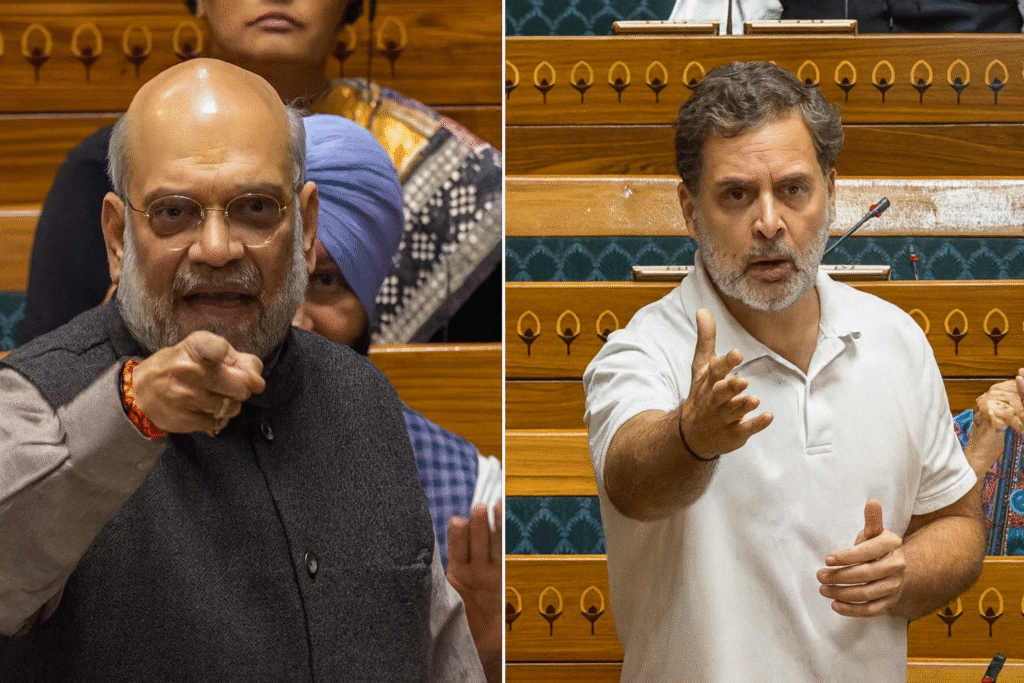
The political storm in Parliament intensified as Home Minister Amit Shah and the Opposition locked horns over allegations of a ‘first vote chori’, turning a routine session into a charged national spectacle. What should have been a day of legislative focus quickly spiraled into sharp exchanges, accusations, and procedural chaos reflecting a deepening distrust between the Treasury and Opposition benches.
At a time when India is grappling with inflation, unemployment, border tensions, and a slowing rural economy, the spectacle raised a pressing question: Is political theatre overtaking governance? The clash may have dominated headlines, but for millions of Indians dealing with real, everyday crises, the confrontation offered more noise than solutions.
Shah Targets Nehru, Indira and Sonia Gandhi in a Scathing Attack
Amit Shah opened his address with full force, throwing direct accusations at the Congress leadership, past and present. His voice rose as he declared, “Vote chori ki parampara Nehru ji ke time par shuru hui. Democracy ka pehla dhokha tab diya gaya tha.”
The ruling benches thumped their desks in approval as Shah framed the earliest years of India’s democracy as compromised by Congress actions.
Shah then turned his attack towards Indira Gandhi, reminding the House of the Emergency. With a sharp tone, he said, “Jab pura desh ki awaaz dabaa di jaye, jab matdaan ki izzat ko pairon tale kuchal diya jaye, usse bada vote chori ka tatha kya ho sakta hai.”
He followed with a stunning allegation against Sonia Gandhi, stating that she became a voter even before completing the procedural requirements of Indian citizenship. “Voter lists Congress ki family ki jaidad thi. Jo chaahe unka naam daal do. Jo chaahe unka naam hata do,” Shah said, triggering instant uproar from the Opposition.
Rahul Gandhi Shoots Back Inside the House
Shah’s aggressive tone drew an immediate intervention from Rahul Gandhi, who repeatedly rose from his seat to object. At one point, Shah insisted he would continue speaking in his own order, to which Rahul snapped, “You cannot dictate democracy. You cannot twist history like this.”
Shah countered instantly, saying, “Aap mujhe meri speech ka order nahi sikha sakte.”
The exchange created a charged atmosphere as members from both sides shouted to defend their leaders. The Speaker struggled to maintain order as the clash intensified into a direct political duel between the two faces of India’s polarised politics.
Opposition Warns: “This Is History Chori, Not Vote Chori”
Stung by the allegations, the Congress launched a rapid counterattack. A senior MP rose and declared, “This is not vote chori. This is history chori. Home Minister is rewriting India’s past to hide today’s failures.”
According to Congress MPs, Nehru strengthened democracy, created institutions and encouraged dissent. They argued that India’s first elections were overseen by independent bodies and that Shah’s statements were politically motivated distortions.
Another Congress leader stated, “Nehru personally encouraged independent candidates. He believed in competition, not control. The Home Minister is misleading the country.”
The Opposition also questioned why the government was spending Parliament’s valuable time debating events of the 1950s when the nation today is reeling under multiple crises.
Shah Hits Back: “You Cannot Hide Behind Nehru Forever”
Amit Shah did not step back for a moment. Instead, he escalated the attack. “Congress jab bhi kathin sawal aata hai, turant Nehru ji ki aadaalat bana leti hai. Unka samman apni jagah hai, par galtiyan toh galtiyan hoti hain,” he said.
He asserted that electoral reforms today were necessary precisely because systems had been compromised in the early decades of independence. “Hum desh ko wohi galtiyan dobara nahi dohraane denge,” Shah said.
He also struck back at the Opposition’s frequent mention of the RSS, saying, “RSS ka naam lekar hum par hamla karna aasaan hai, par ek baar swayamsevak ban kar desh seva karke dekhe. Ideology se darr nahi lagta. Bharatiyata usi se banti hai.”
Shah’s Defense of Electoral Reforms
Shah insisted that a clean and transparent electoral system was the foundation on which all good governance rests.
He reiterated that the new reforms aim to remove loopholes in voter registration, reduce bogus voting, synchronise databases and strengthen booth-level monitoring.
According to him, “Yeh sudhaar kisi ek party ke liye nahi, aane wali pidiyon ke liye hain. Bharat ka bhavishya hum aaj taiyaar kar rahe hain.”
He reminded Parliament of what he called multiple documented cases of illegal voter registrations under Congress rule and said the reforms were aimed at preventing those practices from ever returning.
But India Is Facing Real Crises. Why Is Parliament Fighting Over Nehru?
This question echoed across the Opposition benches and on social media as the debate went viral. Several MPs pointed out that India is currently battling urgent and dangerous crises that require immediate government intervention.
The IndiGo aviation crisis
Thousands of flights have been cancelled or delayed, massive queues have been reported at airports, and frustrated passengers have taken to social media demanding accountability.
Delhi’s deadly pollution
With AQI levels breaching hazardous marks, schools have been forced to shut down multiple times. Residents are struggling to breathe and medical experts are raising alarms about long-term lung damage.
The sliding rupee
The currency continues to weaken, pushing up import costs and adding pressure on families as daily essentials become more expensive.
An Opposition MP remarked, “Desh saans nahi le paa raha, par sarkar purane kisse gina rahi hai. Yeh vote chori debate kis kaam ka.”
Another member from a regional party said, “Janta ko flight nahi mil rahi, hawa zeher ban chuki hai, paise ki kimat gir rahi hai. Aur yahan aag lagi hai Nehru ke naam par.”
Opposition Accuses Government of Diversion Tactics
Several Congress leaders accused the government of using historical blame as a political strategy.
A whip said, “When today’s problems become too big, the government brings out Nehru. This is the new national escape plan.”
They pointed to rising joblessness, growing inflation, farmers’ concerns, and law-and-order pressures in some states.
They argued that the government is more interested in reviving old political wounds than addressing current suffering.
A Congress spokesperson told reporters, “Instead of fixing the mess of 2025, the Home Minister is fighting the ghosts of 1951.”
Government Defends Itself: “Reforms Define the Next Century”
BJP MPs countered that electoral reforms are not a diversion but a priority.
A senior BJP leader said, “Rajniti ka mool hi vote hai. Agar vote hi bhrasht ho jaye, toh governance kaise sahi chalega.”
According to government voices, the problems India is facing today are being addressed simultaneously by the concerned ministries and should not interfere with long-term institutional reforms.
Shah reinforced this argument. “Desh ki chunavi vyavastha ko saaf karna humari zimmedari hai. Flights aur pollution bhi theek honge, par chunav sudhaar ka arth hi desh ka bhavishya badalna hai.”
Parliament Turns Into a Theatre of Ideology and Anger
The session was marked by frequent shouting, slogans, walkouts, and heated confrontations. At moments, it felt less like a policy discussion and more like a battlefield of ideologies.
A political analyst watching the proceedings commented, “This is not a fight about elections. This is a fight about who controls the narrative of India’s past and future.”
Both sides seemed determined to dominate the national conversation. But the disconnect between political priorities and public concerns became increasingly stark.
Is India’s Democracy Stuck Between the Past and the Present?
The showdown raises deeper questions about political priorities. Should a country battling real-time crises spend Parliament’s energy relitigating events from 70 years ago? Or is cleaning the electoral system truly the foundation of a stronger future?
Critics say India is drifting toward a political culture obsessed with scoring historical points instead of solving real problems. Supporters of the government argue that without strong electoral reforms, no administration can address these challenges effectively.
India needs a strong future, yes. But it also needs a functioning present. And today, Parliament is burning over Nehru while the country outside gasps for breath, struggles for flights, and fights inflation. The real battle is not just inside the House. It is outside, where the people wait for solutions!


