

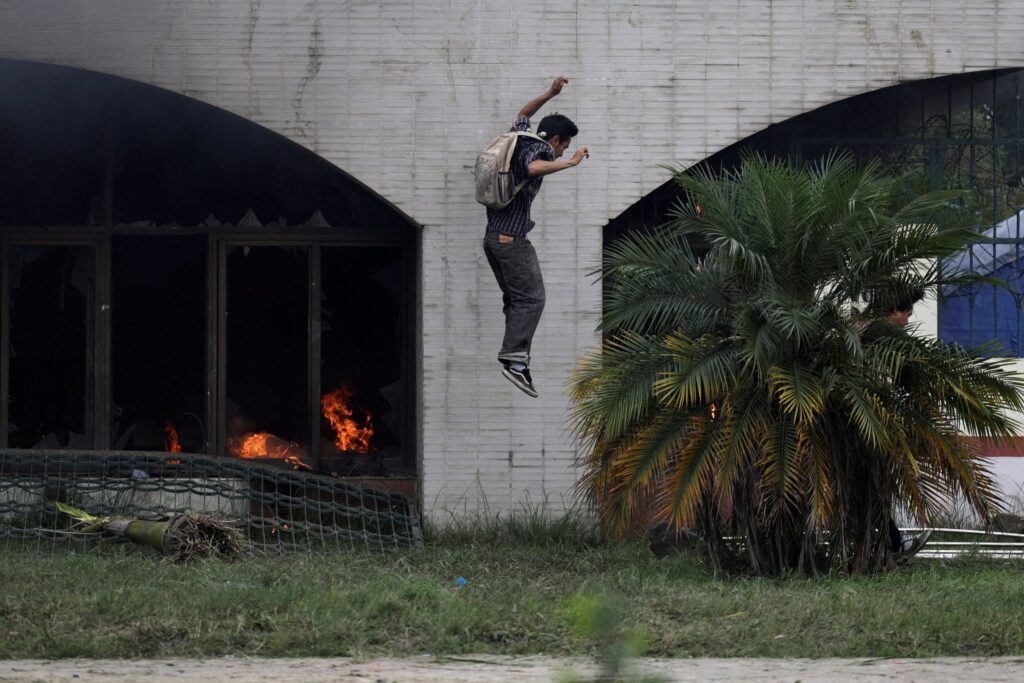
The Gen Z movement in Nepal, which erupted over two dramatic days on September 8 and 9, did more than force the resignation of then Prime Minister K.P. Sharma Oli. It pushed the Himalayan nation into one of its gravest political and economic crises in decades. A government committee report tabled at a Cabinet meeting in Singha Durbar has now put hard numbers to the chaos. The protests caused physical losses worth Rs 84.45 billion, led to the deaths of 77 people, injured 2,429 others, and shook the foundations of Nepal’s fragile economy.
Presented on Thursday before the Cabinet headed by Prime Minister Sushila Karki, the report offers the most comprehensive account yet of how a youth-driven movement transformed into a nationwide upheaval, leaving behind destroyed institutions, grieving families and a government struggling to rebuild trust.
What the report reveals
The government-appointed committee was tasked with assessing loss of life, injuries, and damage to public and private property during the Gen Z protests. Its findings are stark.
According to the report, the unrest caused Rs 84.45 billion in physical damage across the country. This figure includes losses to government infrastructure, private property, and community assets. The committee confirmed that 77 people lost their lives, while 2,429 individuals sustained injuries, many of them serious.
The scale of damage underlines how quickly a movement that began as digital dissent spilled into violent confrontation on the streets.
Nationwide spread of destruction
The committee made it clear that the Gen Z movement was not confined to Kathmandu. Damage was reported in all seven provinces, affecting 54 out of Nepal’s 77 districts and 262 local units.
Urban centres bore the brunt, but semi-urban and rural municipalities were also hit. Government buildings, municipal offices, police posts and courts were attacked or vandalised. In several areas, private homes and businesses were caught in the crossfire between protesters and security forces.
This nationwide footprint is one of the reasons the financial cost has ballooned to unprecedented levels.
Buildings and vehicles destroyed
One of the most striking aspects of the report is its granular breakdown of losses.
The committee recorded damage to 2,671 buildings across the country. These included ministries, courts, local government offices, commercial establishments, educational institutions, and private residences.
Equally alarming is the destruction of transport assets. A total of 12,659 vehicles were damaged or destroyed during the protests. These ranged from public buses and government vehicles to private cars and motorcycles, severely disrupting mobility and livelihoods.
For many families and small business owners, the loss of vehicles meant the loss of their primary source of income.
Public versus private losses
The report categorised the damage into three broad sectors.
The public sector suffered losses worth Rs 44.93 billion, including damage to central government buildings, provincial offices, security installations and public infrastructure.
The private sector accounted for Rs 33.54 billion in losses. Shops, factories, warehouses, hotels and private homes were looted, burned or vandalised during the unrest.
The remaining Rs 5.97 billion in damage was recorded under community and other sectors, covering cooperatives, social institutions and shared assets.
This split highlights that while the state was a major target, ordinary citizens and businesses paid a heavy price.
Human cost of the protests
Beyond the numbers lies a grim human story.
The committee confirmed that 77 people died as a direct or indirect result of the protests. Of these, 20 deaths occurred on September 8, 37 on September 9, while 20 others died in the days that followed due to injuries sustained during clashes.
The injury data is equally revealing. Among the 2,429 injured, 17 were children under the age of 13. A staggering 1,433 injured individuals were aged between 13 and 28, underscoring how deeply the violence affected the very generation that powered the movement.
Hospitals in Kathmandu and other cities were overwhelmed, with doctors reporting shortages of beds, medicines and trauma care facilities during the peak of the unrest.
Damage to iconic institutions
The protests struck at the symbolic heart of the Nepali state.
Key national institutions including Singha Durbar, the Prime Minister’s Office, Parliament buildings, and parts of the Supreme Court complex suffered damage. Several ministries were vandalised, with offices ransacked and official records destroyed.
For many observers, the attack on these institutions reflected not just anger at a government, but a deeper frustration with what protesters described as systemic corruption, elite impunity, and political stagnation.
How the uprising unfolded
The Gen Z movement was born online. Anger over governance failures, unemployment and restrictions on digital freedoms quickly turned into coordinated street action. Social media platforms became tools for mobilisation, allowing thousands of young people to assemble within hours.
What began as peaceful demonstrations soon escalated. Clashes between protesters and security forces turned violent. Curfews were imposed, internet services disrupted, and security personnel deployed in large numbers.
By the second day, the situation had spiralled out of control. Fires, vandalism and mass confrontations paralysed cities, eventually forcing K.P. Sharma Oli to resign in an attempt to restore calm.
Political fallout
The resignation of Oli marked a dramatic turning point. Sushila Karki, a former chief justice, was brought in to lead an interim administration tasked with stabilising the country, restoring order and preparing for political transition.
At the Cabinet meeting in Singha Durbar, Prime Minister Karki received the committee’s report along with recommendations for reconstruction and compensation. Officials said the government would prioritise relief for victims, rebuilding critical infrastructure, and accountability for excesses committed during the unrest.
However, political analysts warn that the challenge is immense. Trust in institutions has been severely eroded, and expectations among young protesters remain high.
Economic shock to Nepal
Beyond physical destruction, the protests dealt a heavy blow to Nepal’s economy.
The government estimates that the unrest caused an overall economic shock of about $586 million, a significant hit for a country with an economy valued at roughly $42 billion. Tourism suffered immediate cancellations, supply chains were disrupted, and investor confidence took a hit.
Small and medium enterprises were particularly vulnerable. Many business owners reported losing inventories built up over years, with no clear assurance of compensation.
Cost of rebuilding
The committee did not stop at damage assessment. It also proposed a reconstruction roadmap.
According to the report, Rs 36.30 billion will be required just to rebuild government and public sector infrastructure. This figure does not include compensation for private losses, medical expenses for the injured, or long-term rehabilitation costs.
So far, the government’s reconstruction fund remains thin, raising concerns about how the massive rebuilding effort will be financed.
Calls for accountability
Human rights groups and civil society organisations have called for independent investigations into the deaths during the protests. Allegations of excessive use of force by security personnel have surfaced, alongside evidence of violence and arson by sections of the protest movement.
The government has promised inquiries, but families of victims say justice will be the real test of whether the post-uprising state is different from what existed before.
A movement at a crossroads
For Nepal’s Gen Z, the uprising marked a historic assertion of political power. It demonstrated that a digitally connected generation can challenge entrenched leadership and force change.
Yet the cost has been devastating. Seventy-seven lives lost, billions in damage, and a nation struggling to heal raise difficult questions about the sustainability of such confrontational politics.
As Nepal moves forward, the legacy of the Gen Z movement will depend on what comes next. Whether the energy of the streets is channelled into institutional reform or dissipates into disillusionment will shape the country’s future.
For now, the numbers in the government report stand as a sobering reminder. A government fell, but the country must still pay the price.


