

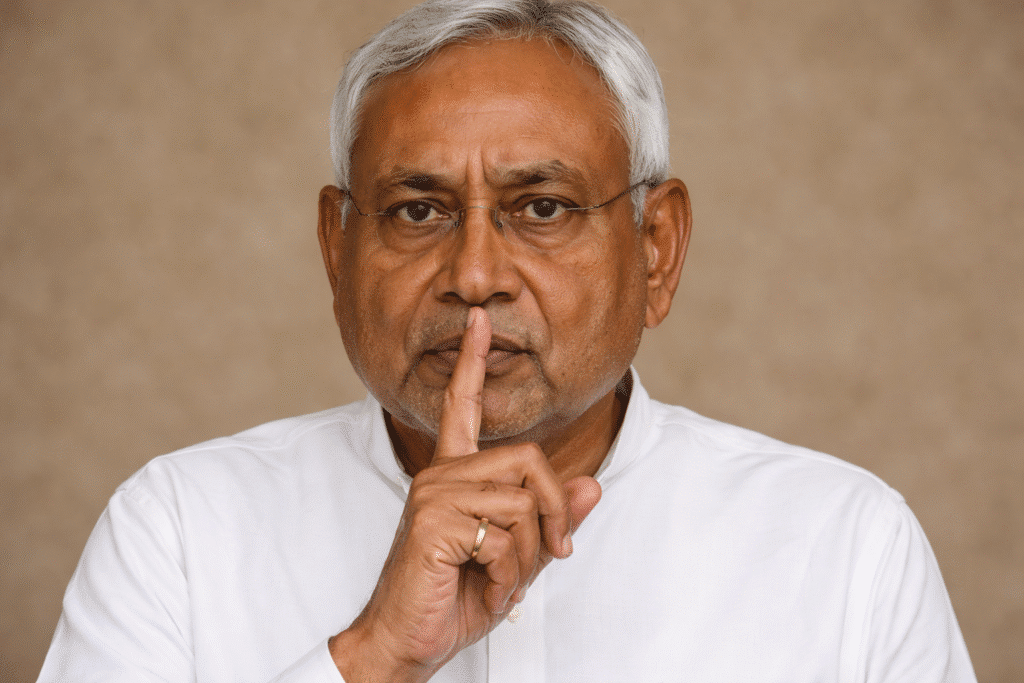
Nitish Kumar found himself at the center of a national controversy after a video from a government job ceremony in Patna showed the Bihar Chief Minister allegedly pulling down the hijab of a Muslim woman doctor on stage. What was meant to be a formal occasion celebrating professional achievement quickly turned into a flashpoint debate on women’s dignity, religious sensitivity, and the standards expected from elected leaders in a constitutional democracy.
The episode has triggered sharp political reactions, divided public opinion, and reopened broader questions about authority, accountability, and behavior in public office.
The Incident at Samvad Bhawan
The incident took place on Monday at Samvad Bhawan in Patna, where the Bihar government had organized an appointment ceremony for more than 1,000 newly selected AYUSH doctors. As the chief minister distributed appointment letters, one woman doctor approached the stage wearing a hijab.
In the now-viral video, Nitish Kumar is seen allegedly pulling down the doctor’s hijab in full public view. The moment was brief but clearly visible. The woman did not appear to expect or consent to the gesture. The setting was official, and the interaction unfolded under cameras.
Deputy Chief Minister Samrat Choudhary briefly touched Kumar’s arm, seemingly attempting to intervene. However, the chief minister continued, leading to visible discomfort and immediate reactions from those present.
Within hours, the footage circulated widely on social media platforms, sparking intense scrutiny.
Opposition Slams the Chief Minister
Opposition parties reacted swiftly and sharply. Leaders from the Congress and Rashtriya Janata Dal (RJD) condemned the incident, describing it as inappropriate and disrespectful. Several opposition figures questioned the chief minister’s conduct and judgment, arguing that such behavior was unbecoming of someone holding the highest executive office in the state.
Some leaders went further, stating that the act reflected a troubling disregard for personal boundaries and women’s dignity. Demands for accountability followed, with critics asserting that public office does not provide immunity from scrutiny.
Allies Offer Defense
Leaders from Nitish Kumar’s political camp and allied parties offered a different interpretation. They characterized the interaction as informal and non-malicious, suggesting it was meant as encouragement rather than offense. Supporters urged critics not to exaggerate the moment or assign intent where none was claimed.
These contrasting reactions have exposed deep political divides, particularly as Bihar prepares for the 2025 Assembly elections. Yet the controversy has extended well beyond electoral calculations.
Women’s Safety Beyond Headlines
Discussions around women’s safety in India often focus on severe crimes such as sexual assault or murder. While those issues remain critical, safety also includes respect, consent, and freedom from humiliation in everyday public spaces.
When a senior political leader feels comfortable touching a woman’s attire during an official ceremony, it raises concerns about normalized behavior and power dynamics. For many women, the discomfort did not stem from the length of the incident, but from the authority behind it.
Such moments risk reinforcing the idea that women’s bodies and choices are open to intervention, particularly when power is involved.
Power and Consent in Public Office
The imbalance of power in this situation is central to the debate. A sitting chief minister represents the authority of the state. A newly appointed doctor, standing on a stage to receive an appointment letter, does not occupy an equal position.
In environments shaped by hierarchy, consent cannot be assumed. What may be dismissed as casual behavior in private life carries significant implications when performed by someone wielding institutional power.
Across workplaces and public institutions in India, women often report that authority figures are rarely questioned for actions that cross personal boundaries. The Patna incident has revived concerns that power frequently shields conduct from accountability.
Faith and Visibility
The religious aspect of the controversy has further intensified scrutiny. The doctor involved was wearing a hijab, an article of faith that has increasingly been politicized in recent years.
For Muslim women, visibility often comes with added vulnerability. Clothing choices are frequently debated in public discourse, transforming personal expression into political symbolism. When a public authority interferes with such expression, it raises concerns about equal treatment in shared civic spaces.
In a plural society, public institutions are expected to respect diversity rather than draw attention to difference.
Leadership and Public Behavior

Leadership is not defined solely by governance outcomes or policy decisions. It is also reflected in conduct, restraint, and awareness of symbolic responsibility.
Elected leaders operate under constant public observation. Their actions, whether deliberate or careless, shape norms and influence how society interprets acceptable behavior.
Defending questionable conduct by emphasizing intent rather than acknowledging impact risks minimizing the lived experiences of those affected. For women and marginalized communities, impact often matters more than explanation.
Institutional Response Matters
Another critical aspect of the episode is the broader institutional reaction. In cases involving public conduct and women’s dignity, clear acknowledgment and accountability can help restore public confidence.
Silence, delayed responses, or ambiguous justifications tend to deepen skepticism. For many observers, the absence of an unequivocal acknowledgment of discomfort raised questions about how seriously such concerns are taken when authority is involved.
Democracy Beyond Numbers
India frequently presents itself as the world’s largest democracy and one of its fastest-growing economies. These claims are supported by data and global recognition. However, democracy is not measured only by electoral size or economic growth.
It is measured by how power is exercised and how citizens are treated in everyday interactions.
When senior leaders face criticism for conduct linked to dignity and respect, it challenges the ethical foundation of governance. Economic progress loses credibility if social sensitivity does not evolve alongside it.
Conclusion: A Moment That Demands Accountability
The Nitish Kumar hijab incident is not just a political controversy or a fleeting viral moment. It is a reflection of the standards expected from those entrusted with public authority.
In a democracy, power must be exercised with restraint. Respect for personal autonomy must remain non-negotiable. Accountability cannot be selective or conditional.
As India moves toward another election cycle, incidents like this demand reflection rather than defensiveness. Leadership is not only about winning mandates. It is about honoring dignity in every public moment.
In the world’s largest democracy, even a single gesture can reveal how deeply democratic values are practiced!


