

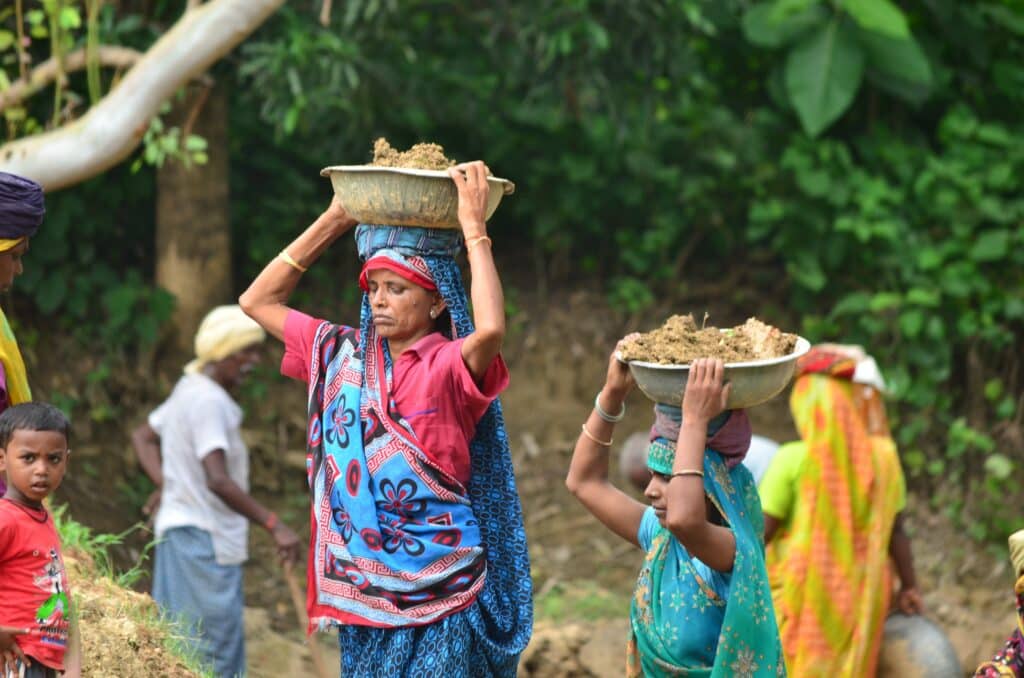
The Indian Parliament is witnessing one of the most consequential welfare policy battles in decades. On 16 December 2025, the Union government introduced the Viksit Bharat Guarantee for Rozgar and Ajeevika Mission (Gramin) Bill, 2025, popularly dubbed RAM G, to replace the Mahatma Gandhi National Rural Employment Guarantee Act (MGNREGA), 2005. What sounds like a bureaucratic overhaul has turned into a fraught political and social confrontation, with concerns ranging from the erosion of rural rights to the politics of renaming a legacy law.
This isn’t just a tweak to a job scheme. It’s a debate over whether India strengthens or weakens its flagship right to work, how federal fiscal responsibilities are shared, and what symbolic meaning attaches to the names of landmark laws making it a defining moment for rural India going into India 2047.
What RAM G Proposes
RAM G retains the central objective of creating work and income in rural India but introduces several key changes:
Increased Workdays: The scheme raises the statutory minimum of guaranteed wage work from 100 to 125 days per rural household annually, providing a larger theoretical safety net for rural workers.
Shifted Financing: Unlike MGNREGA, where the Centre bore 100% of labour costs, RAM G introduces a cost-sharing model, with the Centre covering a larger portion in Northeastern and hilly states and most other states carrying a higher share. This shifts some fiscal responsibility to the states.
Budget Allocation Caps: The Centre will determine state-wise allocations, and states must cover any expenditure that exceeds this budget. This effectively turns the open-ended funding model of MGNREGA into a capped allocation system.
Seasonal Pauses: The bill allows for up to 60 days of work suspension during peak agricultural periods, aligning employment schedules with local cropping patterns.
Centralised Planning: Works under RAM G must adhere to Viksit Gram Panchayat Plans and integrate into a National Rural Infrastructure Stack, connecting local projects to national priorities such as water security, climate resilience, and rural infrastructure development.
Digital Monitoring and Timely Payments: The scheme emphasizes digital tracking of work and weekly wage payments, aiming to reduce delays and increase transparency in implementation.
Government defenders argue that these reforms make rural employment more productive, environmentally sustainable, and fiscally manageable, while also integrating local projects with broader national development goals.
Critics’ Concerns
Civil society groups and social activists warn that RAM G may undermine the rural job guarantee rather than strengthen it. Under MGNREGA, any rural household volunteering for unskilled work was entitled to up to 100 days of employment fully funded by the Centre. Critics argue that RAM G abolishes this unconditional right, replacing it with a centralized, allocation-based, and budget-capped scheme.
Instead of being demand-driven, RAM G relies on normative allocations. The Centre decides where and how much funding is available, potentially capping guaranteed work and reintroducing restrictions reminiscent of pre-MGNREGA schemes, which provided only a few days of employment to most rural workers.
The shift in financial responsibility to states may discourage them from expanding worker entitlements, while the centralization of planning could dilute local decision-making. Under MGNREGA, Gram Sabha consultations and grassroots planning ensured projects met community needs, a safeguard that RAM G’s centralized structure might compromise.
Some activists describe RAM G as a regression to a pre-MGNREGA era, where “employment assurance” did not translate into real and predictable workdays for rural households.
Political Debate and Symbolism
The removal of ‘Mahatma Gandhi’ from India’s best-known rural employment law has sparked a political and symbolic controversy. Opposition leaders and activists view the renaming to RAM G as an attempt to rewrite history and distance the program from Gandhi’s social justice legacy.
Congress leader Priyanka Gandhi Vadra attacked the government over its Bill to replace MGNREGA, saying that it stands to “weaken” the original Act’s guaranteed 100 days of employment to the poorest of the poor. She also expressed her inability to understand the Modi government’s “obsession” with renaming schemes, and demanded that the bill be sent to a parliamentary Standing Committee for further scrutiny.
State leaders have voiced strong opposition as well. Ministers from Kerala highlighted the potential multi-crore fiscal burdens due to the shifted cost share, while Punjab’s chief minister criticized the rebranding as a distraction from critical issues such as wage assurance and fake beneficiaries. Leaders like V.D. Satheesan have argued that the bill is part of a larger pattern of removing Congress-era legacies and undermining iconic figures.
Whether seen as political theater or substantive critique, the debate around “Gandhi vs RAM” has intensified national attention on the scheme.
Impact on Rural Workers
For rural households, RAM G’s implications are significant. Although the scheme promises more days of work in principle, budget caps and seasonal pauses may reduce actual work availability if allocations are exhausted or blocks are temporarily suspended.
The introduction of weekly wage payments and digital attendance tracking is a potential improvement in income certainty and efficiency. However, timely implementation will heavily depend on state capacity and fiscal health.
Linking employment to climate-resilient infrastructure projects could bring long-term benefits, enhancing agricultural productivity and environmental sustainability. Yet these advantages hinge on local communities retaining agency in project planning and execution, ensuring that the scheme meets their real needs rather than being driven solely by central directives.
Legislative Outlook
RAM G is currently under debate in Parliament. Opposition parties are pushing for extensive discussion and possible referral to a Standing Committee, while the government seeks a swift passage during the winter session.
If enacted without strong safeguards for worker rights, financing, and local governance, RAM G could redefine rural welfare in India. Its long-term success will depend on the practical delivery of work, timeliness of wages, and the empowerment of local decision-making structures.
Looking Ahead
RAM G represents more than a legislative update. It stands at the crossroads of rights-based welfare and centrally determined entitlements, between fiscal federalism and budget caps, and between symbolic legacy and substantive livelihood security.
The key question is whether rural India retains a right to predictable work or transitions into a project-based program governed by allocations and administrative priorities. The success of RAM G will be measured not by its name or policy papers, but by the work, wages, and welfare it delivers to the millions of rural households it promises to serve.
In the battle between legacy and reform, rural India’s future will be defined by how well RAM G translates promise into reality!


