

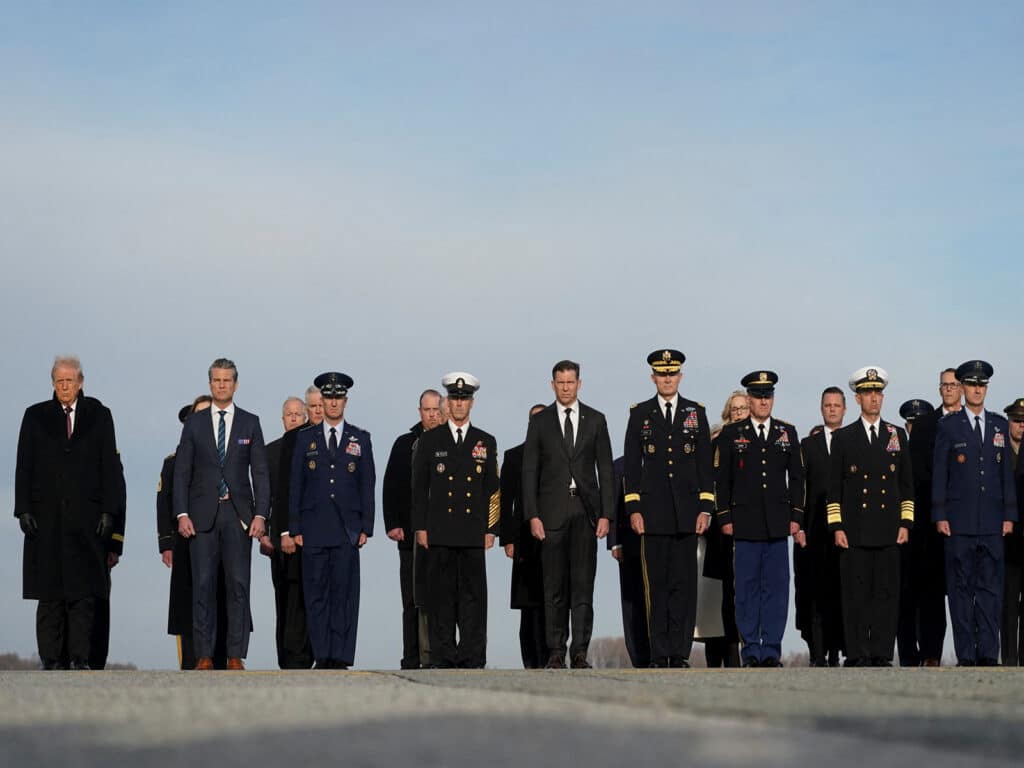
The United States has launched a large-scale military offensive, Operation Hawkeye Strike, targeting Islamic State (ISIS) positions in eastern Syria. This operation comes in direct retaliation for the deaths of two Iowa National Guard soldiers and one U.S. civilian contractor, who were killed during a deadly ambush near Palmyra, Syria.
The strike marks one of the most significant U.S. military responses in the region in recent years, demonstrating Washington’s determination to counter ISIS resurgence and send a clear message that attacks on American personnel will not go unanswered.
The Deadly Palmyra Attack
On December 13, 2025, a lone ISIS gunman ambushed a U.S. military patrol near Palmyra, Syria. The attack resulted in the deaths of:
- Sgt. Edgar Brian Torres-Tovar, Iowa National Guard
- Sgt. William Nathaniel Howard, Iowa National Guard
- Ayad Mansoor Sakat, a U.S. civilian contractor supporting logistics operations
Several other U.S. soldiers and two Syrian troops were wounded in the attack. This was the first combat-related U.S. deaths in Syria since 2019, underscoring the ongoing threat posed by ISIS sleeper cells even after the collapse of the terror group’s territorial “caliphate.”
U.S. intelligence quickly attributed the attack to ISIS-affiliated operatives operating from remote parts of eastern Syria. Analysts suggest that while the group no longer holds territory, its network of insurgents, sympathizers, and lone actors remains capable of lethal attacks, particularly against coalition forces and local partner troops.
The Strategic Significance of Operation Hawkeye Strike
On December 19, 2025, the U.S. military responded with Operation Hawkeye Strike, a large-scale, multi-domain assault designed to degrade ISIS’s operational capabilities.
The operation involved:
- Precision airstrikes by F-15 and A-10 fighter jets
- Apache attack helicopters for close air support
- HIMARS rocket artillery systems targeting ISIS infrastructure
- Coordination with special operations and intelligence units to identify and neutralize high-value targets
More than 70 ISIS locations were struck across central Syria, including training camps, command centers, weapons depots, and fighters’ hideouts. The operation’s scale and precision reflect Washington’s intent to significantly disrupt ISIS networks while avoiding civilian casualties.
A senior U.S. defense official described the operation as “deliberate, proportional, and focused exclusively on ISIS infrastructure”, emphasizing that the U.S. took extensive measures to minimize collateral damage.
Pentagon and U.S. Leadership Statements
Secretary of Defense Pete Hegseth called the strikes “vengeance” for the Palmyra ambush, clarifying that the operation was not the start of a new war, but a focused retaliatory action.
President Donald Trump echoed this sentiment, stating that the operation was a serious and proportional response to ensure the safety of American troops and that ISIS would face severe consequences for any attacks on U.S. personnel.
A Pentagon spokesperson highlighted that the operation also sends a message to other terrorist organizations in the region that attacking U.S. forces carries immediate and decisive consequences.
The Human Cost and Iowa’s Mourning
The deaths of Sgt. Torres-Tovar and Sgt. Howard shook communities in Iowa and across the United States. Governor Kim Reynolds ordered flags at half-staff and described the fallen soldiers as “brave, selfless, and committed to protecting others”.
Vigils were held across the state, and family members called for continued support for deployed troops while demanding accountability for the attack. National Guard officials emphasized that these soldiers represented the highest standards of training, courage, and service, and their sacrifices highlight the risks faced by U.S. forces in Syria.
ISIS in Syria: The Persistent Threat
Despite losing its territorial caliphate in 2019, ISIS remains a potent threat through guerrilla-style tactics, ambushes, bombings, and drone attacks. U.S. and UN intelligence estimates suggest that 1,500 to 3,000 fighters remain active across Syria and Iraq.
Eastern Syria, particularly regions like Deir ez-Zor and Raqqa, provides ideal conditions for ISIS to regroup, due to weak governance, economic instability, and ongoing conflicts among local militias and foreign forces.
Analysts warn that ISIS is increasingly using small, mobile units and lone actors to carry out attacks, making detection and deterrence more difficult. Operation Hawkeye Strike reflects U.S. concern that ISIS is attempting to reassert itself by directly targeting American personnel.
Regional and Geopolitical Implications
Syria’s complex landscape includes Russian forces, Iranian-backed militias, Kurdish-led Syrian Democratic Forces, and various insurgent groups. While the U.S. strikes specifically targeted ISIS, there remains a risk of miscalculation and escalation, particularly in areas where multiple armed actors operate in close proximity.
The Syrian government, now under President Ahmed al-Sharaa, publicly supported the U.S. operation and condemned ISIS’s actions. This cooperation marks a shift in Syria’s approach to foreign counterterrorism efforts, signaling potential collaboration with U.S. forces against remaining ISIS cells.
Security experts note that while Operation Hawkeye Strike significantly weakens ISIS, long-term vigilance and sustained counterterrorism operations remain essential to prevent resurgence.
U.S. Military Presence in Syria
Currently, approximately 1,000 U.S. troops are deployed in Syria to:
- Support local partner forces in counterterrorism operations
- Advise and assist in stabilization and reconstruction efforts
- Conduct intelligence-driven operations against ISIS
These troops operate in forward bases, including the strategic At Tanq Garrison, which has previously been a target for attacks. The Palmyra ambush underscores the ongoing dangers faced by U.S. personnel in Syria, even years after the territorial defeat of ISIS.
International and Domestic Response
Internationally, U.S. allies in the region expressed support for the strikes, framing them as part of the broader fight against global terrorism. Human rights organizations, however, called for transparency regarding civilian casualties and post-strike assessments.
Domestically, U.S. lawmakers from both parties emphasized the need to balance troop safety with counterterrorism objectives, while ensuring that American forces are adequately supported and equipped.
Strategic Implications and Future Outlook
Operation Hawkeye Strike demonstrates the U.S. commitment to decisive action against ISIS and other extremist groups. Defense officials have indicated that follow-up operations may continue if intelligence indicates remaining threats.
Analysts caution that ISIS remains adaptable and resilient, capable of exploiting instability to launch attacks. The operation sends a clear deterrent message but also highlights the persistent risks for American forces operating in volatile regions.
Impact and Implications
Operation Hawkeye Strike is a decisive U.S. military response to the deadly Palmyra ambush, sending a strong signal to ISIS and other terrorist groups. It emphasizes that attacks on American personnel will be met with swift and overwhelming force, while also demonstrating Washington’s ongoing commitment to counterterrorism and regional stability.
The offensive underscores the sacrifices of American soldiers and contractors, the enduring threat of ISIS, and the importance of international cooperation in combating terrorism. As the U.S. evaluates the operation’s impact, attention now focuses on honoring the fallen, supporting their families, and preventing ISIS from exploiting instability in Syria to stage further deadly attacks.


