

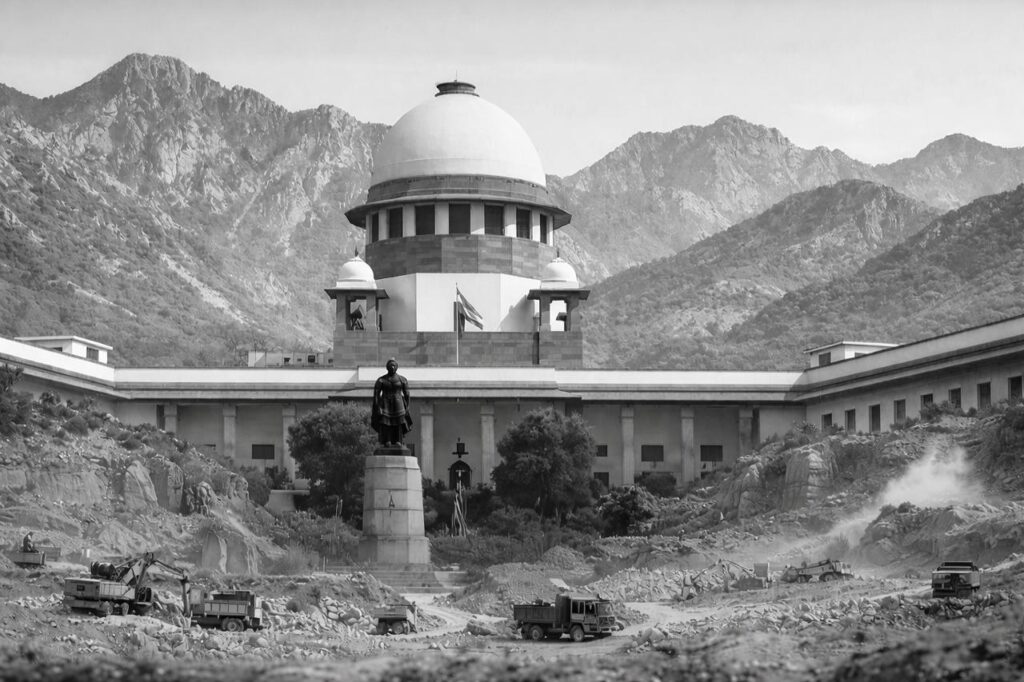
In a landmark decision on December 29, 2025, the Supreme Court of India has stayed its November 20 order that adopted the Environment Ministry’s definition of the Aravalli Hills as landforms rising at least 100 metres above surrounding terrain. The move comes amid criticism from environmentalists and the Forest Survey of India, who warned that the threshold narrowed protected areas, potentially exposing sensitive regions to mining and construction.
The Aravalli Hills, stretching across Delhi, Haryana, Rajasthan, and Gujarat, are among the oldest fold mountain systems and are crucial for groundwater recharge, climate regulation, biodiversity, and soil conservation. Experts have stressed that even lower hills and ridges play an essential ecological role, and their exclusion could undermine decades of conservation efforts.
The Supreme Court directed that the November 20 order remain in abeyance until a fresh expert committee conducts environmental assessments and clarifies boundaries. The matter is listed for hearing on January 21, 2026.
The 100-Metre Definition and Its Implications
The earlier verdict adopted a height-based criterion that classified hills above 100 metres as part of the Aravalli Range, with clusters of two or more such hills considered “ranges.” While intended to standardize protection measures, critics argued that this metric excluded ecologically vital lower slopes and ridges, leaving them vulnerable to exploitation.
Environmentalists pointed out that smaller hills are key to groundwater recharge, soil stability, and biodiversity, and the narrow definition could effectively open these areas to mining and urban encroachment.
Why the Supreme Court Intervened
The Supreme Court’s stay addresses legal, ecological, and scientific concerns. The Bench, led by Chief Justice Surya Kant with Justices J.K. Maheshwari and A.G. Masih, noted that expert findings and prior observations required clarification.
Key reasons for the stay:
- Ambiguity in definition: A single-parameter height criterion fails to capture the complex ecological and geological reality of the Aravalli system.
- Environmental risk: Narrowing the protected area could allow mining, construction, and deforestation, threatening biodiversity and water resources.
- Need for scientific review: The court emphasized the importance of multi-disciplinary expert input before implementing any legal framework.
The Chief Justice remarked, “We direct that the recommendations of the committee and the findings of the Supreme Court shall remain in abeyance till a fresh review is conducted.” This underscored the judiciary’s focus on scientific grounding in environmental policy.
Formation of a Fresh Expert Committee
A high-powered expert committee will be constituted, comprising geologists, ecologists, environmental scientists, and independent researchers. Its mandate includes:
- Revisiting the 100-metre threshold.
- Conducting environmental and ecological impact assessments.
- Clarifying boundaries of the Aravalli Range.
- Recommending balanced regulatory measures for sustainable mining and development.
The committee’s findings will inform the next hearing on January 21, 2026, potentially reshaping the legal framework for Aravalli conservation.
Political and Public Reactions
Union Environment Minister Bhupender Yadav welcomed the stay, noting that it does not compromise environmental protection and that mining restrictions will remain in place.
Congress leader Jairam Ramesh described the move as a rebuke to government plans and celebrated it as a victory for environmental advocacy.
Civil society and public protests have intensified, with thousands marching in Rajasthan and student groups staging demonstrations demanding inclusive criteria and stronger protection. Experts warned that the 100-metre criterion could exclude nearly half the Aravalli system, endangering biodiversity and water security.
Environmental Significance of the Aravalli Hills
The Aravalli Hills play a critical ecological role:
- Groundwater Recharge: Replenishing aquifers supplying millions.
- Climate Regulation: Buffering extreme weather and controlling dust storms.
- Biodiversity: Habitat for numerous endemic and endangered species.
- Soil and Flood Control: Reducing erosion and mitigating floods.
Protection of lower hills, slopes, and ridges is essential, as they are integral to the overall ecological network.
Legal and Policy Implications
The Supreme Court’s intervention may reshape environmental law in India. It highlights:
- The necessity of scientific validation before enforcing environmental definitions.
- Importance of integrated landscape management, considering interconnected ecological functions.
- Judicial precedent for scrutinizing administrative definitions that may compromise ecological protection.
The case could serve as a benchmark for future environmental litigation where developmental and ecological interests intersect.
Mining Concerns and Regulatory Oversight
Mining in the Aravalli region has long been contentious. The earlier 100-metre definition risked opening protected areas to exploitation. The Supreme Court’s stay and expert committee formation aim to balance development with conservation, ensuring that regulatory frameworks are ecologically sustainable.
In the interim, new mining leases in core areas remain banned, preventing immediate ecological degradation. The next hearing will be pivotal in establishing long-term protection and sustainable land-use policies.
Looking Ahead: January 21, 2026
The upcoming hearing will focus on:
- Expert committee findings and recommendations.
- Clarification of Aravalli Hills and Range boundaries.
- Framework for sustainable mining and development.
- Science-based environmental policy enforcement.
The outcomes will have far-reaching implications for regional ecology, water security, and biodiversity, particularly in northwestern India.
Aravallis in Focus
The Supreme Court’s stay on the Aravalli Hills definition marks a historic intervention in environmental governance. By pausing its November 20 order, the court emphasized scientific rigor, ecological integrity, and balanced development.
The formation of a high-powered expert committee and the scheduled review on January 21, 2026, suggest that India’s ecological and legal framework is evolving to accommodate science and public interest. The case underscores the delicate balance between environmental protection and developmental imperatives, potentially setting a benchmark for future judicial interventions in ecological matters.
This decision reinforces the principle that policy and law must be firmly grounded in ecological reality, ensuring that the Aravalli Hills continue to safeguard water, biodiversity, and climate resilience for generations to come.


