

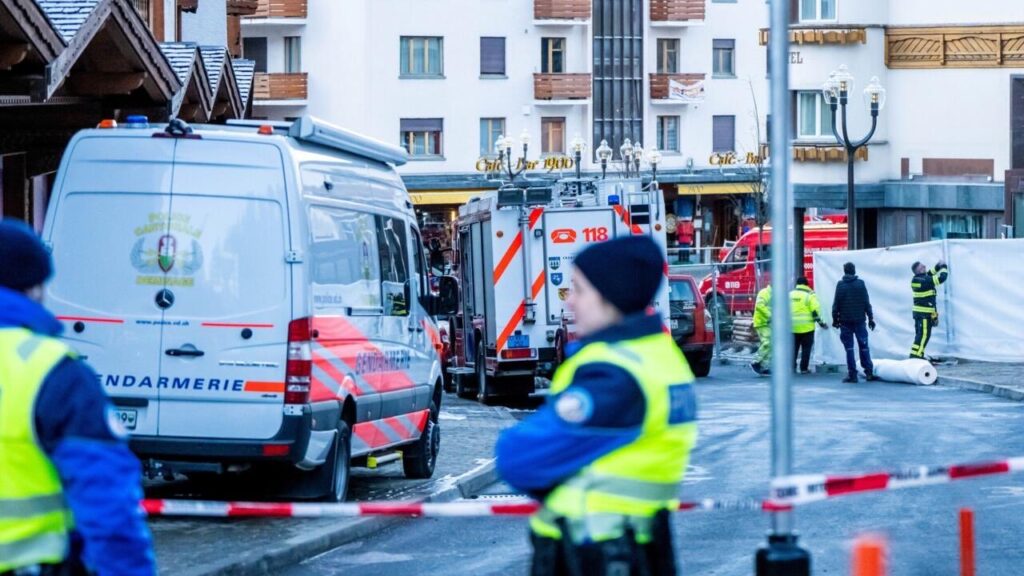
Crans‑Montana, Switzerland- A night of celebration ended in one of the worst civilian tragedies in modern Swiss history when a devastating fire tore through Crans‑Montana’s Le Constellation bar in the early hours of New Year’s Day. At least 40 people have died and 115 others are injured, many critically, after flames spread with horrifying speed inside the packed venue just after 1:30 a.m. on January 1, 2026. Authorities warn that the toll could rise as medical teams continue to treat the severely burned and as some victims remain unidentified.
The disaster has shocked Switzerland and the world, drawing an outpouring of support for victims and families, and prompting urgent questions about public safety, emergency response, and crowd management in popular tourist destinations.
Sudden Blaze in Packed Bar
According to police and emergency services, the blaze originated in the basement level of Crans‑Montana’s Le Constellation, a busy venue known for attracting both locals and international visitors during peak season. The fire reportedly began during the crowded New Year’s celebration and quickly engulfed the building’s interior.
Valais Canton Police Chief Frédéric Gisler confirmed that around 40 people have died and 115 have been injured, many severely. “We are counting around 40 people who have died and 115 injured, most of them seriously,” Gisler said at an afternoon press briefing.
Authorities immediately ruled out terrorism or a deliberate attack and stated the blaze was likely accidental, potentially ignited by indoor pyrotechnics or sparklers that touched the wooden and foam ceiling. Investigators are still working to determine the exact ignition source.
Eyewitness Accounts: Panic and Escape
Survivors described harrowing scenes of smoke, panic, and desperate attempts to flee. Two young men who escaped told a French news affiliate they struggled to breathe as thick black smoke filled the crowded bar. “The only way out was through a window,” they said, recounting how they hid under a table before breaking glass to escape.
Another eyewitness described seeing smoke billow and people pounding on windows in a frantic effort to get out. “There was a huge crowd movement. Everyone was fighting to get out,” the witness said.
Other accounts suggest that bartenders carried bottles with lit sparklers close to the ceiling, igniting the fire that rapidly spread through the venue.
Victim Profiles and National Impact
Most victims are teenagers and young adults, with preliminary reports indicating many were between the ages of 16 and 26. Identification has been particularly challenging due to the severity of injuries, and Swiss authorities have said it could take days or even weeks to identify all those who perished.
Among the first victims publicly identified is Emanuele Galeppini, a 16‑year‑old Italian international golfer. His death was confirmed amidst the ongoing identification efforts.
Foreign nationals are among the dead and injured, including Italian, French, and Australian citizens, with consular teams working closely with Swiss authorities to assist families and provide medical and legal support.
Emergency Response Under Strain
Swiss emergency services responded swiftly, deploying more than 40 ambulances, 13 helicopters, and a large contingent of firefighters and first responders to the scene. Local hospitals were quickly overwhelmed, with intensive care units in the Valais canton reaching capacity within hours.
Dr. Robert Larribau, head of emergency care at Geneva University Hospital, said the scale of severe burn injuries far exceeded national capacity. Switzerland is coordinating with neighboring countries to transfer patients to specialized facilities in Germany, Italy, and France.
Authorities also imposed a no‑fly zone over Crans‑Montana to support aerial evacuation and emergency response operations.
Official Statements and Mourning
Swiss President Guy Parmelin, who assumed office on January 1, described the disaster as “a drama of unknown scale” and one of the most traumatic events in the nation’s history. He announced five days of national mourning and pledged government support for victims’ families.
At a press conference alongside Valais canton officials, Parmelin said authorities would do everything possible to care for the injured and support the affected families. “Some don’t yet know if their children have died. Some are in hospital, in serious condition, and we are going to do everything we can to allow things to proceed as fast and as efficiently as possible,” he said.
Mathias Reynard, head of the Valais government, expressed deep sorrow, saying, “This evening should have been a moment of celebration and coming together, but it turned into a nightmare.”
Prosecutor General Beatrice Pilloud declined to comment on specific causes of the fire, emphasizing that it was too early to draw conclusions while the investigation continues.
Medical Situation and Transfers Abroad
Hospitals in the Valais region declared emergencies as wards filled with smoke inhalation and burn victims. Many were stabilized and then transferred to major medical centers in Zurich, Lausanne, Geneva, and neighboring countries.
Dr. Larribau highlighted that some patients required specialized burn care, prompting coordination with EU medical teams. “The injured are being distributed across hospitals that can provide the necessary treatment,” he said.
Community Reaction and Ongoing Chaos
Local residents expressed shock and grief as Crans‑Montana adjusted to the backlash from the disaster. Vigils and memorials have sprung up near the site of Crans‑Montana’s Le Constellation as relatives and friends await updates.
Some locals who would normally have visited the bar described their disbelief. One resident said she almost went to the venue that night but chose to stay in town center instead — a decision she now counts as a fortunate escape.
Fire Safety, Investigation and Legal Questions
The cause of the fire remains under investigation. Authorities are exploring whether pyrotechnics or sparklers used inside the bar ignited flammable ceiling materials and whether safety protocols, including exits and crowd limits, were adequately followed.
Officials have not yet confirmed whether the bar exceeded its capacity that night, and prosecutors are reviewing compliance with fire and safety regulations.
Safety experts are calling for a broader review of fire codes, evacuation planning, and enforcement of safety standards in entertainment venues, particularly those hosting large crowds in enclosed spaces.
International Response
World leaders and foreign governments have expressed condolences and solidarity with Switzerland. Irish Taoiseach Micheal Martin called the event “an unimaginable tragedy,” while Ukrainian President Volodymyr Zelenskyy and others sent messages of support to victims and their families.
Italian and French authorities are actively involved, with medical and diplomatic support flowing into Swiss hospitals and reception centers. European Union health teams are assisting with patient transfers and clinical care where needed.
Looking Ahead
As authorities work to identify the deceased and care for the injured, questions about public safety, emergency preparedness, and crowd management are coming to the fore. The tragedy at Crans‑Montana’s Le Constellation has underscored the urgent need for rigorous enforcement of safety regulations in crowded venues.
For families and communities affected, the long road to healing has just begun. With national mourning underway and international support pouring in, Switzerland faces the heartbreaking task of piecing together the details of this catastrophic event while honoring the memories of those lost.


