

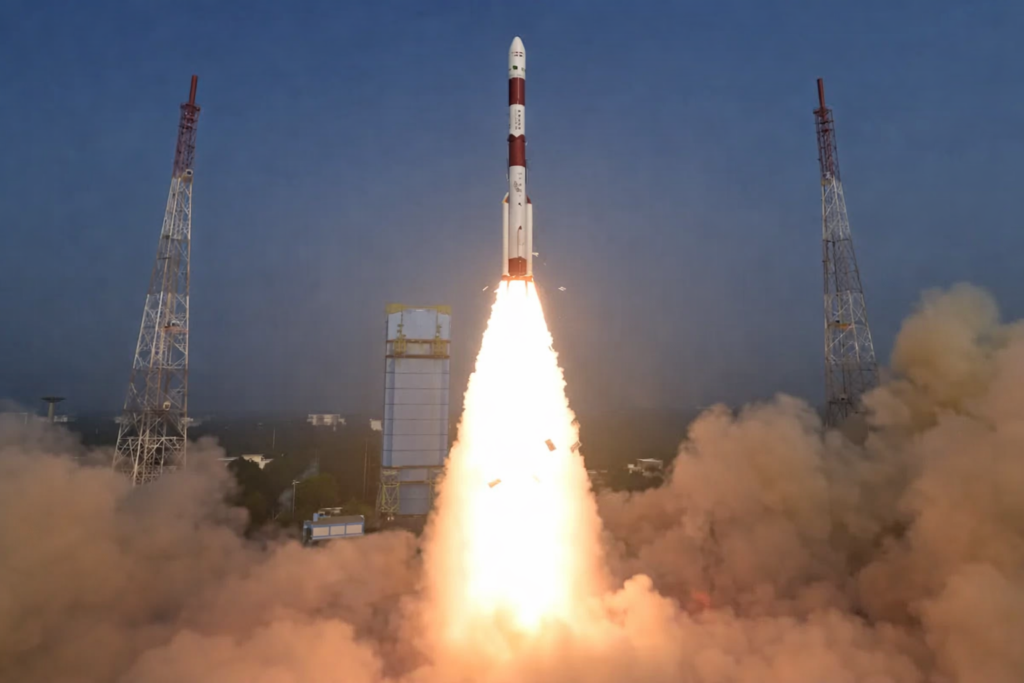
India’s space programme suffered a serious setback on January 12, 2026, when the Indian Space Research Organisation’s PSLV-C62 launch vehicle failed to complete its mission after developing a critical anomaly during its third stage. The rocket, carrying 16 satellites including the high-value EOS-N1 “Anvesha” Earth observation spacecraft, lifted off successfully from the Satish Dhawan Space Centre at Sriharikota but lost stability before it could place its payloads into their intended orbit.
The failure marks the second consecutive breakdown of the Polar Satellite Launch Vehicle, a rocket that for decades had been regarded as the most reliable pillar of India’s space infrastructure. With this mission, ISRO had hoped to begin the 2026 launch calendar on a strong note. Instead, the incident has raised urgent questions about quality control, solid rocket motor performance and the future of India’s commercial and strategic launch programme.
What the PSLV-C62 Mission Was Designed to Achieve
PSLV-C62 was planned as a multi-payload mission with both national and international significance. Its primary satellite, EOS-N1, also known as Anvesha, was a 400-kilogram hyperspectral Earth observation satellite developed in collaboration with the Defence Research and Development Organisation. It was designed to provide high-resolution data for agriculture, forestry management, water resources, mineral mapping and strategic surveillance, strengthening India’s civilian planning and defence monitoring capabilities.
Alongside EOS-N1, the rocket was carrying 15 co-passenger satellites from Indian startups and international partners. These included CubeSats, experimental spacecraft and a Spanish re-entry capsule called KID, designed to test controlled atmospheric re-entry and recovery technologies. For India’s private space sector, the mission was meant to demonstrate the country’s expanding role in the global small-satellite launch market and to showcase the reliability of ISRO’s launch services to international customers.
The mission was intended to deploy all payloads into a 512-kilometre sun-synchronous orbit, an orbital configuration widely used for Earth observation because it allows satellites to pass over the same location at the same local solar time each day, enabling consistent imaging.
How the Launch Unfolded
The PSLV-C62 lifted off at around 10:18 am local time. The first and second stages of the four-stage rocket performed as expected, pushing the vehicle through the atmosphere and onto its planned ascent path. Telemetry from ground stations and onboard sensors indicated stable flight during these early phases.
The anomaly occurred during the third stage, known as PS3, which is powered by a solid rocket motor. Near the end of the PS3 burn, mission controllers observed a disturbance in the rocket’s motion, followed by a deviation from the intended trajectory. Because the fourth stage can only perform orbital injection if the vehicle is on a precise flight path, the deviation meant that the sequence to deploy the satellites could not be executed.
As a result, none of the 16 satellites reached their target orbit. They are believed to have either re-entered the atmosphere or ended up in unusable trajectories, amounting to a total loss of the mission’s payload.
ISRO’s Official Statement
ISRO Chairman V. Narayanan addressed the situation shortly after the anomaly was detected, confirming that the problem occurred late in the third stage and that a detailed technical review was underway.
He said, “The performance of the PSLV rocket was normal up to the third stage. Close to the end of PS3, a disturbance was observed and the vehicle deviated from its intended trajectory. We are analysing all flight data and will provide detailed findings once the review is complete.”
The statement underscored ISRO’s focus on a data-driven investigation rather than speculation. No political or ministerial statements were issued in the immediate aftermath, in line with ISRO’s standard practice of allowing engineering assessments to guide the response to launch failures.
Why the Third Stage Is Critical
The PSLV uses a four-stage configuration that alternates between solid and liquid propulsion. The third stage plays a vital role because it provides a significant portion of the velocity needed before the fourth stage takes over for final orbital insertion.
Unlike liquid engines, solid rocket motors cannot be throttled, shut down or adjusted once they are ignited. Any instability in thrust, pressure or combustion during a solid stage is therefore extremely difficult to correct in real time. Even a small deviation can grow into a major trajectory error, which appears to have been the case with PSLV-C62.
Engineers will now examine whether the disturbance was caused by a problem with the propellant, the structure of the motor, or the guidance system’s ability to respond to unexpected forces.
A Repeat of the PSLV-C61 Setback
The failure of PSLV-C62 has taken on added significance because it follows a similar incident involving PSLV-C61 in May 2025. That mission was also lost due to a third-stage anomaly, when a pressure drop in the PS3 solid motor prevented the rocket from delivering its EOS-09 satellite into orbit.
Before these two incidents, the PSLV had built a reputation for reliability with more than 60 successful missions and a success rate above 90 percent. Two failures in the same stage within less than a year have raised concerns within the space community that the problem may be systemic rather than accidental.
Strategic and Commercial Consequences
The immediate impact of the PSLV-C62 failure is the loss of EOS-N1, a satellite that would have supported a wide range of civilian and defence applications. Hyperspectral data from the satellite was expected to improve crop monitoring, natural resource management and environmental assessment, while also providing intelligence-grade imagery for national security purposes.
The failure also wiped out multiple commercial and experimental satellites belonging to Indian startups and foreign partners. For these companies, the loss represents not only financial damage but also the loss of months or years of research and development that had gone into preparing their payloads for launch.
For NewSpace India Limited, ISRO’s commercial launch arm, the incident is a blow to confidence in India’s launch services. In the competitive global launch market, reliability is the most important selling point, and consecutive failures can influence how customers assess risk when choosing a launch provider.
What Happens Next
ISRO will now carry out a comprehensive failure analysis, focusing on the PS3 motor, propellant behaviour, structural integrity and the guidance system’s response to the disturbance. Engineers will also review manufacturing and quality control processes to determine whether any hidden defects or deviations contributed to the anomaly.
Only after this technical review is complete will ISRO decide when the PSLV can return to flight. Historically, the agency has preferred to delay launches rather than risk another failure, prioritising long-term reliability over short-term schedules.
A Defining Moment for India’s Space Programme
The PSLV-C62 failure represents a critical moment for India’s space launch capability. The loss of 16 satellites, including a key national Earth observation platform, has placed renewed scrutiny on the rocket that once formed the backbone of ISRO’s launch fleet.
How ISRO diagnoses and resolves the third-stage problem will determine whether the PSLV can regain its status as India’s trusted workhorse or whether the country will need to rely more heavily on newer launch systems as it pursues its expanding ambitions in space.


