

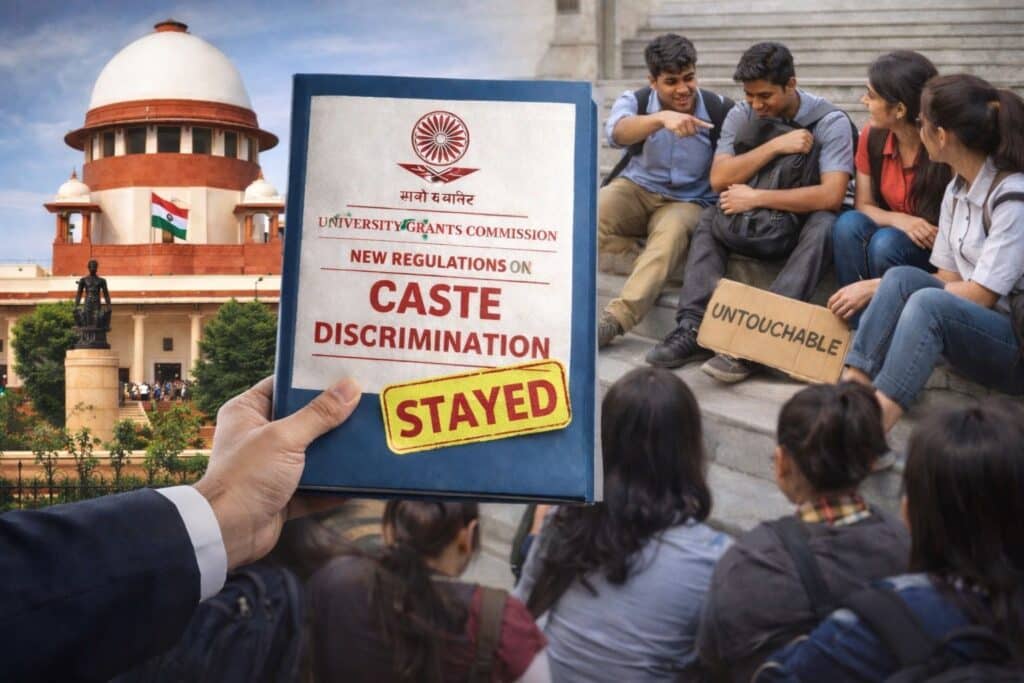
On January 29, 2026, the Supreme Court of India stayed the University Grants Commission’s Promotion of Equity in Higher Education Institutions Regulations, 2026, citing concerns over vague drafting, legal inconsistency, and potential misuse. A Bench led by Chief Justice Surya Kant and Justice Joymalya Bagchi ordered that the regulations remain suspended until further review and reinstated the UGC’s 2012 guidelines governing caste discrimination complaints in higher education institutions.
The Court observed that the language used in the new regulations lacked clarity and could contribute to social division. It cautioned that policies aimed at addressing caste discrimination must be framed with legal precision to avoid unintended consequences.
The matter has been scheduled for further hearing on March 19, 2026, with notices issued to the Central Government and the UGC.
Origins of the Rules
The UGC notified the 2026 Equity Regulations on January 13, 2026, positioning them as a stronger legal mechanism to address caste-based and identity-based discrimination in universities and colleges. The new framework replaced the UGC’s earlier 2012 advisory guidelines, shifting from recommendations to enforceable statutory obligations.
The regulations sought to strengthen institutional accountability by mandating faster grievance redressal, creating structured oversight mechanisms, and introducing penalties for non-compliance. The stated objective was to ensure timely action in cases of discrimination, particularly involving historically marginalized communities.
What the 2026 Rules Say
Under the new framework, higher education institutions were required to establish Equal Opportunity Centres and form Equity Committees responsible for investigating complaints related to caste discrimination and other forms of bias. These committees were tasked with handling grievances within fixed timelines and submitting compliance reports to regulatory authorities.
The regulations also mandated the creation of Equity Squads, grievance helplines, and digital reporting systems to allow students and staff to file complaints more easily. Monitoring teams were proposed to track institutional adherence to grievance timelines and procedural requirements.
Universities that failed to comply with these mandates faced the possibility of regulatory penalties, including administrative action by the UGC.
Committee Structure
A major element of the regulations concerned the composition of Equity Committees. Institutions were required to include representatives from Scheduled Castes, Scheduled Tribes, Other Backward Classes, women, and persons with disabilities in these bodies.
However, the regulations did not mandate representation for students or faculty from the General Category, a design choice that became a central point of criticism. Opponents argued that the committee structure risked creating perceptions of bias, while supporters said representation for historically disadvantaged groups was necessary to address systemic inequalities.
Universities were also directed to place these committees under senior administrative oversight and ensure that their proceedings were documented through digital grievance systems.
Legal Challenge
Multiple petitions were filed before the Supreme Court challenging the validity of the 2026 regulations. Petitioners included Mritunjay Tiwari, Advocate Vineet Jindal, and Rahul Dewan, among others.
The petitioners argued that the regulations violated Article 14 of the Constitution, which guarantees equality before the law. They contended that the framework offered grievance protection only to certain caste groups while excluding General Category students, thereby creating an unequal legal structure.
They also argued that the regulations lacked adequate procedural safeguards for individuals accused of discrimination, raising concerns over due process, reputational harm, and the potential misuse of complaint mechanisms.
Regulation 3(c) Under Scrutiny
A key point of contention was Regulation 3(c), which defined caste-based discrimination as discrimination only against SC, ST, and OBC communities. Petitioners argued that this definition excluded General Category students from seeking protection under the same framework.
The Supreme Court also noted a drafting inconsistency between Regulation 3(c) and Regulation 3(e). While Regulation 3(c) restricted caste discrimination protections to reserved categories, Regulation 3(e) adopted a broader definition of discrimination that included religion, caste, gender, disability, race, and place of birth.
The Bench questioned the rationale behind maintaining a narrow caste-specific clause when a broader anti-discrimination provision already existed, flagging the drafting as legally inconsistent.
Supreme Court Observations
During proceedings, the Bench expressed concerns over the potential social impact of the regulations. The Court noted that vague legal language could increase the risk of misuse and contribute to divisions within educational institutions.
Chief Justice Surya Kant remarked that policy frameworks addressing caste-related issues must be carefully structured to avoid reinforcing identity-based segmentation. The Bench also warned against the risk of institutional segregation, including in hostels or academic spaces, if regulatory provisions were interpreted narrowly or applied unevenly.
The Court indicated that the regulations may require redrafting and suggested that a panel of eminent jurists could be involved in reviewing the language and structure of the rules.
Campus Protests Across States
The notification of the 2026 regulations triggered student protests across multiple states, including Delhi, Uttar Pradesh, Rajasthan, Bihar, and Madhya Pradesh. Demonstrations were reported in university towns such as Meerut, Ghaziabad, Varanasi, Deoria, Pilibhit, Jaipur, and Madhubani.
Student groups, particularly those representing General Category students, argued that the regulations were vague and biased. Protesters claimed the rules could lead to false complaints, legal harassment, and reputational damage without sufficient procedural safeguards.
In Uttar Pradesh, demonstrators staged symbolic protests by wearing chains, black bands, and funeral shrouds to express opposition to the regulations. At Delhi University, student groups submitted memoranda describing the framework as ambiguous and potentially divisive.
Divergent Student Responses
Reactions to the Supreme Court’s stay have been mixed among student communities. Several General Category student organizations welcomed the decision, describing it as an opportunity to revise provisions they viewed as legally unbalanced.
At the same time, some students from SC, ST, and OBC backgrounds expressed concern that the suspension of the regulations could weaken institutional mechanisms for addressing discrimination. Activists supporting stronger anti-discrimination enforcement argued that the focus should be on improving the framework rather than halting it.
University administrators reported heightened sensitivity on campuses, with institutions monitoring student sentiment and adjusting grievance processes in line with the restored 2012 guidelines.
Political Responses and Debate
The Supreme Court’s intervention has generated political reactions across party lines. Some political leaders described the stay as a setback for the Central Government’s policy agenda, while others framed it as a necessary step to ensure constitutional balance.
Members of Parliament and state leaders raised concerns over the drafting of the regulations, questioning whether the UGC had adequately consulted stakeholders before finalizing the framework. Parliamentary education committee members also pointed to earlier recommendations calling for clearer definitions of discrimination and more balanced grievance mechanisms.
The issue has since become part of broader political debate around regulatory authority, identity-based policy, and institutional governance.
2012 Rules Restored
Following the Court’s stay, higher education institutions have reverted to the UGC’s 2012 guidelines on caste discrimination. Unlike the 2026 framework, the 2012 guidelines operate on an advisory basis and do not impose statutory deadlines or enforceable penalties.
Under the older framework, universities handle discrimination complaints through internal grievance redressal cells. Institutions retain broader discretion in managing complaint timelines and disciplinary processes.
Supporters of the 2012 model argue that it provides greater flexibility and reduces the risk of procedural misuse. Critics, however, contend that the absence of enforcement mechanisms allows institutions to delay or inadequately address discrimination complaints.
Impact on Universities
The suspension of the 2026 regulations has created immediate administrative challenges for universities that had begun implementing the new system. Institutions must now determine how to process complaints filed under the stayed framework and whether actions taken during the interim period remain valid.
Universities are also reviewing committee structures that were formed in compliance with the new regulations and assessing whether they should be dissolved or restructured under the reinstated guidelines.
Administrators report ongoing efforts to update students and staff about grievance procedures and to maintain continuity in complaint handling during the transition.
Next Steps in the Case
The Supreme Court is expected to conduct a detailed hearing on March 19, 2026, during which the Centre, the UGC, and petitioners will present arguments on the constitutional validity of the regulations, legal clarity, and procedural safeguards.
The Court may choose to uphold the regulations with modifications, order a redraft of specific clauses, strike down contentious provisions such as Regulation 3(c), or maintain the stay pending further review.
Until a final ruling is issued, the 2026 Equity Regulations will remain suspended.


