

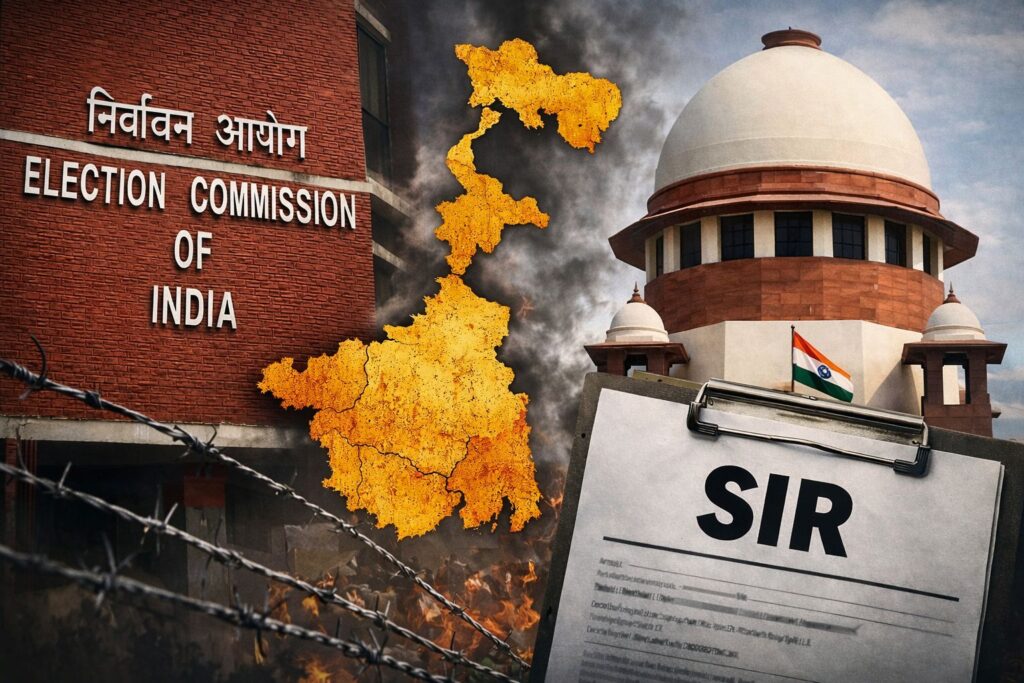
The Supreme Court on Monday delivered a blunt and far-reaching warning to all state governments, declaring that the Special Intensive Revision of electoral rolls cannot be obstructed under any circumstances. In a hearing that escalated into a pointed judicial scrutiny of the West Bengal administration, the apex court also extended the SIR deadline in the state by one week, shifting it beyond February 14, even as it questioned delays, administrative conduct and law and order failures linked to the exercise.
The case arises from a petition filed by West Bengal Chief Minister Mamata Banerjee, who has challenged the Election Commission of India’s SIR exercise in the state, alleging irregularities, overreach and unjustified deployment of micro observers. The court, however, made it clear that while legal objections would be examined, the constitutional process itself cannot be stalled.
“We will issue whatever orders or clarifications are required. But we will not allow any impediment to the SIR process. This must be understood by all states,” Chief Justice of India Surya Kant said during proceedings.
Court’s Message to States
The hearing was conducted by a Bench comprising Chief Justice Surya Kant, Justice Joymalya Bagchi and Justice Vipul M Pancholi, and centred on the Election Commission’s response to Mamata Banerjee’s petition. At the heart of the dispute is the special intensive revision of electoral rolls in West Bengal, an exercise the state government has repeatedly questioned.
The Supreme Court firmly rejected any attempt to halt or dilute the process. While acknowledging that grievances regarding implementation and safeguards could be examined, the Bench stressed that no state has the authority to interfere with an electoral revision mandated under Article 324 of the Constitution.
The court extended the SIR deadline in West Bengal by one week to ensure procedural fairness and adequate opportunity for hearings. However, it simultaneously signalled impatience with what it described as avoidable delays and last minute compliance by the state government.
The Bench noted that cooperation between constitutional authorities must be timely and substantive, not reactive. The extension, the court clarified, was not an endorsement of obstruction but a measure to protect voter rights while allowing the exercise to reach completion.
Micro Observers and the 8,500 Officers Row
A central flashpoint in the case has been the deployment of micro observers by the Election Commission in West Bengal. Mamata Banerjee’s petition objected to their large scale induction, alleging that it reflected distrust of the state administration and created unnecessary friction on the ground.
The Election Commission defended its decision robustly. It told the court that it had written five separate letters to the West Bengal government seeking the names and details of officers required for the SIR process.
“They have not given,” the Commission submitted, explaining that the absence of timely cooperation forced it to deploy micro observers to ensure the integrity of the exercise.
The Commission further stated that particulars of officers sought were not shared, making it impossible to rely solely on state machinery. It maintained that the deployment of micro observers was well within its constitutional authority.
During the hearing, the Chief Justice observed that 8,500 officers had now been made available by the state government in connection with the SIR.
“If done earlier, it would probably get approved,” he remarked, indicating that the delay had weakened the state’s position.
The Bench directly questioned the timing of the compliance. Addressing the Chief Minister, the Chief Justice asked why the names of officers were sent late on February 7, when directions had been issued on February 4.
“Why are you sending names at 12 am on February 7 when we gave directions on February 4?” the court asked.
In its recorded order, the Supreme Court noted that on February 4, Mamata Banerjee had appeared before the court with her counsels and stated that the state was willing to provide competent officers for the SIR exercise. The court further recorded that on February 7, at 11.57 am, the Advocate on Record informed senior counsel for the Election Commission that the state was ready to provide 8,505 officers.
The court’s observations reflected concern over delayed administrative responses during a time sensitive constitutional exercise.
Bengal’s Counter in Court
Appearing for the West Bengal government, senior advocate Abhishek Manu Singhvi disputed the Election Commission’s version of events. He told the court that the Commission had never specifically requested Group B officers from the state and that the allegation of non cooperation was misleading.
Singhvi argued that the Commission’s reliance on micro observers was unnecessary and escalated tensions on the ground.
Separately, Shyam Diwan, appearing for Mamata Banerjee, submitted that the names of officers had been compiled and shared, and that the state had acted within reasonable time. He contended that the narrative of deliberate delay was being overstated.
The sharp divergence in courtroom submissions highlighted the broader friction between the state government and the Election Commission, not just over manpower but over the overall design and execution of the SIR exercise.
Mamata Banerjee’s petition alleges that the SIR process suffers from irregularities and risks disenfranchising genuine voters. She has questioned the classification of voters under discrepancy lists and argued that the scale of scrutiny is disproportionate and disruptive.
Law and Order and Electoral Integrity
Beyond administrative disputes, the SIR exercise in West Bengal has been shadowed by law and order concerns. The Election Commission has informed the Supreme Court that election officials faced intimidation, threats and violence at multiple hearing centres, forcing some proceedings to be suspended.
The Commission alleged that booth level officers and micro observers were placed in unsafe conditions and that official documents were destroyed during disruptions. These allegations prompted the Supreme Court to issue a show cause notice to the West Bengal Director General of Police, directing him to file a personal affidavit explaining the situation.
The court underscored that ensuring security during electoral processes is a constitutional obligation of the state and that failure to protect officials conducting statutory duties raises serious concerns.
The Bench made it clear that electoral integrity cannot be compromised by disorder, administrative lapses or political contestation. While safeguarding voter rights, the court emphasised that the purpose of SIR is verification, not exclusion, and that due process must prevail.
As West Bengal moves closer to assembly elections, the Supreme Court’s intervention has set a firm judicial boundary. The message is unmistakable. Electoral roll revision will proceed, constitutional authorities must cooperate, and obstruction will not be tolerated.


