

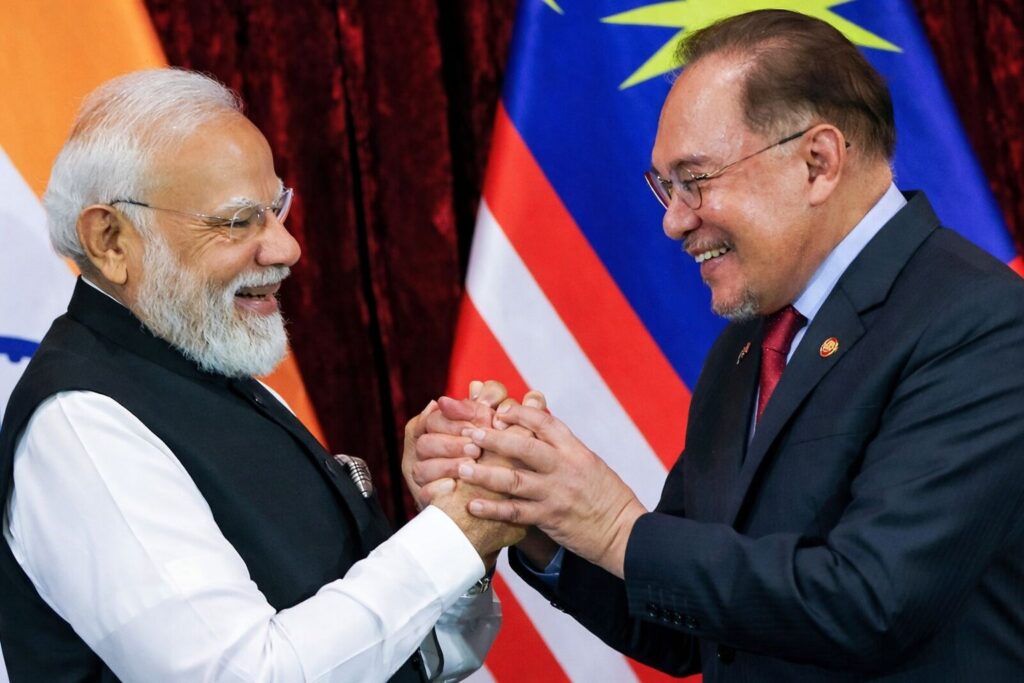
India and Malaysia on Saturday moved to fast-track their Comprehensive Strategic Partnership, with Prime Minister Narendra Modi and Malaysian Prime Minister Anwar Ibrahim signalling tighter security coordination, expanded defence ties and deeper cooperation in semiconductors and digital technology following talks in Kuala Lumpur.
Prime Minister Modi said the relationship had entered a decisive phase of delivery, stressing that the two countries were committed to translating agreements into outcomes. “India and Malaysia have agreed to deepen cooperation across defence, security, trade, technology and the digital economy, with a shared commitment to timely implementation,” Modi said.
The visit, Modi’s first to Malaysia since the partnership was elevated in 2024, marked a shift from broad political signalling to implementation. Officials on both sides said the talks were aimed at converting commitments into deliverables amid growing regional uncertainty and intensifying economic competition in the Indo-Pacific.
Modi and Anwar said relations dating back to Malaysia’s independence in 1957 were being recalibrated to reflect current strategic realities. Defence, counter-terrorism, high-technology manufacturing and trade were identified as priority areas, alongside continued emphasis on people-to-people links and institutional cooperation.
Strategic Reset
The Comprehensive Strategic Partnership framework agreed in 2024 significantly widened the scope of India–Malaysia relations. Until recently, ties were driven largely by trade, diaspora links and multilateral engagement within ASEAN-led forums. The Kuala Lumpur talks sought to embed the relationship more firmly in strategic and security cooperation.
Anwar described the engagement as vital and strategic, stressing that cooperation now spans political, economic and security domains.“We consider this engagement very strategic and critical to advance and enhance relations between Malaysia and India. Our partnership is truly comprehensive,” Anwar said.
Modi said the partnership had matured into one of substance, underpinned by mutual trust and converging interests, adding that both governments were aligned on ensuring swift execution of agreed initiatives. vital and strategic, stressing that cooperation now spans political, economic and security domains. Modi said the partnership had matured into one of substance, underpinned by mutual trust and converging interests.
Both leaders directed their foreign ministries and line agencies to ensure follow-through on agreements reached during the visit. Officials said the emphasis was on execution, with timelines attached to cooperation in defence, technology, trade facilitation and institutional coordination.
The two sides reviewed progress across multiple bilateral mechanisms and agreed that the partnership should be outcome-driven rather than declaratory. Officials noted that the scope of cooperation now extends beyond traditional diplomacy into areas with direct economic and security implications.
Security and Terror
Security cooperation emerged as a central pillar of the talks. In joint remarks, both leaders condemned terrorism in all its forms and pledged closer coordination to counter radicalisation, violent extremism and terror financing.
Modi said there would be no compromise and no double standards in the fight against terrorism. “There can be no justification for terrorism in any form, and there must be no double standards in confronting it,” he said. The inclusion of cross-border terrorism in the shared understanding was seen by analysts as politically significant, signalling stronger alignment between New Delhi and Kuala Lumpur on security concerns.
India and Malaysia agreed to strengthen intelligence sharing, capacity-building programmes and coordination between security agencies. Officials said cooperation would focus on information exchange, training and institutional linkages aimed at improving preparedness and response capabilities.
Defence dialogue was also expanded, with both sides reviewing existing military exchanges, training programmes and staff-level talks. Maritime security featured prominently, reflecting shared interests in safeguarding sea lanes and maintaining stability across the wider Indo-Pacific.
Naval visits and joint exercises were cited as practical mechanisms to enhance interoperability and operational familiarity between the two militaries. Officials said defence engagement would continue to evolve in line with mutual strategic assessments.
Trade and Technology
Economic cooperation remained the backbone of the relationship, with discussions increasingly focused on strategic and high-value sectors. Both leaders reaffirmed their commitment to expanding bilateral trade and investment, particularly in semiconductors, electronics manufacturing, digital services and energy.
Malaysia’s role in the global semiconductor supply chain was paired with India’s ambition to develop domestic chip manufacturing and design capacity. Officials said cooperation would span talent development, supply-chain resilience and downstream manufacturing, positioning the sector as a long-term pillar of bilateral economic engagement.
The digital economy was identified as another growth driver. India’s experience with digital public infrastructure and large-scale platforms has generated interest in Malaysia, with plans to collaborate on fintech, cybersecurity and digital governance.
Trade facilitation measures were also discussed, including efforts to modernise existing trade frameworks and explore local-currency settlement mechanisms. Officials said reducing transaction costs and improving regulatory alignment would be critical to sustaining trade growth in a volatile global environment.
Diplomatic Direction
The talks reflected a shared assessment of the regional and global environment. Modi reiterated India’s support for ASEAN centrality and described the Indo-Pacific as central to global economic growth. Anwar said Malaysia valued partnerships that were balanced, inclusive and rules-based.
The two leaders discussed cooperation in multilateral forums and support for reforms of global institutions to better reflect contemporary realities. Malaysia reiterated its support for a greater Indian role in global governance.
Officials on both sides stressed that the success of the partnership would be judged by implementation rather than announcements. With mechanisms now in place across defence, security, technology and trade, the India–Malaysia relationship is entering a phase where delivery is expected to determine its strategic weight.


