

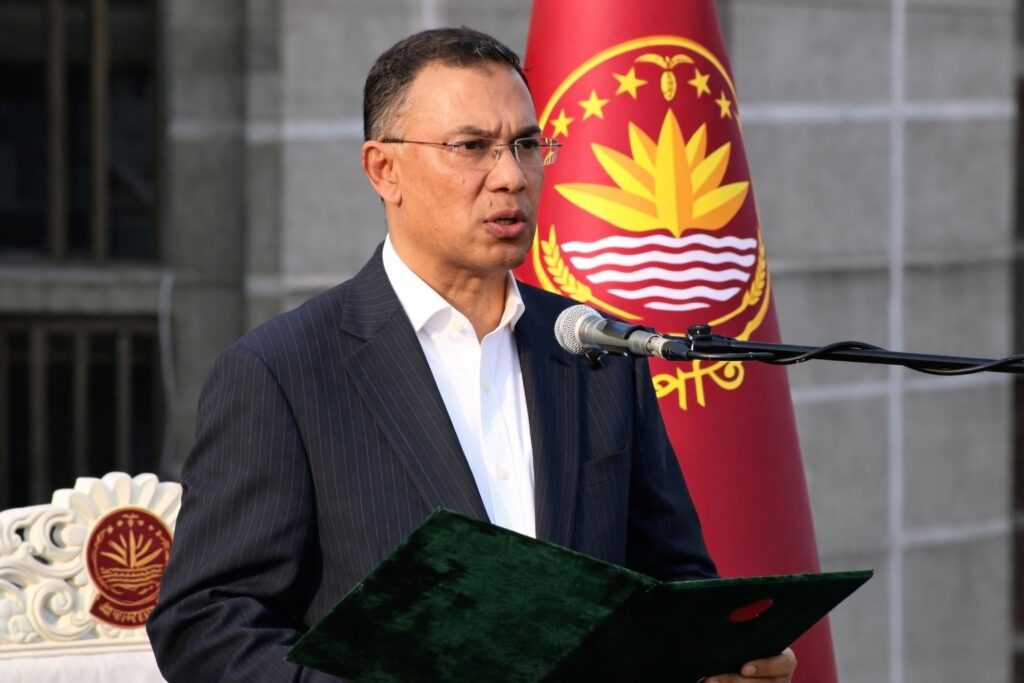
Bangladesh entered a new political era on 17 February 2026 as Tarique Rahman was sworn in as Prime Minister following a decisive parliamentary victory. The ceremony, held at the South Plaza of the Jatiya Sangsad in Dhaka, marked the end of an 18 month interim administration led by Nobel laureate Muhammad Yunus and the formal return of party-based governance.
The event drew more than a thousand domestic and foreign dignitaries, underlining the regional significance of Bangladesh’s transition. Among the prominent attendees was Om Birla, Speaker of India’s Lok Sabha, signalling New Delhi’s close watch on developments in Dhaka.
Rahman’s oath concluded a turbulent chapter that began with mass protests in 2024 and the resignation of long-time leader Sheikh Hasina, who had dominated Bangladeshi politics for more than 15 years.
Election Mandate
The 13th parliamentary elections delivered a commanding mandate to the Bangladesh Nationalist Party. The BNP secured 209 of the 297 contested seats, comfortably crossing the threshold required to form government.
Jamaat-e-Islami, once banned from contesting elections, returned with 68 seats in what observers described as a major political comeback. The Awami League, led by Hasina, did not contest the polls, a factor that reshaped the electoral field and intensified debate over the inclusiveness of the transition.
The scale of the victory places Rahman in a strong parliamentary position. However, the legitimacy of the electoral process and the broader political environment remain subjects of scrutiny both domestically and internationally.
Ceremony Signals
The choice of venue was symbolic. Traditionally, prime ministerial oaths were administered at the presidential residence. Holding the ceremony at the national parliament complex suggested a deliberate emphasis on institutional authority and parliamentary sovereignty.
Earlier in the day, newly elected members of parliament were sworn in by the Chief Election Commissioner, underscoring procedural continuity after the interim phase.
In his first remarks after taking office, Rahman said he would seek to surpass the performance of his predecessors. Standing beneath portraits of his parents, former prime minister Khaleda Zia and former president Ziaur Rahman, he invoked political legacy while promising reform and stability.
“I will try to do better than them,” he said, in a brief statement that balanced deference to lineage with an assertion of personal responsibility.
Dynastic Return
Rahman’s rise represents the return of a powerful political dynasty. The rivalry between Sheikh Hasina and Khaleda Zia defined Bangladesh’s politics for decades, often described as the era of the “Battle of Begums.” With Rahman’s ascent, leadership has shifted to the next generation.
His years in exile and past legal controversies add complexity to his political narrative. Supporters view his victory as vindication after years of political marginalisation. Critics question whether dynastic politics can deliver structural reform in a country grappling with economic pressures, governance challenges and social tensions.
Yunus Farewell
If Rahman’s oath symbolised renewal, Yunus’s farewell address ensured that the transition would not be geopolitically quiet.
In his final televised speech, Yunus defended his interim administration and outlined what he described as a sovereign, interest-driven foreign policy. He declared that Bangladesh was no longer a country with a submissive diplomatic posture.
He highlighted Bangladesh’s maritime access as a gateway to the global economy and spoke of regional cooperation involving Nepal, Bhutan and India’s northeastern states, commonly known as the Seven Sisters.
Notably, he referred to the Seven Sisters without explicitly naming India, a choice that drew immediate attention in New Delhi.
Seven Sisters
The Seven Sisters refer to seven Indian states in the northeast, geographically connected to the rest of India by a narrow corridor. The region holds strategic importance for India’s security and connectivity policies.
Yunus’s framing of the region within a broader economic vision that grouped it alongside sovereign neighbours triggered criticism from Indian commentators and former officials. Some argued that the omission of India’s name was diplomatically pointed and risked blurring political sensitivities.
Bangladesh and India share deep economic, cultural and security ties. Trade, energy cooperation and cross-border connectivity projects have expanded significantly over the past decade. Any rhetorical shift affecting this relationship carries weight.
Yunus did not directly criticise India. However, his emphasis on independent positioning and diversified partnerships was widely interpreted as a recalibration of diplomatic tone.
China Factor
China featured prominently in Yunus’s remarks. He cited progress in cooperation with Beijing, including involvement in infrastructure and development projects such as river management initiatives and healthcare facilities in northern Bangladesh.
China has become a major economic partner for Bangladesh, financing roads, bridges and power projects. For India, Chinese engagement in South Asia is closely watched, particularly in areas near sensitive border regions.
By pairing references to the Seven Sisters with mentions of China-backed initiatives, Yunus appeared to outline a strategic balancing approach. Supporters argue that such diversification enhances Bangladesh’s bargaining power. Critics warn that it could complicate relations with India at a delicate moment.
Domestic Strains
Yunus’s interim administration was tasked with stabilising the country after the 2024 unrest. While it oversaw elections and maintained administrative continuity, it faced criticism over law and order concerns and alleged attacks on minority communities.
Opponents accused the interim leadership of focusing heavily on foreign policy positioning while domestic grievances simmered. Yunus rejected such claims, arguing that the transitional government laid the groundwork for democratic restoration.
The political temperature remains elevated. The absence of the Awami League from the electoral contest and the return of previously marginalised forces reflect an evolving landscape rather than settled consensus.
Diplomatic Reset
Rahman now faces the task of consolidating authority at home while recalibrating Bangladesh’s external relations.
India is likely to seek reassurance that bilateral cooperation will remain stable. Trade, transit agreements and security coordination remain pillars of the relationship. At the same time, Bangladesh is expected to continue engaging China as an economic partner.
Balancing these relationships requires diplomatic precision. Bangladesh’s geographic position between South and Southeast Asia gives it leverage but also exposes it to strategic competition.
Rahman has yet to outline a detailed foreign policy roadmap. Early signals suggest an emphasis on economic growth, investment and regional stability. Whether this translates into a softer tone toward India or continuity with Yunus’s assertive posture remains to be seen.
Strategic Crossroads
Bangladesh’s transition is more than a domestic political event. It is a moment that intersects with wider geopolitical currents in South Asia.
The combination of a decisive electoral mandate, a dynastic return to power and a farewell speech that stirred regional sensitivities has created a complex starting point for the new government.
For Rahman, the immediate challenge is governance. For the region, the question is alignment. Bangladesh stands at a strategic crossroads, navigating between continuity and recalibration, legacy and reform.
The oath ceremony signalled authority. The coming months will determine direction.


