

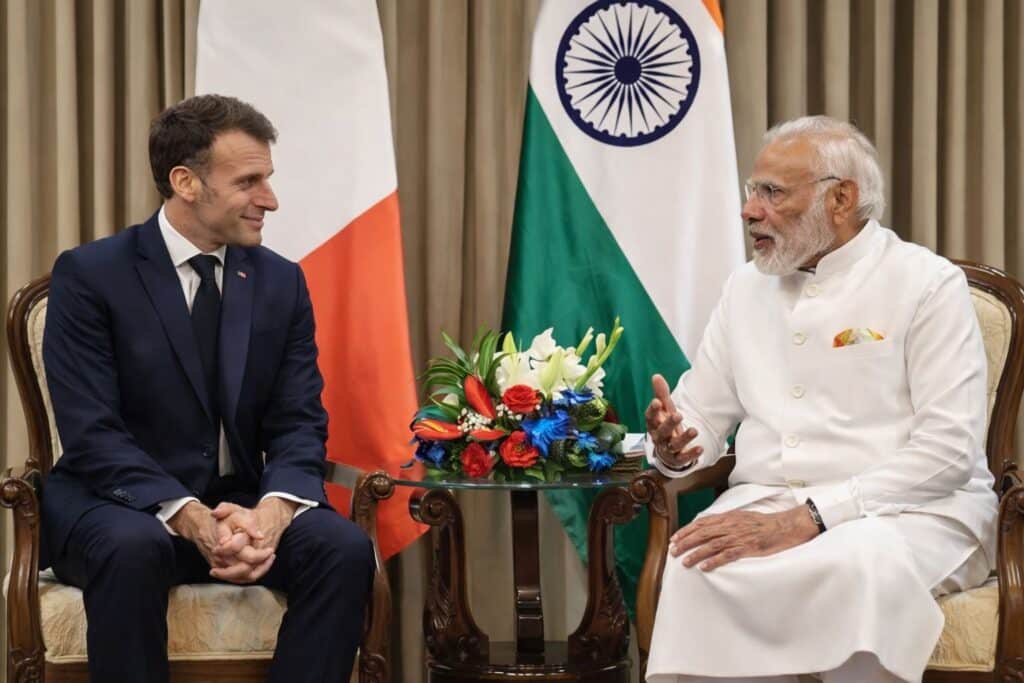
Prime Minister Narendra Modi and French President Emmanuel Macron held high-stakes bilateral talks in Mumbai on 17 February 2026, anchoring what both sides described as a decisive phase in the India–France strategic partnership.
The meeting formed the centrepiece of Macron’s three-day official visit to India and comes at a time of shifting global power balances, supply chain realignments and intensifying competition in defence technology and artificial intelligence.
Officials said the leaders reviewed the full spectrum of the India–France Strategic Partnership, including defence cooperation, advanced technologies, trade expansion, Indo-Pacific security and climate collaboration. The talks were framed not as a routine diplomatic exchange but as a strategic recalibration between two nations seeking greater autonomy in a fragmented global order.
Visit Context
This is Macron’s fourth visit to India since assuming office in 2017, underlining continuity in bilateral engagement. His itinerary includes participation in the India AI Impact Summit in New Delhi and interactions with business leaders and innovators under the newly launched India–France Year of Innovation 2026.
The Mumbai leg of the visit carried symbolic and strategic weight. Macron paid tribute to the victims of the 2008 Mumbai terror attacks, reinforcing shared commitments on counter-terrorism and security cooperation. The city also hosted high-level CEO roundtables signalling deepening private-sector alignment.
Rafale Focus
At the centre of defence discussions is a potential contract for 114 Rafale fighter aircraft manufactured by Dassault Aviation. The proposed deal, estimated at around 35 billion dollars, would mark India’s largest ever fighter jet acquisition and one of France’s biggest defence export orders.
Government sources indicate that 18 jets would be acquired in fly-away condition while 96 would be manufactured in India under the Make in India framework. The arrangement is expected to include technology transfer, local assembly and long-term maintenance infrastructure.
Negotiations also reportedly include discussions around the naval Rafale-M variant for India’s aircraft carriers, though officials emphasise that pricing and final contractual structures remain under deliberation.
If concluded, the agreement would significantly strengthen the Indian Air Force’s operational capability while deepening defence industrial cooperation between the two countries.
Beyond Jets
The defence agenda extends well beyond the Rafale platform. Officials confirmed talks on:
- Precision-guided munitions including HAMMER missiles
- Helicopter manufacturing cooperation
- Jet engine technology collaboration
- Naval and submarine systems
- Expanded joint exercises in the Indo-Pacific
Both sides are also working under a renewed ten-year Defence Cooperation Agreement aimed at institutionalising long-term collaboration across design, production and logistics.
French officials described India as a key strategic defence partner in the Indo-Pacific, while Indian officials stressed the importance of diversifying procurement and strengthening indigenous capability.
AI Push
Parallel to defence discussions, artificial intelligence emerged as a central pillar of the summit.
Modi and Macron jointly launched the India–France Year of Innovation 2026 at the Gateway of India. The year-long programme will convene startups, researchers, universities and technology companies to collaborate in AI, quantum computing, space technology and digital infrastructure.
Macron is scheduled to attend the India AI Impact Summit in New Delhi, building on the 2025 AI Action Summit hosted in Paris. Officials said the two countries aim to cooperate on trustworthy AI frameworks, ethical governance standards and joint research funding mechanisms.
India and France are positioning themselves as democratic technology powers seeking to shape global AI rules while accelerating commercial innovation.
Trade Expansion
Bilateral trade between India and France currently stands at approximately 15 billion dollars annually. Both governments have expressed intent to scale this significantly through enhanced market access, investment facilitation and sector-specific partnerships.
Key areas under discussion include:
- Aerospace and defence manufacturing
- Renewable energy and hydrogen
- Pharmaceuticals and healthcare
- Digital payments including expansion of India’s UPI platform
- Critical minerals for semiconductor and battery supply chains
French companies have shown increasing interest in India’s infrastructure and manufacturing sectors, while Indian firms are expanding their footprint in Europe.
Indo-Pacific Lens
Strategic coordination in the Indo-Pacific featured prominently in the discussions. France, with territories and naval presence in the region, shares India’s emphasis on freedom of navigation, maritime security and rules-based order.
Joint naval exercises and maritime domain awareness initiatives are expected to expand, particularly in the Western Indian Ocean. Both countries see their partnership as a stabilising force amid intensifying competition among major powers.
Diplomats noted that India and France often align on issues of strategic autonomy, multilateral reform and balanced global engagement.
Business Diplomacy
The Mumbai summit also included interactions with industry leaders from both countries. CEO roundtables focused on defence production, technology transfer and startup collaboration.
The India–France Year of Innovation will feature business forums, academic exchanges and cultural programmes throughout 2026. Officials said the initiative is designed to move beyond symbolic diplomacy and create structured, measurable outcomes.
Cultural diplomacy also played a role. Macron’s participation in public events and innovation showcases highlighted the soft power dimension of the partnership, reinforcing people-to-people ties and educational exchanges.
Security Signal
Security arrangements across Mumbai underscored the significance of the visit. High-level protection protocols and coordinated traffic management reflected the scale of the bilateral engagement.
The tribute to the 2008 terror attack victims carried a broader message of shared resolve against terrorism. Both countries have previously cooperated closely in intelligence sharing and counter-terror initiatives.
Global Implications
The Modi–Macron summit arrives at a time when global alliances are being reassessed. Europe is seeking deeper engagement in the Indo-Pacific, while India is diversifying defence suppliers and technology partners.
If the Rafale negotiations conclude successfully and innovation frameworks translate into tangible projects, the summit could redefine India–France ties for the next decade.
For India, the partnership offers advanced technology access and industrial collaboration aligned with domestic manufacturing goals. For France, it secures a pivotal role in one of the world’s fastest-growing major economies.
Next Steps
While negotiations on the Rafale acquisition and related defence systems are ongoing, officials indicated that technical and financial assessments are at an advanced stage. Any final agreement would require formal contractual clearance and cabinet approval in India.
The launch of the India–France Year of Innovation 2026 and expanded AI collaboration mechanisms are expected to proceed through institutional frameworks involving ministries, research bodies and private industry stakeholders.
The Mumbai summit thus marked a substantive review of bilateral priorities rather than a symbolic engagement. Defence procurement timelines, technology transfer agreements and joint innovation programmes will now determine the pace at which the outcomes of the Modi–Macron meeting translate into measurable strategic gains.


