

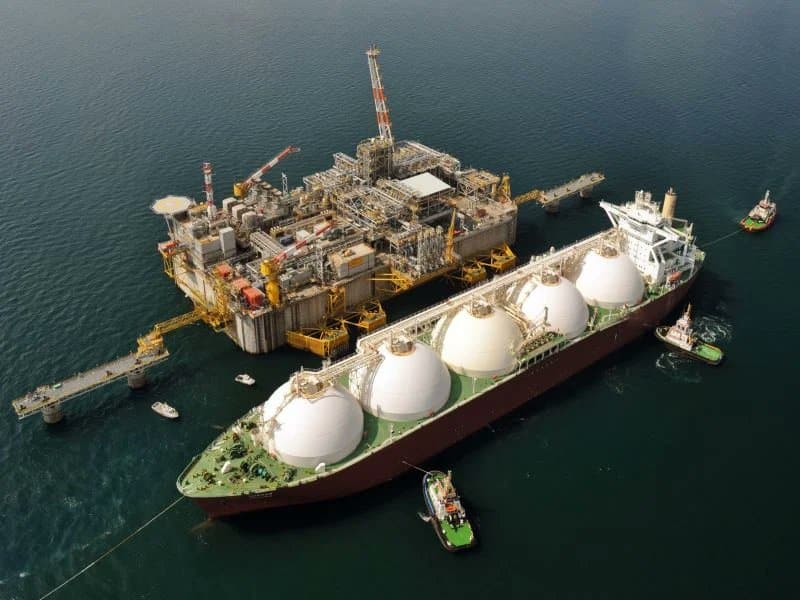
A missile strike on Ras Laffan Industrial City has disrupted operations at the core of the global liquefied natural gas system, damaging infrastructure that underpins a significant share of international gas trade. The facility is central to Qatar’s export network, supplying long-term contracted volumes and spot cargoes to Asia and Europe.
QatarEnergy has confirmed that around 17% of LNG export capacity has been knocked offline. The scale of the damage points to a prolonged outage, with repair timelines extending between three and five years. “We’ll be losing 12.8 million tonnes per year of LNG for three to five years,” said Saad al-Kaabi. The disruption has affected critical liquefaction trains and associated infrastructure, limiting the facility’s ability to maintain normal output levels.
The strike comes alongside heightened tensions affecting the South Pars Gas Field, the world’s largest gas reservoir shared between Iran and Qatar. Together, these developments place a concentrated portion of global gas production under direct strain, exposing the risks associated with geographically clustered energy infrastructure.
Scale of disruption and economic losses
The loss of approximately 12.8 million tonnes per annum of LNG output represents a significant contraction in global supply. This volume accounts for nearly a fifth of Qatar’s export capacity and a meaningful share of flexible LNG available to international markets.
The financial impact is equally substantial. “Annual revenue lost from the damaged facilities is around $20 billion,” Saad al-Kaabi said, highlighting the scale of the economic shock. The disruption extends beyond LNG, affecting output of LPG, naphtha, sulfur and helium, all of which are integral to industrial and technological supply chains.
Facilities linked to ExxonMobil, which holds a significant stake in the affected assets, have also been impacted. This underscores the global nature of the disruption, with consequences extending beyond national energy balances to corporate operations and international investment flows.
Structural shock to global LNG markets
The duration of the disruption marks a shift from short-term volatility to structural imbalance in global gas markets. A three to five year reduction in supply removes a key source of flexibility, tightening the system over an extended period.
At current run rates, each month of disruption removes roughly one to one and a half percent of annual global LNG supply. Over time, this compounds into a persistent deficit, particularly as demand continues to expand in Asia and remains elevated in Europe. “For production to restart, first we need hostilities to cease,” Saad al-Kaabi said, indicating that recovery timelines remain closely tied to geopolitical conditions.
The disruption also raises concerns about Qatar’s North Field expansion, a major project expected to add substantial new supply in the coming years. Any delays could extend market tightness beyond the immediate crisis and into the latter part of the decade.
Global impact across Asia and Europe
The supply shock is expected to have uneven but widespread effects across major importing regions. In Asia, countries such as India, China, Japan and South Korea rely heavily on Qatari LNG to meet energy demand. Reduced availability is likely to intensify competition for cargoes, particularly in the spot market, and push up procurement costs.
India remains particularly exposed, with approximately 45 to 47% of its LNG imports sourced from Qatar. The disruption is expected to affect city gas distribution systems, including household PNG and transport CNG, as well as fertiliser production and industrial fuel use. Higher import costs may translate into increased subsidy burdens and broader inflationary pressures.
In Europe, the reduction in LNG supply adds to an already complex energy landscape shaped by reduced pipeline flows. Lower availability of Qatari cargoes may complicate efforts to build storage levels and maintain supply security, particularly during peak demand periods. The situation unfolds against a wider geopolitical backdrop involving Vladimir Putin and ongoing debates over energy diversification and strategic dependence.
Contracts, shipping and system risk
The disruption is placing immediate strain on long-term LNG contracts. “We may have to declare force majeure on long-term contracts for up to five years,” Saad al-Kaabi said, referring to supply commitments to countries including Italy, Belgium, South Korea and China. Such a move would alter established trade flows and increase reliance on volatile spot markets.
At the same time, logistical risks are rising. LNG shipments from Qatar pass through the Strait of Hormuz, a critical maritime route now facing heightened security concerns. Increased insurance costs, potential delays and reduced tanker availability could further constrain supply, even where production capacity is unaffected.
The disruption highlights a broader structural vulnerability within the global LNG system. Ras Laffan Industrial City represents one of the most efficient integrated gas hubs in the world. While this concentration enables scale and cost efficiency in stable conditions, it also creates a single point of failure. Disruption at one location can have cascading effects across global markets, reinforcing the need for diversification and resilience in energy supply chains.


