

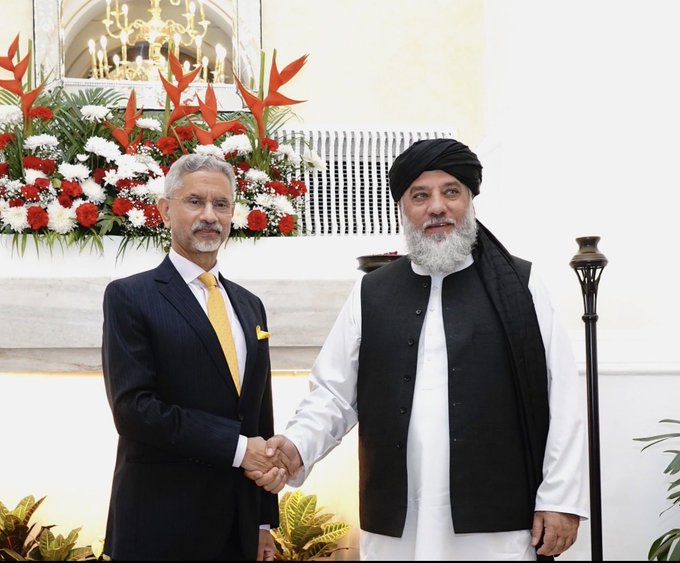
Afghanistan has launched a major economic outreach to India, offering a five-year tax exemption to Indian companies investing in new sectors such as gold mining, rare minerals, agriculture, pharmaceuticals, energy and industrial manufacturing. The announcement by Afghanistan’s Minister of Commerce and Industry, Alhaj Nooruddin Azizi, during his visit to New Delhi reflects Kabul’s attempt to rebuild its struggling economy through foreign investment and restore strategic economic ties with India.
Speaking to Indian business leaders, Minister Azizi said, “India is our priority partner for investment. We are ready to offer full tax exemption and all necessary support to Indian companies willing to build Afghanistan’s industrial future.”
Azizi added that Indian investors would receive tax holidays, subsidized or free land, and an extremely low 1 percent import duty on machinery and raw materials. For Afghanistan, the goal is to attract capable partners, create jobs, revive idle industrial zones and transform the relationship into one driven by investment, production and long-term cooperation..
Why Afghanistan Needs India
Afghanistan’s push towards India is shaped by shifting regional realities. Trade disruptions with Pakistan, coupled with unstable border conditions, have forced Kabul to look for reliable alternatives. India, with its strong record in mining, engineering, energy and infrastructure, stands out as the most dependable partner.
The country possesses billions of dollars’ worth of untapped mineral wealth, including gold, copper, lithium, gemstones and rare earth minerals. Afghan officials believe Indian companies can help map, extract and process these minerals far more effectively than any other foreign player.
Reinforcing this, Afghanistan’s Foreign Minister Mawlawi Amir Khan Muttaqi stated, “We have invited India to explore investment in our minerals and energy sectors. Afghanistan welcomes India’s expertise and long-term partnership.”
With more than 1,000 mineral-rich fields still unexplored, Afghanistan is eager to bring in Indian firms that can deploy modern machinery, conduct surveys, and build processing plants that generate local value and employment.
What India Is Being Offered
Afghanistan has created an investment package designed to remove traditional entry barriers and make Indian companies early beneficiaries of a high-opportunity market.
Key Highlights:
• Five-year tax holiday for Indian investors entering new sectors
• Only 1 percent import duty on machinery and raw materials
• Free or subsidized industrial land for major projects
• Preferential tariff access for manufacturing
• Very low competition, especially in mining
• Support for Indian energy firms to restart earlier projects
Minister Azizi reinforced this during talks, saying, “Our doors are open for Indian investors. You will face very few competitors here. Afghanistan wants India to lead the revival of our mining and energy sectors.”
Trade Revival and Connectivity
To support the investment push, India and Afghanistan are reopening trade channels. New air-cargo corridors connecting Kabul, Delhi and Amritsar are being restored for faster movement of goods.
Both sides have also agreed to deploy commercial representatives in their embassies, ensuring smoother coordination. A new India–Afghanistan Joint Chamber of Commerce and Industry is being established to provide institutional backing to investors.
Emphasizing the importance of renewing ties, Muttaqi remarked, “We want to expand our trade with India. Afghanistan seeks long-term economic cooperation, not temporary engagement.”
These measures create the most structured economic framework between the two nations in years and offer Indian businesses a more predictable operating environment.
Why the Opportunity Matters for India
For Indian companies, Afghanistan presents a rare combination of low investment cost, high reward potential and strategic positioning. Its mineral reserves, especially gold and rare earth elements, are increasingly important for global supply chains.
Afghan officials openly acknowledge that the same rare minerals sought by Western governments cannot be accessed without cooperation from Taliban-controlled Afghanistan. This gives Kabul significant leverage and opens a unique channel for India.
Afghanistan’s leadership has repeatedly emphasized its preference for Indian involvement. Minister Azizi said, “India brings credibility and capability. We trust Indian companies to develop our resources responsibly and transparently.”
Indian firms are being encouraged to combine extraction with on-ground processing, an approach that supports Afghan employment while reducing India’s import dependency.
Challenges and Caution
Despite the tempting offers, Indian companies are advised to proceed with strategic caution. Afghanistan’s political stability remains uncertain, and concerns persist regarding the predictability of regulations, security of mining leases and the enforceability of contracts under the Taliban administration.
Infrastructure limitations pose another challenge. Many regions lack consistent electricity, reliable roads and industrial-grade facilities required for large-scale production. Companies must also consider geopolitical sensitivities, especially regarding sanctions, diplomatic pressures and reputational risk.
Industry experts recommend a phased approach, starting with feasibility studies, technical surveys and controlled pilot projects before committing to full-scale investments. While the opportunities are substantial, due diligence remains crucial.
A New Regional Equation
The potential entry of Indian companies into Afghanistan’s mineral and industrial sectors could reshape regional dynamics. With Pakistan no longer seen as a stable trade corridor and Central Asia opening newer energy routes, India has an opportunity to expand its influence through economic engagement rather than political intervention.
For Afghanistan, Indian investment represents credibility, technical skill, infrastructure capacity and the chance to build a sustainable economy beyond humanitarian aid. For India, this partnership offers access to crucial resources, strategic positioning and long-term economic returns.
In the end, Afghanistan’s offer is not just an investment proposal. It is India’s moment to shape a region in motion and lead where others hesitate!


