

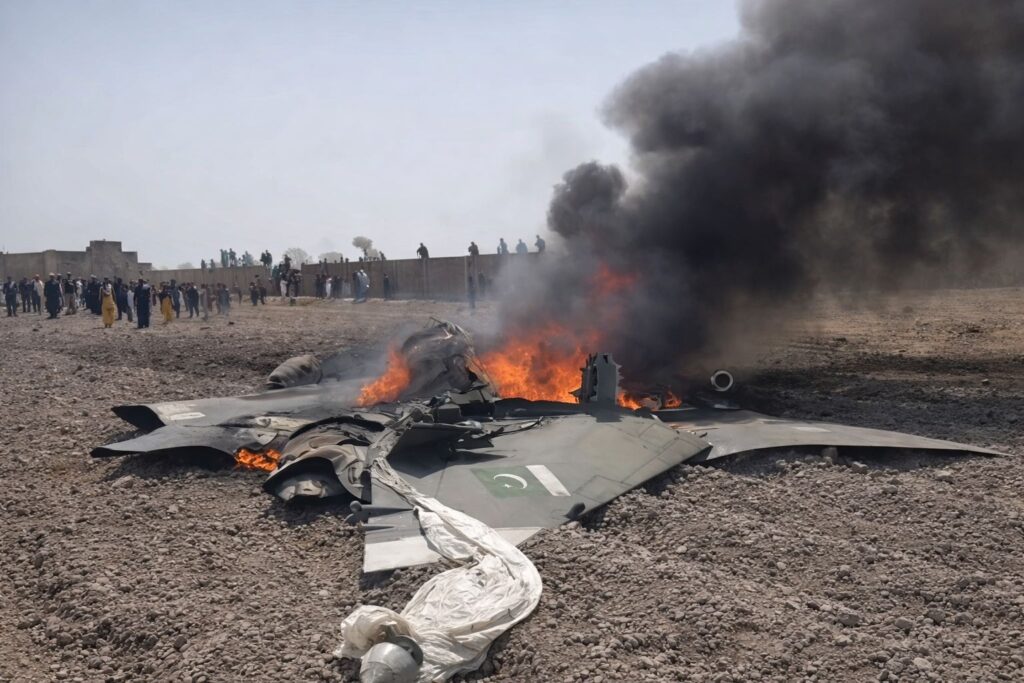
Pakistan has formally declared what it described as an open war against Taliban-led Afghanistan, marking the most serious military confrontation between the two neighbours since the Taliban returned to power in 2021. The announcement followed a night of intense cross-border fighting, coordinated airstrikes and artillery exchanges that rapidly escalated into a wider military operation across multiple sectors of the disputed Durand Line.
Islamabad said the offensive, launched under the name Operation Ghazab lil-Haq, was triggered by sustained attacks originating from Afghan territory. Pakistani officials accused the Taliban administration of enabling militant groups that target Pakistan’s security forces, an allegation Kabul has repeatedly denied.
The fighting has expanded beyond isolated frontier skirmishes into confirmed air operations over major Afghan cities and heavy ground engagements along the 2,600 kilometre border, raising fears of prolonged conflict between the two South Asian neighbours.
Operation Ghazab lil-Haq Launched
Pakistan’s military, through Inter-Services Public Relations Director-General Ahmed Sharif Chaudhry, said the armed forces responded to what it described as unprovoked aggression by the Afghan Taliban regime.
Addressing a press briefing, the DG ISPR called on the Afghan Taliban to make a choice between Pakistan and militant organisations.
I want to make one thing clear: the oppressive Afghan Taliban regime has to make a clear choice, choose between TTP, BLA, Daesh, Al-Qaeda, terrorists and terrorist organisations and between Pakistan, he said.
Pakistan has made it clear before, it is not something new. Let it be known that our choice is absolutely clear, it will always be Pakistan over everything.
He said Pakistani forces repulsed attacks across 53 locations along the frontier before launching retaliatory strikes.
Airstrikes Hit Kabul and Kandahar
Pakistan confirmed that air operations targeted what it described as Afghan military infrastructure in Kabul, Kandahar, Paktia, Nangarhar and Khost.
According to the military briefing, the strikes hit brigade and battalion headquarters, ammunition depots, armoured vehicle storage sites and sector command facilities. Officials said the targets were selected based on intelligence assessments and aimed at degrading Taliban capabilities.
The escalation marks one of the most significant cross-border military actions between Afghanistan and Pakistan in recent years.
Casualties and Destruction Claims
Pakistan released updated casualty figures during Friday’s briefing. Ahmed Sharif Chaudhry said 274 Taliban officials and militants were killed and more than 400 injured since the start of the operation. He confirmed that 12 Pakistani soldiers were killed and 27 others wounded in the fighting.
Pakistan also claimed that 115 tanks, armoured vehicles and artillery systems belonging to Taliban forces were destroyed. The military said 73 Taliban border posts were demolished and 18 were now under Pakistani control.
These figures have not been independently verified.
Afghan authorities dispute Pakistan’s claims and have issued their own casualty figures, saying Pakistani soldiers were killed in retaliatory strikes. Kabul has not confirmed numbers matching Islamabad’s account.
Drone Attacks Intercepted
During the briefing, Ahmed Sharif Chaudhry said the Afghan Taliban attempted to deploy rudimentary drones to carry out attacks in Sibi, Abbottabad and Nowshera.
Our anti-drone systems took them out, he said. Afghanistan has claimed it conducted drone operations targeting Pakistani positions. Pakistan maintains that all attempted aerial incursions were intercepted.
The reported use of drones reflects a technological escalation in a conflict that has historically involved artillery and ground clashes.
Taliban Response
The Afghan Taliban have accused Pakistan of violating Afghan sovereignty and conducting air raids that endangered both military and civilian areas. Officials in Kabul described the strikes as aggression and said Afghan forces responded in defence of territorial integrity.
Taliban representatives deny harbouring anti-Pakistan militant groups, including Tehrik-i-Taliban Pakistan, an accusation Islamabad has repeatedly made. Afghan authorities maintain that Pakistan is shifting blame for its internal security challenges.
Border Dispute and Militant Safe Havens
The crisis centres on the long-standing dispute over the Durand Line and allegations of militant safe havens.
Pakistan accuses Taliban authorities of allowing armed groups to operate from Afghan soil and launch attacks inside Pakistan. Afghanistan rejects these accusations and disputes the legitimacy of the Durand Line as a formally recognised international border.
Tensions over border fencing, cross-border raids and militant activity have repeatedly strained relations in recent years. The current escalation, however, represents one of the most severe confrontations since the Taliban regained power.
International Reaction
The escalation has prompted international concern. United Nations Secretary-General Antonio Guterres expressed alarm over the developments and urged both sides to exercise restraint.
The United Kingdom’s Foreign Office called for immediate de-escalation, warning that sustained hostilities could destabilise the region. Regional powers including China, Iran and Russia have advocated diplomatic engagement to prevent further deterioration.
Azerbaijan Declares Support for Pakistan
In a strong diplomatic statement, Azerbaijan declared firm and unconditional support for Pakistan amid the escalating conflict.
We are deeply concerned about the reports of war between Pakistan and Afghanistan. In these difficult and painful moments, Azerbaijan stands firmly and unconditionally with brotherly Pakistan.
Our nations are bound not only by strategic partnership, but by unshakable brotherhood, shared history, and mutual loyalty. Pakistan has always stood by Azerbaijan and today, Azerbaijan stands by Pakistan.
We strongly support Pakistan’s sovereignty, territorial integrity, and security. If necessary, Azerbaijan is ready to support with its voice, its strength, and even with its life and property. Brotherhood is not just words, it is proven in hard times.
The statement marks one of the clearest expressions of foreign backing for Islamabad since the outbreak of hostilities.
Current Situation
Military operations remain active across multiple sectors of the Afghanistan-Pakistan frontier. Both countries are on heightened alert and no ceasefire has been announced. Diplomatic channels remain open, but no formal peace initiative has been confirmed.
The situation remains fluid, with Afghanistan and Pakistan continuing to exchange accusations, casualty claims and strategic warnings. Security analysts caution that sustained confrontation between Pakistan and Taliban-led Afghanistan risks destabilising South and Central Asia if not contained through diplomatic engagement.


