

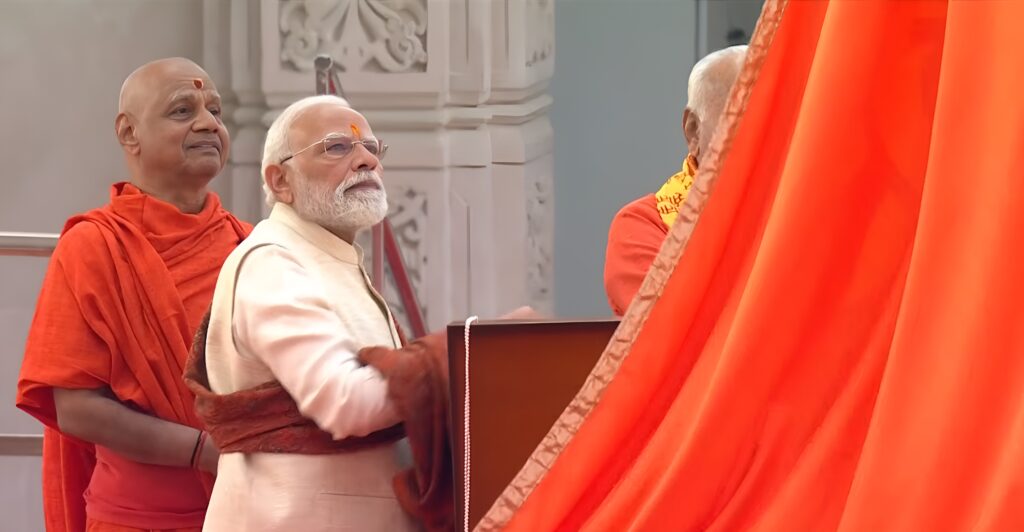
Ayodhya witnessed a landmark event in India’s contemporary cultural narrative as Prime Minister Narendra Modi hoisted the saffron Dharma Dhwaj atop the Shri Ram Janmabhoomi Temple, marking the formal completion of the temple’s construction phase. The ceremony was performed during the auspicious Abhijit Muhurat, considered the most sacred window for decisive actions in Vedic tradition. The temple precincts resounded with chants of “Jai Shri Ram” as thousands of devotees and spiritual leaders watched the moment unfold.
The Prime Minister was accompanied by RSS Sarsanghchalak Mohan Bhagwat, Uttar Pradesh Chief Minister Yogi Adityanath, senior dignitaries and saints. Prior to the hoisting, PM Modi visited and offered prayers at shrines dedicated to Maharishi Valmiki, Maharishi Vashishtha, Bharadwaj, Shringi Rishi and other revered sages, paying tribute to the spiritual lineage connecting the Ramayana narrative with Ayodhya’s identity.
A Long Journey
Ayodhya has for centuries been regarded as the birthplace of Bhagwan Shri Ram, the central figure of the epic Ramayana and an enduring symbol of Dharma, duty and ideal governance. The site has been the centre of legal, historical and political debate for over 130 years.
The Ram Janmabhoomi dispute went through multiple legal proceedings in the colonial and post-independence eras. In 1992, the demolition of the Babri Masjid triggered nationwide unrest and decades of litigation. The turning point came in November 2019, when the Supreme Court of India issued a unanimous verdict awarding the land for construction of a temple and directing the allocation of alternative land for a mosque. Following the judgment, the government established the Shri Ram Janmabhoomi Teerth Kshetra Trust to oversee the construction.
The Pran Pratishta of the idol of Ram Lalla was performed in January 2024, marking a pivotal milestone witnessed globally. The Dhwajarohan, now positioned atop the spire, represents the culmination of a civilisational aspiration carried by generations of devotees and cultural custodians.
Symbolism of the Dharma Dhwaj
The 10-foot-high and 20-foot-long triangular Dhwaj integrates multiple spiritual symbols. The radiant Sun represents the courage and brilliance of the Suryavansh lineage of Lord Ram. The sacred Om denotes eternal consciousness and universal truth. The Kovidara tree signifies rooted heritage, resilience and the flourishing of civilisation. Constructed using parachute-grade nylon and silk-satin weave, the flag is designed to withstand extreme climate and high wind speed, symbolising strength and endurance.
In his keynote address, Prime Minister Modi articulated the national significance of the moment. He noted that the hoisting of the Dharma Dhwaj symbolised “the rejuvenation of Indian civilisation and the values associated with Ram Rajya.” He stated that the principles represented by the flag reflected truth, unity, equality and the elimination of social suffering, and that the ceremony marked “the beginning of a new chapter for Bharat founded on heritage and self-confidence.”
Leadership Perspectives
The ceremony drew commentary that reflected a broader sentiment of cultural consolidation.
RSS Sarsanghchalak Mohan Bhagwat described the event as “a moment that reinforces national self-respect and acknowledges the perseverance and devotion of countless individuals who contributed to this journey.”
Uttar Pradesh Chief Minister Yogi Adityanath observed that the unfurling of the saffron flag represented “the enduring light of Dharma and the unity of a nation bound by shared values and historical memory.”
The ceremony also coincided with Guru Tegh Bahadur’s martyrdom day, which several speakers referenced as a reminder of sacrifice made in defence of religious freedom and human dignity.
Security and Crowd Management
Ayodhya was secured under extensive arrangements to manage the massive turnout. Nearly 7,000 personnel, including NSG, ATS, anti-drone squads and special operations units, were deployed. A 2.5-kilometre Ram Path corridor was regulated through QR-based access control, supported by integrated command-and-control systems, digital monitoring and public broadcast infrastructure. Medical, emergency and traffic systems were coordinated flawlessly, reflecting national-level preparedness.
Economic and Developmental Impact
Beyond spiritual symbolism, the Dhwajarohan marks a transformative step in Ayodhya’s vision as a global spiritual tourism hub. Large-scale infrastructure development is underway, including enhancements to transportation, cultural institutions and hospitality capacity.
The newly developed Ayodhya International Airport, expanded multi-lane road networks, riverfront beautification, hotels, pilgrimage housing zones and cultural museums are augmenting the region’s appeal. Local industries such as artisanal crafts, temple goods, handicraft manufacturing and tourism services are expected to benefit substantially. Economists project Ayodhya to become one of the fastest-growing tourism economies in India, generating increased employment and MSME expansion.
A New Beginning for Bharat
The hoisting of the saffron Dharma Dhwaj is widely viewed as a symbolic transition from construction to spiritual operationalisation, from historical contest to cultural harmony and from inherited memory to future ambition. It represents unity, optimism and a renewed expression of national cultural identity.
Ayodhya’s saffron flag signals unity, heritage and national confidence, marking the beginning of a powerful new era for Bharat!


