

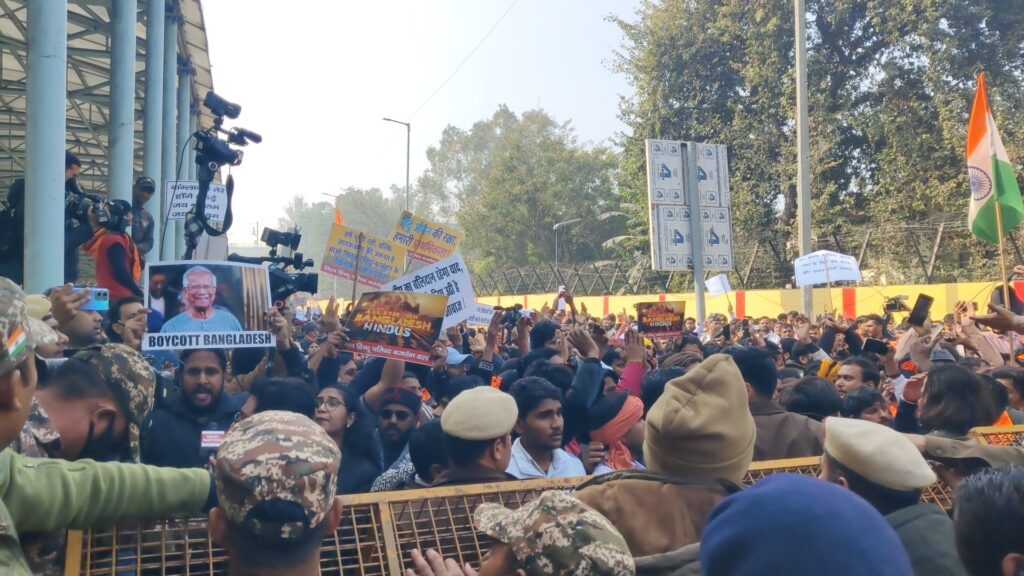
Protests have intensified across multiple Indian cities following the brutal lynching of a Hindu garment worker in Bangladesh, turning a criminal case into a regional flashpoint. Demonstrations outside the Bangladesh High Commission in New Delhi, clashes with police, and coordinated nationwide protests led by Hindu organisations have placed the killing of Dipu Chandra Das at the centre of a widening political and diplomatic confrontation.
What began as outrage over a lynching has now evolved into a broader debate on minority safety, mob violence, and accountability in Bangladesh, with governments on both sides responding amid mounting public pressure.
Delhi Protests Turn Confrontational
The most intense protests have unfolded in New Delhi, where hundreds of demonstrators gathered outside the Bangladesh High Commission over consecutive days. Protesters carried placards demanding justice for Dipu Chandra Das and raised slogans accusing Bangladeshi authorities of failing to protect Hindu minorities.
As crowds swelled, protesters attempted to push past police barricades guarding the diplomatic enclave. Security forces responded with baton charges and detentions to prevent a breach of the High Commission perimeter. Police deployed additional personnel and layered security cordons to contain the situation.
Authorities later stated that while the protests were largely spontaneous, the situation became volatile when demonstrators ignored repeated warnings and attempted to cross restricted zones. Traffic restrictions were imposed in surrounding areas, and several protesters were briefly detained before being released.
Protests Spread Beyond the Capital
The anger was not confined to Delhi. Kolkata, home to a significant population with familial ties to Bangladesh, witnessed large demonstrations near the Bangladesh Deputy High Commission. Protesters blocked roads, waved flags, and demanded stronger diplomatic action.
Similar demonstrations were reported in Hyderabad, Assam, and other cities, indicating the nationwide scale of the backlash. In Assam, protesters gathered near key intersections, while in Hyderabad, rallies were held condemning the killing and calling for international attention.
The protests were coordinated in part by Hindu organisations, including the Vishwa Hindu Parishad, which announced sustained demonstrations and warned that the agitation would continue until justice was delivered. In West Bengal, political leaders joined the protests and announced plans for border-area demonstrations, signalling an escalation beyond symbolic outrage.
India’s Official Response
India’s Ministry of External Affairs condemned the lynching in strong terms, describing the killing as deeply disturbing and emphasising that such violence cannot be justified under any circumstances.
At the same time, the ministry rejected certain reports from Bangladeshi media suggesting that Indian authorities allowed violent breaches at diplomatic premises. Officials described such claims as misleading, stating that security was maintained and no diplomatic property was harmed.
The Indian government urged Bangladesh to ensure swift justice and take concrete steps to protect minority communities, while reiterating that protests in India would be handled in accordance with law and security protocols.
Diplomatic Sensitivities and Envoy Exchanges
The protests have added strain to India–Bangladesh relations, prompting diplomatic exchanges between the two countries. Bangladesh expressed concern over demonstrations near its diplomatic missions, while India maintained that lawful protest is a democratic right and that adequate security arrangements were in place.
Both sides summoned envoys to convey their positions, reflecting the sensitivity of the issue and its potential impact on bilateral ties. Diplomats on both sides have since sought to de-escalate tensions, but officials acknowledge that public sentiment remains highly charged.
The Incident That Sparked the Protests
Behind the protests lies a grim sequence of events that unfolded on December 18 in Bhaluka, Mymensingh district of Bangladesh.
Dipu Chandra Das, a Hindu garment factory worker, was accused by coworkers of making a religiously offensive remark during a workplace event, allegedly saying “all gods are the same.” The statement was quickly framed as blasphemy.
According to Bangladesh law enforcement agencies, no verified evidence has been found to confirm that Dipu made any such remark. There is no recording, written complaint, or credible independent witness testimony supporting the allegation.
Despite this, rumours spread rapidly inside the factory and surrounding areas.
From Accusation to Mob Violence
As the allegation gained traction, tensions escalated inside the factory. Dipu was confronted by coworkers, and a crowd soon formed. Videos later circulated showing him being dragged out and assaulted by a growing mob.
In an attempt to save his life, Dipu ran toward the Bhaluka police station, seeking refuge. Footage shows him entering the compound, injured and visibly terrified. However, the crowd followed him, vastly outnumbering the officers present.
Unable to control the mob, police were overwhelmed. Dipu was dragged back out, taken to a roadside location along the Dhaka–Mymensingh highway, tied to a tree, beaten further, and ultimately set on fire.
The lynching took place in broad daylight, in the presence of onlookers, many of whom recorded the violence instead of intervening.
Family Rejects Blasphemy Claim
Dipu’s family has categorically rejected the blasphemy accusation. According to relatives, the real trigger was a workplace dispute, not religion.
Family members stated that Dipu had recently taken an internal assessment for a supervisory role, leading to friction with coworkers. On the day of the incident, he was reportedly dismissed from his job, intensifying tensions.
They believe the blasphemy allegation was used as a tool to inflame emotions and justify violence. Investigators’ inability to find evidence supporting the allegation has strengthened the family’s claim.
Bangladesh Investigation and Arrests
Following national and international outrage, Bangladesh authorities launched an investigation. Police and security agencies reviewed video footage, identified suspects, and conducted raids in the area.
So far, at least 12 people have been arrested in connection with the lynching, including individuals accused of instigating the mob. Officials have indicated that the attack did not appear entirely spontaneous, suggesting elements of coordination.
Authorities reiterated that mob justice is a criminal offence and that those responsible would face prosecution.
Government Reaction in Bangladesh
The interim government of Bangladesh condemned the killing as barbaric and unacceptable, stating that it goes against the country’s legal and moral framework. Officials promised strict action and urged the public not to take the law into their own hands.
At the same time, rights groups have argued that repeated incidents of mob violence point to deeper challenges, including delayed intervention and weak deterrence mechanisms.
Minority Fears and Domestic Protests
The lynching has intensified fear among minority communities in Bangladesh, particularly Hindus. Protests were held in Dhaka, including gatherings near the National Press Club, where demonstrators demanded justice and stronger protection.
Community leaders warned that rumours and religious accusations can quickly become deadly when institutional safeguards fail. For many minorities, Dipu’s death has reinforced a sense of vulnerability.
A Widow’s Appeal
One of the most poignant aspects of this tragedy has been the emotional response from Dipu’s wife. In public appeals, she begged for protection for her family and for others like them. She spoke of her husband as a loving father, a dedicated worker, and someone who did not deserve the violent end he met.
Her words resonated deeply on social media, where millions watched, shared, and reacted with empathy. Many users expressed solidarity, calling for justice and highlighting the need for systemic change to protect ordinary citizens from extraordinary violence.
The Question That Will Not Go Away
If a man can be lynched and burned over an unproven rumour in Bangladesh, who will be next when mobs replace the law?
Until justice is complete, Dipu Chandra Das remains a symbol of a system that reacted too late.
Dipu Chandra Das was not killed by blasphemy. He was killed by a lie, a mob, and the failure to stop it in time!


