

Bangladesh is witnessing one of its most volatile political moments in recent years as large-scale protests escalate into a broader diplomatic and security crisis involving India. Demonstrators across multiple cities are demanding the extradition of former Prime Minister Sheikh Hasina from India, accusing New Delhi of shielding her after she fled the country amid mass unrest.
What began as a domestic protest movement has now spilled into anti-India demonstrations, direct threats to Indian diplomatic missions, and incidents that have raised alarm across the region. With national elections approaching next year, the unrest is exposing deep fractures within Bangladesh’s political, security and diplomatic landscape.
Protests Target Indian Diplomatic Presence
The most serious escalation occurred on December 17, when members of the protest group July Oikya marched toward the Indian High Commission in Dhaka. Protesters demanded Hasina’s return to face legal proceedings following her August 2024 flight to India, which came after student-led unrest that ultimately forced her exit from power.
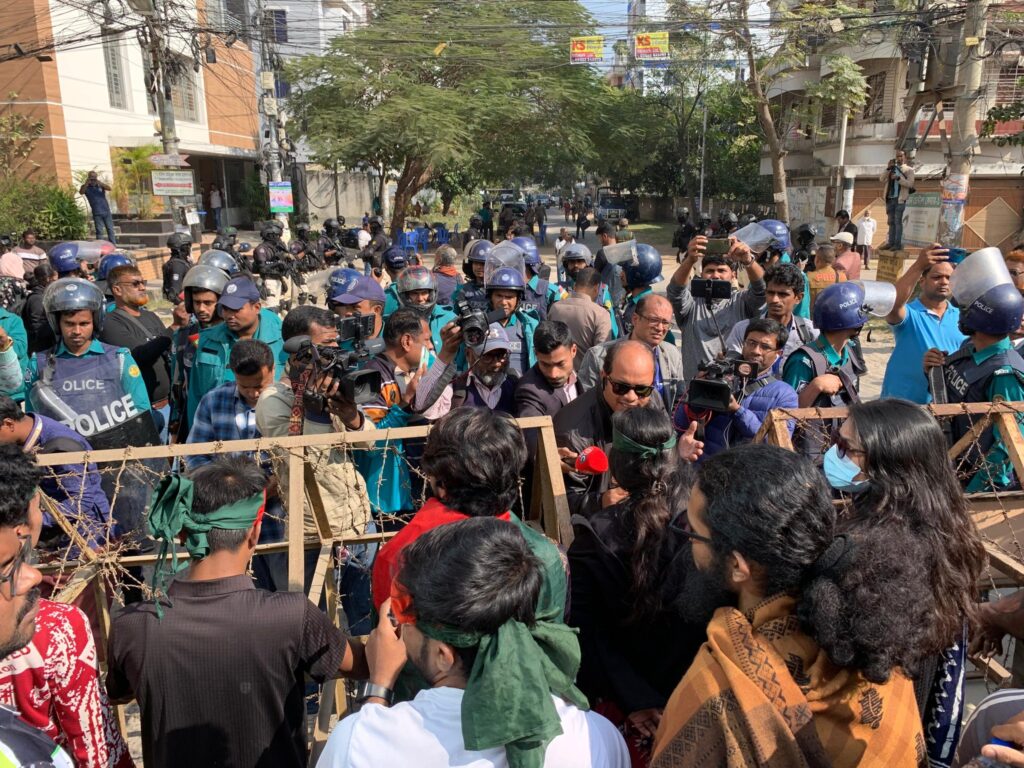
Bangladeshi security forces blocked the march before it reached the diplomatic compound, citing grave security risks. Protesters gathered near barricades, chanting anti-India slogans and accusing New Delhi of interference in Bangladesh’s political affairs.
Authorities later confirmed that the protest was stopped to prevent any breach of diplomatic security, a move that underscored the seriousness of the threat perception.
India Raises Diplomatic Alarm
Following the Dhaka protests, India summoned Bangladesh’s High Commissioner, formally conveying its concerns over the safety of its diplomatic personnel and premises. Indian officials stressed that host governments are obligated to ensure the protection of foreign missions under the Vienna Convention on Diplomatic Relations.
As a precautionary measure, an Indian visa application centre in Dhaka closed early, reflecting heightened threat assessments. While described as temporary, the decision sent a clear signal that New Delhi views the situation as more than routine political unrest.
Protests Spread Beyond Dhaka
The crisis widened on December 18, when demonstrations extended to Rajshahi, a key city in northern Bangladesh. Bangladeshi security forces blocked roads near the Indian Assistant High Commission after intelligence inputs warned of attempts by protesters to target the facility.
Officials described the crowd as increasingly aggressive, with radical Islamist elements joining the marches. Security deployments were significantly reinforced to prevent any breach of diplomatic premises.
Images and videos from the area showed a tense standoff between protesters and security personnel, highlighting how rapidly the unrest has expanded beyond the capital.
Radical Threats Intensify Concerns
The protests took a darker turn when militant rhetoric emerged from the demonstrations. A radical leader, Rashid Pradhan, was quoted by local media issuing an explicit warning.
“We stopped here this time. Next time, we will enter the Indian High Commission in Dhaka. Indian domination will not continue on Bengali soil,” he said.
Such statements have raised serious concerns among regional security analysts, who warn that unchecked radicalisation within protest movements could endanger diplomatic norms and civilian safety.
While Bangladesh’s interim authorities have not endorsed these remarks, critics argue that failure to decisively condemn extremist threats risks emboldening radical actors.
Sheikh Hasina and the Core of the Protest Movement
Sheikh Hasina, one of Bangladesh’s longest-serving prime ministers, was forced out of office following months of protests driven largely by students, civil society groups and opposition voices. Demonstrators accused her government of authoritarian governance, suppression of dissent, electoral manipulation, and human rights abuses.
After her departure, legal proceedings were initiated against her, including cases linked to the violent suppression of protests. For many Bangladeshis, her presence in India symbolises unfinished justice and reinforces the perception that political elites escape accountability.
The demand for Hasina’s extradition has now become the central rallying point of the protest movement, cutting across ideological and organisational lines.
Maritime Clash Raises Stakes Further
Tensions escalated further with a serious maritime incident in the Bay of Bengal on December 18. An Indian fishing trawler was rammed by a Bangladeshi vessel, resulting in the death of two Indian fishermen, according to Indian authorities.
The incident has added a new and dangerous dimension to the crisis. While investigations are ongoing, the clash has heightened concerns that political hostility is now translating into physical confrontation, affecting civilians and cross-border activity.
Indian officials described the incident as deeply troubling, particularly given the broader context of rising diplomatic and security tensions.
Pattern of Escalation Alarms Observers
Analysts note that the current crisis fits into a broader pattern of rising hostility, especially during periods of political instability in Bangladesh. Previous incidents have included cross-border confrontations, threats near frontier areas and disputes linked to religious structures.
While these incidents occurred at different times, regional experts warn that the cumulative effect points to eroding trust and weakening restraint.
The convergence of street protests, radical rhetoric and cross-border incidents has elevated the situation from a domestic political issue to a regional security concern.
India’s Continued Engagement Despite Strain
Despite the escalating hostility, India has continued economic aid, humanitarian assistance and institutional cooperation with Bangladesh. This includes emergency support, development financing, defence training, educational opportunities and cultural exchanges.
However, voices within India are increasingly questioning whether strategic restraint without consequences has encouraged further provocation. Security experts argue that goodwill must be balanced with clear diplomatic red lines to prevent escalation.
The debate reflects a growing reassessment of how India should respond to sustained challenges while maintaining regional stability.
Bangladesh Ahead of a Critical Election Year
The unrest comes as Bangladesh approaches national elections next year, a period historically marked by political volatility. The protests are shaping the pre-election narrative, with opposition groups framing the extradition demand as a test of justice and sovereignty.
At the same time, authorities face the challenge of restoring order without further inflaming public anger. How the government manages security, free expression and diplomatic responsibilities in the coming months will significantly influence Bangladesh’s democratic trajectory.
International and Regional Implications
Global and regional actors are closely monitoring developments. Bangladesh’s strategic location, growing economy and role in South Asian connectivity projects mean that prolonged instability could have far-reaching geopolitical consequences.
For India, the situation tests its ability to balance legal process, diplomatic responsibility and regional leadership. For Bangladesh, it is a moment that will shape its international credibility and internal cohesion.
What Lies Ahead
As protests continue, Bangladesh stands at a decisive crossroads. The demand for Sheikh Hasina’s extradition has evolved into a broader struggle over accountability, state authority and foreign relations.
Whether the crisis leads to legal action, political reform or deeper confrontation remains uncertain. What is clear is that the current trajectory is unsustainable without credible dialogue, firm security measures and diplomatic clarity.
For now, Bangladesh’s streets remain tense, Indian missions remain on high alert, and South Asia watches closely as one of the region’s most consequential political crises continues to unfold.


