

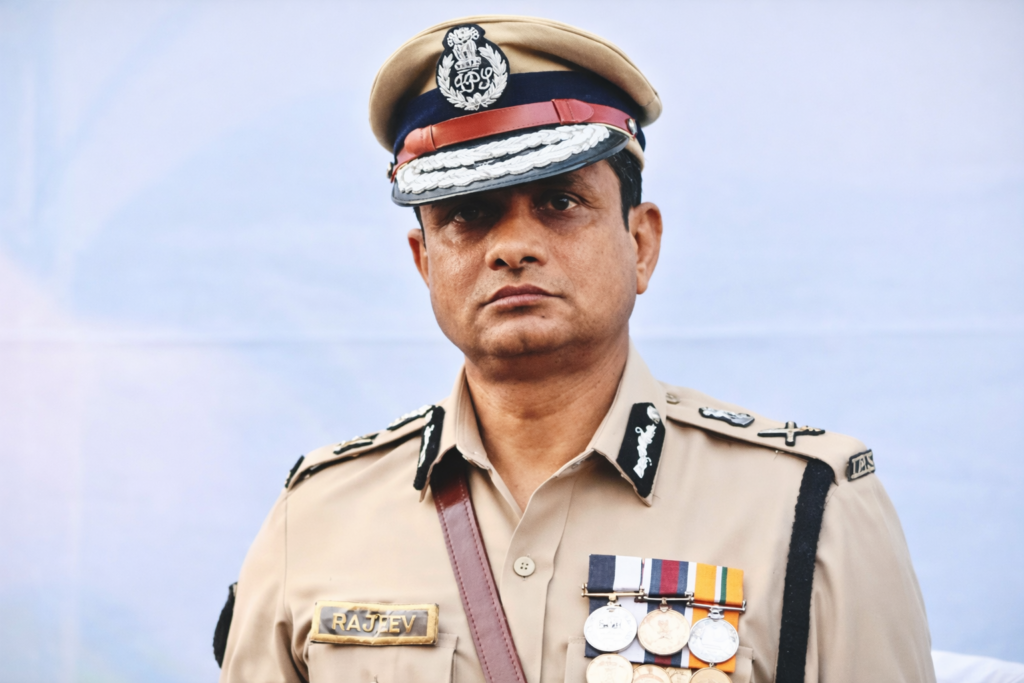
Bengal’s top cop, Rajeev Kumar, is once again at the centre of a national political and legal storm after the Enforcement Directorate (ED) sought his suspension just days before a scheduled Supreme Court hearing linked to the I-PAC search controversy. The move has revived a confrontation that has been unfolding for more than a decade, placing one of India’s most senior state police officers at the heart of a debate over investigative authority, federal balance, and the limits of administrative power.
While the ED has framed its plea as an institutional necessity aimed at preserving the integrity of an ongoing probe, the episode has increasingly come to symbolise a deeper concern within India’s governance structure: whether prolonged investigation, without adjudicatory finality, is being used as a pressure tool rather than a path to resolution.
The controversy has also reignited long-standing tensions between the Centre and the West Bengal government, with Chief Minister Mamata Banerjee openly defending Kumar and accusing central agencies of political targeting.
The Officer
Rajeev Kumar is a 1989-batch Indian Police Service officer of the West Bengal cadre, with more than three decades of service across intelligence, urban policing, and complex financial crime investigation. Over the years, he has held some of the most sensitive positions in the state police hierarchy, including Commissioner of Kolkata Police, head of the state police’s Special Investigation Team (SIT), and ultimately Director General of Police.
His rise to national prominence came during the investigation into the Saradha chit-fund scam, a massive financial fraud that affected thousands of depositors across West Bengal and neighbouring states. The scale of the scam, and its political ramifications, ensured that the investigation would be closely watched by both state and central authorities.
From the moment the Saradha probe entered the national spotlight, Kumar’s role became politically consequential, placing him at the intersection of law enforcement and high-stakes politics.
The Transfer
As head of the SIT, Rajeev Kumar supervised the initial Saradha investigation. The West Bengal government has consistently maintained that the SIT made arrests, froze assets, and prepared charge sheets before the Supreme Court ordered the transfer of the case to the Central Bureau of Investigation (CBI) in 2014, citing its interstate nature.
Central agencies have disputed this account, alleging delays, procedural lapses, and incomplete sharing of evidence. These allegations have been repeatedly raised in court filings over the years and continue to form the backbone of ongoing legal proceedings.
What remains undisputed, however, is that no court has returned a finding of guilt against Kumar in connection with these claims. Nor has any completed departmental inquiry established misconduct.
The Flashpoint
The conflict reached a dramatic peak in February 2019, when CBI officers attempted to question Rajeev Kumar at his official residence in Kolkata. The Kolkata Police intervened, citing procedural irregularities and lack of coordination, and briefly detained the CBI team.
The episode escalated rapidly into a constitutional and political confrontation. West Bengal Chief Minister Mamata Banerjee staged an unprecedented public sit-in protest in Kolkata, openly defending a serving police officer and accusing the Centre of misusing central investigative agencies to undermine the state government.
“They are using central agencies to harass officers who do not bow down,” Banerjee said at the protest site, framing the action against Kumar as an attack on federal principles and the autonomy of elected state governments.
The CBI, for its part, maintained that its officers were obstructed from performing their statutory duties.
The Supreme Court intervened within days. While directing Rajeev Kumar to cooperate with the investigation, it declined to authorise his arrest, custodial interrogation, or suspension- a restraint that would become a recurring reference point in later proceedings.
Political Undercurrents
Supporters of Rajeev Kumar have often pointed to earlier political frictions as context for the prolonged scrutiny he has faced. During the 2019 general election campaign, a controversy erupted over permissions related to the landing of Union Home Minister Amit Shah’s helicopter in West Bengal. State authorities cited security and protocol considerations, while opposition leaders alleged deliberate obstruction.
Although no court has established mala fide intent or wrongdoing in relation to that episode, Kumar’s name figured prominently in subsequent political narratives around it. Within the state administration, the incident is often cited as an example of how administrative decisions later became politicised, shaping perceptions of bias and vendetta.
Court’s Position
Since 2019, courts have neither convicted Rajeev Kumar nor issued findings establishing culpability. Judicial orders have criticised delays and emphasised the need for cooperation, but have consistently stopped short of endorsing coercive action such as arrest or suspension.
This prolonged legal limbo has persisted for years. Within policing circles, there is concern that scrutiny without closure risks becoming punitive by duration, particularly when the officer involved continues to hold a constitutional post.
ED’s Entry
Alongside the CBI’s proceedings, the Enforcement Directorate pursued money-laundering angles linked to Saradha and related financial probes. Over time, Kumar’s name surfaced repeatedly in ED affidavits, largely in connection with alleged non-cooperation during the SIT phase of the investigation.
The agency’s latest intervention followed searches conducted at the office of political consultancy I-PAC and the residence of its director. FIRs were subsequently registered by the West Bengal Police against ED officials, prompting the central agency to approach the Supreme Court alleging obstruction.
I-PAC Row
In January 2026, the Supreme Court stayed the FIRs registered against ED officials and issued notice to the West Bengal government and Chief Minister Mamata Banerjee. The Court agreed to examine the ED’s claim that its officers faced “wrongful restriction” during the searches.
It was against this backdrop that the ED sought Rajeev Kumar’s suspension, arguing that a serving Director General of Police under scrutiny undermines institutional integrity and could influence the course of investigation.
Suspension Demand
Suspending a Director General of Police is an extraordinary administrative step. Indian service law treats suspension as a serious measure, typically justified only when an officer’s continuance in office would directly impede justice or compromise evidence.
In its submission, the ED alleged that its officers faced “wrongful restriction” and that senior state officials had “compromised the agency’s ability to independently carry out its statutory duties.” The agency maintained that suspension should be viewed as an administrative safeguard rather than a declaration of guilt.
Supporters of Kumar counter that this threshold has not been met, pointing out that courts have repeatedly allowed him to remain in service while directing cooperation.
Election Timing
A recurring argument made by the West Bengal government relates to timing. Major investigative actions involving Rajeev Kumar, including summons, court filings, and suspension pleas have coincided with politically sensitive moments, particularly election cycles.
While this does not invalidate the legality of investigations, state officials argue that such sequencing reinforces perceptions of political pressure, especially in a polarised environment where law enforcement actions are closely scrutinised for motive.
The Pushback
Mamata Banerjee has been unequivocal in her defence of Rajeev Kumar. Responding to the ED’s actions linked to I-PAC, she said the raids were “an attempt to steal data and undermine our electoral strategy.”
When allegations were raised that she had interfered with the ED’s functioning, Banerjee dismissed them as a “blatant lie,” insisting that due process must prevail over administrative pressure. She has repeatedly stated that her government will stand by officers who act within the scope of law.
The Officer’s Stand
Rajeev Kumar has not made public political statements on the matter. His position has been articulated through legal submissions.
He has maintained that no court has found him guilty of evidence tampering or shielding accused individuals and that he complied with judicial directions to cooperate. Repeated suspension pleas, he argues, amount to punishment without adjudication.
The Larger Question
The case has sharpened focus on how senior police officers are treated while investigations remain pending. For policing institutions, the concern is that prolonged proceedings without resolution risk weakening command authority and discouraging independent decision-making.
For state governments, the issue is structural, touching on the balance between central investigative power and state autonomy.
What Next
The Supreme Court is expected to hear arguments on the ED’s suspension plea alongside the broader I-PAC-related proceedings. The court’s ruling will determine whether Rajeev Kumar continues in office or is required to step aside pending further investigation.
The outcome is likely to have implications beyond West Bengal, shaping how senior police officers are treated during ongoing probes.
Until then, Rajeev Kumar remains in office under scrutiny, but not convicted as the legal process moves forward!


