

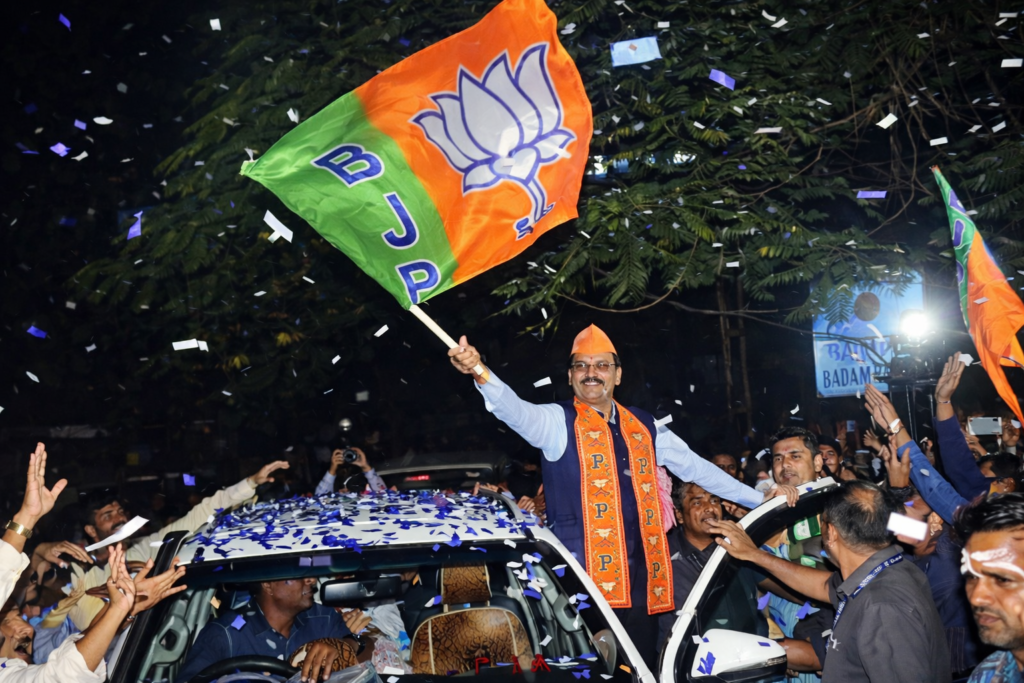
Mumbai’s civic politics has undergone its most significant transformation in a quarter of a century. The BJP-led Mahayuti alliance is set to take control of the Brihanmumbai Municipal Corporation (BMC), ending the Shiv Sena’s uninterrupted dominance of India’s richest municipal body since the late 1990s.
Counting of votes from the January 16 civic polls shows the Mahayuti coalition, comprising the Bharatiya Janata Party, the Eknath Shinde-led Shiv Sena, and Ajit Pawar’s faction of the Nationalist Congress Party, crossing the majority mark in the 227-member civic house. While the State Election Commission is yet to formally notify all ward results, trends across major counting centres point to a decisive shift in Mumbai’s urban power structure.
BMC Results Snapshot
As counting progressed through multiple rounds on Thursday, the Mahayuti alliance was leading in approximately 119 wards, comfortably above the halfway mark of 114 required to control the BMC. The BJP emerged as the single largest party, leading in between 80 and 98 wards at various stages of the count, depending on the completion of individual rounds.
The opposition bloc, led primarily by the Shiv Sena (Uddhav Balasaheb Thackeray) faction and supported in parts by the Maharashtra Navnirman Sena, trailed with roughly 65 to 75 seats. The Congress remained confined to a limited footprint, winning or leading in the low teens.
Although several wards remained under verification during late rounds due to routine counting clarifications, election officials indicated that the overall trend was unlikely to change.
Why the BMC Matters
The Brihanmumbai Municipal Corporation is not just another civic institution. With an annual budget exceeding that of several Indian states, the BMC controls Mumbai’s roads, drainage networks, hospitals, public schools, solid waste systems, coastal infrastructure, and redevelopment permissions.
Control of the BMC has historically translated into sustained political influence in Mumbai, allowing the ruling party to shape local governance, build grassroots networks, and maintain long-term visibility in the city. For decades, this role was fulfilled by the Shiv Sena, which built its organisational strength around municipal politics.
The 2026 result marks the first time since the late 1990s that a non-Sena formation is positioned to command a clear majority in the civic body.
A Long-Delayed Election
The scale of the political shift is amplified by the long delay preceding these polls. The previous BMC election was held in 2017, with the next due in 2022. However, the civic body remained under administrative control for nearly four years due to disputes over ward delimitation, reservation policies, and legal challenges.
This prolonged gap weakened traditional incumbency advantages and turned the election into a referendum on alliance politics rather than individual corporator legacies. When voting finally took place on January 16, turnout stood at approximately 52.94 percent, one of the higher participation rates seen in Mumbai’s civic elections since the early 1990s.
BJP’s Mumbai Breakthrough
The BJP’s performance represents a structural breakthrough in Mumbai. While the party has been a major force in Maharashtra for over a decade, it had previously struggled to translate its state-level dominance into full civic control of the BMC.
This time, the BJP not only consolidated its traditional middle-class and urban voter base but also made inroads into several wards that had long been considered Shiv Sena strongholds. Party candidates registered leads in central and western suburban belts, as well as select working-class areas where contests had historically been tightly fought.
Political analysts tracking the count noted that the BJP’s ward-level organisation, combined with alliance seat-sharing, prevented vote fragmentation and maximised conversion rates.
Impact of the Shiv Sena Split
The division of the Shiv Sena proved decisive in reshaping Mumbai’s civic map. For decades, the party’s unified structure allowed it to dominate local elections through a strong network of shakhas and corporators.
The split between the Uddhav Thackeray faction and the Eknath Shinde faction fractured this network. While both factions retained loyal vote banks, neither was able to independently replicate the consolidated strength of the undivided Sena.
By aligning with the BJP, the Shinde faction ensured that anti-UBT votes were not dispersed, while the Thackeray faction faced the challenge of defending legacy turf without the benefit of incumbency or administrative control.
Opposition’s Limited Recovery
The opposition attempted consolidation through tactical understandings in select wards, particularly between Shiv Sena (UBT) and the MNS. While this strategy narrowed margins in parts of Mumbai, it did not produce enough wins to offset the Mahayuti’s broader momentum.
Congress leaders acknowledged that the party lacked organisational depth in Mumbai compared to earlier decades, limiting its ability to influence the overall result despite isolated ward-level successes.
Several opposition leaders also raised procedural concerns during counting, though election officials stated that these did not affect aggregate outcomes.
Statewide Civic Pattern
Mumbai’s result mirrors a wider trend across Maharashtra. On the same counting day, the Mahayuti alliance was leading in 26 of the state’s 29 municipal corporations, including key urban centres such as Pune, Thane, Nashik, Pimpri-Chinchwad, and Nagpur.
The consistency of results across cities suggests a broader urban consolidation behind the ruling alliance rather than a Mumbai-specific anomaly. For the state government, this provides political reinforcement at a time when municipal governance and urban infrastructure are under increasing public scrutiny.
Counting Process and Oversight
Vote counting began at 10 am across 23 designated centres in Mumbai under tight security and supervision by the State Election Commission. Officials reported minor delays in some wards due to verification checks and electronic display issues, but said these were resolved through standard procedures.
Election authorities reiterated that all results would be formally notified only after completion of ward-wise verification and certification.
Political Reactions
Chief Minister Devendra Fadnavis welcomed the emerging trends, describing the civic results as a mandate for stability and governance in Maharashtra’s cities. In a brief comment during counting, he said the verdict reflected public trust in the Mahayuti’s urban development agenda.
On the opposition side, Shiv Sena (UBT) leaders questioned aspects of the electoral process. Party chief Uddhav Thackeray criticised the Election Commission during the voting phase, saying, “The Constitution says vote, but the Election Commission says prove it,” a remark that underscored opposition unease rather than altering the result narrative.
Beyond these statements, senior leaders from both camps largely refrained from extended commentary, awaiting formal declaration of results.
What Changes Now
If the final notification confirms current trends, the Mahayuti alliance will gain control of the BMC’s general body and key committees, including the powerful Standing Committee that oversees budgetary decisions.
This is expected to influence priorities in infrastructure spending, coastal protection projects, road development, and public health facilities. While the municipal commissioner retains executive authority, political control of the house shapes agenda-setting and long-term planning.
The result also recalibrates Mumbai’s political symbolism. For decades, control of the BMC was synonymous with Shiv Sena’s identity. That equation has now been decisively altered.
Final Result Awaited
As of late Thursday evening, the State Election Commission had not issued a complete official notification of all 227 ward results. However, with the Mahayuti alliance crossing the majority threshold in trends and leading by a clear margin, the outcome is widely regarded as settled.
Once formally declared, the 2026 BMC election will be recorded as a turning point in Mumbai’s civic history, marking the end of one political era and the beginning of another.


