

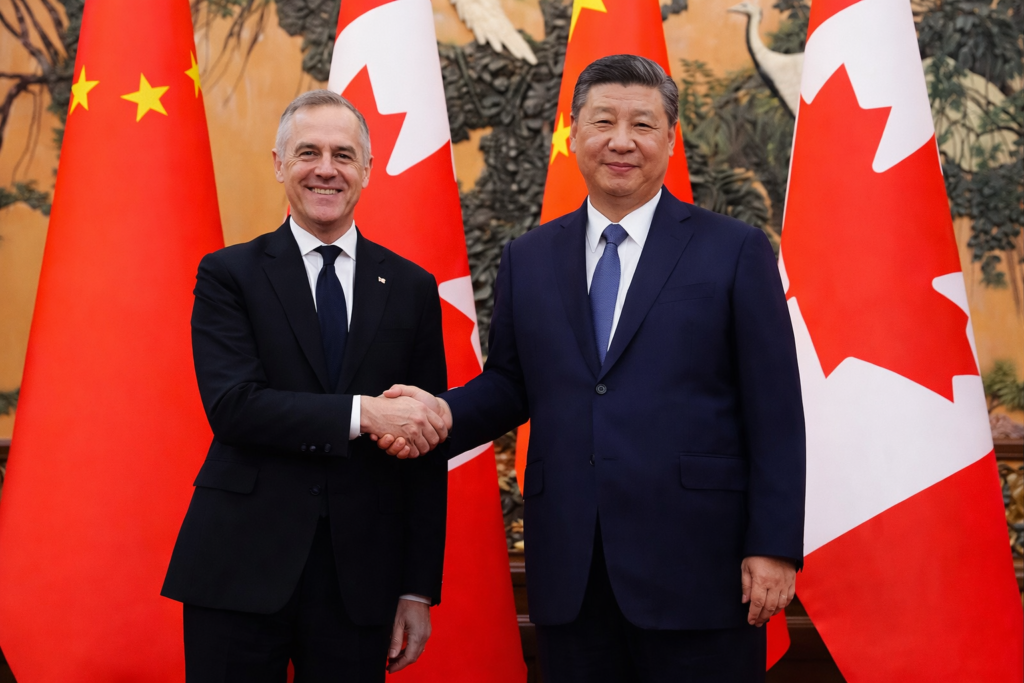
Canada and China have announced a strategic partnership aimed at rebuilding trade and diplomatic ties after years of tension, marking the most significant shift in relations between the two countries since 2017.
The agreement was unveiled in Beijing on 16 January following talks between Canadian Prime Minister Mark Carney and Chinese President Xi Jinping. It includes commitments to ease trade restrictions, restore formal dialogue mechanisms and expand cooperation across sectors ranging from agriculture and energy to finance, public safety and cultural exchanges.
Carney’s four-day visit to China is the first by a Canadian prime minister in nearly nine years and comes amid growing uncertainty in global trade and geopolitics.
First visit in nearly a decade
Relations between Ottawa and Beijing have been strained for much of the past decade, shaped by diplomatic disputes, retaliatory trade measures and a prolonged breakdown in high-level engagement.
Ties deteriorated sharply after 2018, when Canada detained Huawei executive Meng Wanzhou at the request of the United States. China responded by detaining two Canadian citizens, who were later released. Subsequent disagreements over trade, security and foreign policy led to the suspension of many bilateral dialogue mechanisms.
High-level political contact became rare, and trade relations worsened as tariffs were imposed on agricultural products and electric vehicles.
Officials on both sides now describe the Beijing meetings as a reset intended to stabilise relations rather than resolve all outstanding differences.
Framework rather than treaty
The strategic partnership announced in Beijing is not a single trade agreement but a broad framework governing future cooperation.
According to official readouts, it covers trade and investment, energy cooperation, financial coordination, law enforcement, food safety, tourism and cultural exchanges. Several memoranda of understanding were signed during the visit to support these areas.
The framework restores ministerial dialogues, joint commissions and working groups that had largely fallen dormant during years of diplomatic strain. Officials said these mechanisms are intended to manage disputes and reduce the risk of escalation.
Electric vehicle tariffs reduced
One of the most immediate outcomes concerns electric vehicles.
Canada has agreed to roll back its effective 100 percent tariff on Chinese electric vehicles and replace it with a quota-based system. Under the arrangement, up to around 49,000 Chinese-made EVs will be allowed into the Canadian market each year at Canada’s standard most-favoured-nation tariff rate of about 6.1 percent.
The quota is expected to rise gradually to approximately 70,000 vehicles within five years.
Canadian officials said the volume reflects import levels before trade tensions escalated and represents a small share of Canada’s overall vehicle market. The move marks a notable shift in Canada’s trade posture and contrasts with the more restrictive approach taken by the United States and some other Western economies.
China eases farm trade barriers
In return, China has committed to easing restrictions on several Canadian agricultural exports.
The most significant change affects canola seed, one of Canada’s largest exports to China before relations deteriorated. Combined tariffs, which had reached about 85 percent, are expected to fall to roughly 15 percent by 1 March.
Chinese authorities also indicated that tariffs on canola meal, lobster, crab and peas would be eased or suspended through at least the end of 2026.
For Canadian farmers, the measures restore access to a key market that had been largely closed during the trade dispute.
Energy cooperation resumes
Energy cooperation forms another core pillar of the partnership.
Canada and China agreed to restart collaboration on clean energy technologies, including renewables, battery storage, solar and wind power. The framework also includes cooperation on conventional energy such as oil and gas development, as well as civil nuclear energy and natural uranium trade.
A new ministerial-level energy dialogue will be established to oversee cooperation, investment flows and technical exchanges.
Energy ties between the two countries had slowed significantly during the period of diplomatic strain despite Canada’s role as a major energy producer.
Financial links strengthened
The partnership also includes measures aimed at stabilising financial relations.
Canada and China agreed to extend and amend their bilateral currency swap arrangement between the Bank of Canada and the People’s Bank of China. The facility is designed to support trade settlement and reduce risk in cross-border transactions.
A new Canada–China financial working group will be created under the existing economic and financial strategic dialogue framework.
Officials said the steps would help facilitate commercial activity during periods of global economic volatility.
Law enforcement cooperation
Despite ongoing political sensitivities, the agreement includes renewed cooperation on public safety.
The two countries signed a memorandum of understanding on combating transnational crime, including cyber-enabled fraud, telecom scams and the trafficking of illicit synthetic drugs.
Law enforcement working groups that had been suspended during the diplomatic downturn are expected to resume operations in the coming months.
Canadian officials said cooperation would focus on criminal activity and shared risks rather than broader security alignment.
Cultural and travel exchanges
The partnership also seeks to revive people-to-people engagement.
Canada and China agreed to restart their joint committee on culture and expand cooperation in education, arts and creative industries. A separate letter of intent was signed between Destination Canada and China Media Group to promote tourism.
Canadian officials said Beijing had also indicated plans to ease travel restrictions for Canadians, though no formal timeline has been announced.
Tourism and educational exchanges had declined sharply during years of strained relations.
Official tone cautious
Speaking after the meeting, Carney framed the agreement as part of a broader effort to stabilise international cooperation.
“The relationship will not only deepen our bilateral ties to the benefit of our peoples but will also help strengthen the multilateral system,” he said, according to an official Canadian statement.
Chinese state media quoted Xi Jinping as saying a stable Canada–China relationship served the interests of both countries and contributed to global peace and stability.
Strategic calculations
The reset comes as Canada seeks to diversify its trade relationships.
The United States accounts for roughly three-quarters of Canadian exports, while China represents less than four percent. Recent trade uncertainty with Washington has reinforced Ottawa’s push to expand engagement with other major economies.
For China, improving ties with Canada offers an opportunity to stabilise relations with an advanced economy at a time of heightened global tensions and slowing growth.
Domestic scrutiny expected
The partnership is expected to face close scrutiny within Canada.
Opposition politicians and labour groups have raised concerns about competition from Chinese electric vehicles and the impact on domestic manufacturing. The government has said the quota system and regulatory oversight will limit disruption.
Officials have also acknowledged that public confidence in China remains cautious after years of diplomatic strain.
Implementation phase begins
Attention now turns to implementation.
Agricultural tariff reductions are expected to take effect by early March. Detailed rules governing electric vehicle imports are still being finalised. Joint committees and working groups are expected to reconvene in the coming months.
Carney is scheduled to return to China later this year for the Asia-Pacific Economic Cooperation leaders’ summit in Shenzhen, indicating that engagement is expected to continue.
A cautious reopening
The Beijing announcement does not resolve all outstanding issues between Canada and China. Instead, it restores formal engagement and establishes a framework for managing economic relations after years of limited contact.
For now, it represents the clearest signal in nearly a decade that both governments are seeking to place the relationship on a more stable footing.


