

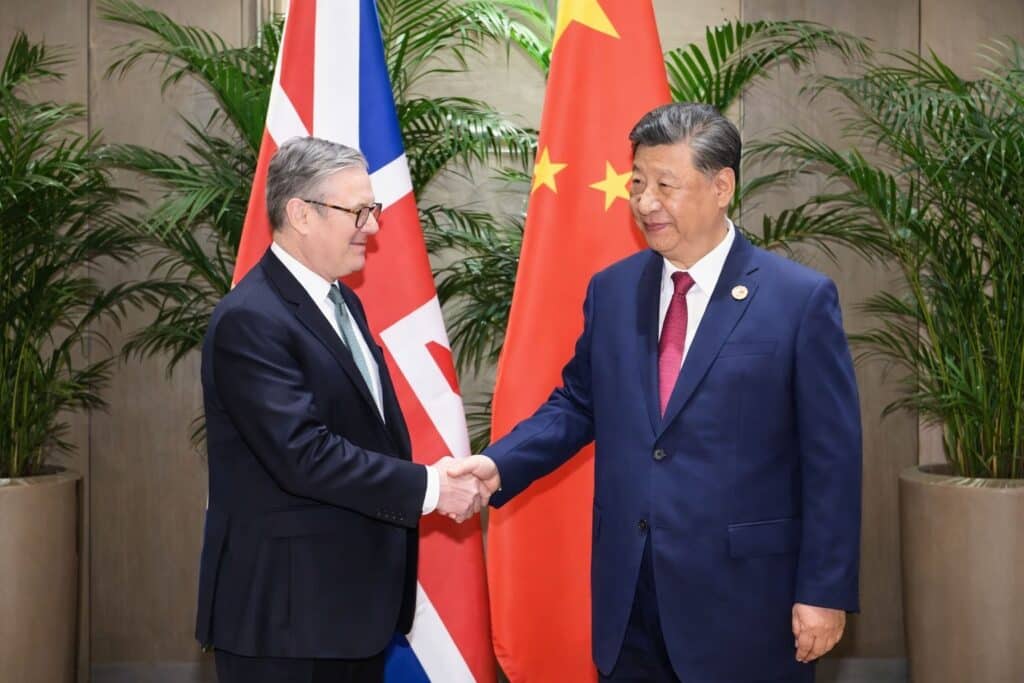
British Prime Minister Keir Starmer met Chinese President Xi Jinping in Beijing in the first visit by a UK leader to China since 2018. The summit marks a significant attempt to reset UK–China relations after years of tension over security concerns, human rights, and political mistrust.
Officials from both sides described the talks as a pragmatic reset aimed at restoring structured engagement. The meeting comes amid global uncertainty, including the Ukraine war, slowing economic growth, and intensifying US–China rivalry.
Strategic tone of the talks
Starmer called China a “vital player on the global stage”, adding that Britain must maintain a “more sophisticated relationship” while being clear-eyed about security risks. He said, “We will be clear-eyed…without compromising our national security or values.”
Xi Jinping highlighted the long-term importance of cooperation, stating the relationship should “withstand the test of history”. Xi urged both nations to “strengthen dialogue and cooperation to bring stability to the world”, emphasizing the geopolitical significance of UK–China coordination.
Trade and economic outcomes
Economic matters dominated the talks. China agreed to reduce tariffs on Scotch whisky from 10 percent to 5 percent, which officials said could generate hundreds of millions of pounds in export revenue over the next five years.
China also introduced a visa-free entry policy allowing UK citizens to stay up to 30 days, aimed at increasing tourism, business travel, and cultural exchange.
AstraZeneca announced a multibillion-dollar expansion of its operations in China, signaling continued confidence in China’s healthcare market. Starmer was accompanied by a delegation of British business leaders from pharmaceuticals, finance, technology, manufacturing, and creative industries, underscoring the economic focus of the visit.
Business and services agreements
Both governments signed deals to expand services trade, financial cooperation, education partnerships, regulatory alignment, and intellectual property protections. British officials emphasized efforts to boost financial services exports, strengthen life sciences collaboration, and facilitate digital trade.
China committed to increasing imports of British goods and maintaining a stable environment for UK businesses operating domestically. Officials described the agreements as aimed at creating predictability and reducing trade barriers.
Migration and law enforcement cooperation
The UK secured Chinese support on migration enforcement and efforts to dismantle criminal networks involved in illegal migration, particularly those facilitating crossings of the English Channel. This includes measures to limit the supply of small boat engines, which have been identified as a critical tool used by traffickers.
Both sides agreed to enhance intelligence-sharing on organized crime and smuggling networks, covering not only migration channels but also human trafficking, financial networks, and the logistics of cross-border criminal operations. UK officials emphasized that this cooperation represents a significant step in bilateral law enforcement collaboration, aiming to improve border security, disrupt criminal enterprises, and reduce the risk of illegal migration incidents. Chinese authorities highlighted their commitment to supporting international efforts to combat transnational crime, framing it as part of broader cooperation in maintaining regional stability and security.
Ukraine and global security
Ukraine and global security was a key topic during the talks. Starmer pressed China to encourage de-escalation in the conflict, highlighting the impact on European stability and global energy supplies. UK officials framed China as a potential mediator that could influence Russia’s calculus, though Beijing reiterated its stance favoring political negotiation over intervention.
Xi emphasized China’s commitment to diplomatic solutions, stating that the international community should “promote peace through dialogue, not confrontation.” Both leaders discussed the broader implications of the Ukraine war, including sanctions regimes, food security, and the risk of wider geopolitical instability in Europe and Asia. Analysts say the discussions underline the UK’s strategy to engage China as a global actor, capable of affecting conflicts beyond bilateral matters.
Human rights discussions
Human rights remained a delicate but prominent part of the talks. Starmer raised concerns over Hong Kong, particularly the detention of British citizen Jimmy Lai, and broader issues in Xinjiang. UK officials described the conversation as direct and respectful, emphasizing Britain’s commitment to rule of law and individual freedoms.
China reiterated that such matters fall under domestic jurisdiction and rejected external interference. Xi argued that criticisms over Hong Kong and Xinjiang represent misunderstandings of China’s legal framework. Despite the disagreement, both sides agreed to maintain ongoing dialogue on these issues, signaling an attempt to balance principle with diplomacy.
National security measures
Starmer made clear that the UK would continue strict oversight of Chinese investments in strategically sensitive sectors, including telecommunications, critical infrastructure, and emerging technologies. He stated, “We will always put our national security first,” emphasizing that economic engagement will not compromise strategic independence.
Officials said enhanced screening mechanisms for foreign investment and increased scrutiny over technology transfers would remain in place. The UK also intends to monitor collaborations in sectors such as quantum computing, artificial intelligence, and telecoms to prevent potential security vulnerabilities. The measures were presented as part of a coordinated approach to engage economically without compromising national safety.
Diplomatic symbolism
The visit carried high symbolic significance, with meetings held at Beijing’s Great Hall of the People, signaling the highest level of diplomatic recognition. Xi referenced the historical relationship between the UK and China and portrayed Starmer’s visit as a return to pragmatic engagement.
The leaders also engaged in soft diplomacy, including exchanges on culture, education, and sporting collaborations, aimed at humanizing bilateral relations. UK officials highlighted these gestures as a complement to concrete economic and strategic agreements, reinforcing that the reset extends beyond policy to broader bilateral engagement.
Possible Xi visit to the UK
Starmer expressed openness to a future state visit by Xi to the UK, which could further normalize high-level relations. Critics in Britain have raised concerns about security, human rights, and the political optics of hosting China’s president. Supporters argued that such a visit would support trade, diplomacy, and strategic dialogue.
Government sources emphasized that any visit would be carefully managed and conditional on progress in economic and security agreements. A potential Xi visit is seen as a test of whether the bilateral reset can produce sustained engagement at the highest levels.
International reaction
The summit drew strong international attention, particularly from Washington. Former US President Donald Trump warned that closer UK–China ties are “very dangerous”, reflecting broader US concerns over Beijing’s growing global influence. Analysts suggest the US will closely monitor any UK initiatives to deepen trade or investment links with China.
Other Western countries are also recalibrating their China policies. Germany, Canada, and several EU members have signaled renewed engagement, even as Washington advocates for a more confrontational stance toward Beijing. The reactions underline the geopolitical implications of the Xi–Starmer talks, with both economic and security consequences for transatlantic alliances.
Power politics
The summit demonstrates evolving global power dynamics. Britain seeks to diversify partnerships while staying anchored in Western security structures, while China leverages economic diplomacy to expand influence, counterbalance US pressure, and reinforce its global standing.
The reset illustrates a trend toward strategic autonomy among middle powers, which increasingly prefer flexible alliances rather than strict alignment with either Washington or Beijing. Officials said agreements on trade, investment, and security cooperation are intended to be practical and measurable.
Hard outcomes
Officials expect tangible results in the short term, including tariff reductions, expanded visa access, and corporate investment growth. Cooperation on migration enforcement and organized crime is expected to deliver measurable domestic benefits. Agreements on services trade, regulatory alignment, and intellectual property aim to enhance market predictability and business confidence.


