

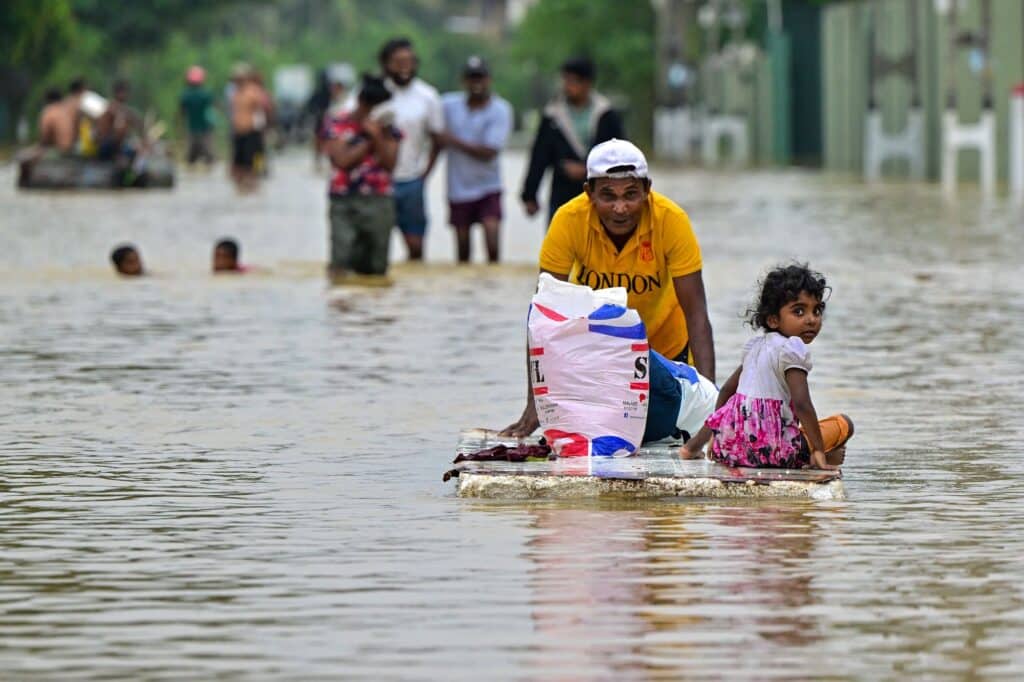
Cyclone Ditwah has triggered one of the worst humanitarian disasters Sri Lanka has faced in decades, unleashing catastrophic floods, deadly landslides and widespread destruction. The death toll has crossed 330, with hundreds still missing, and entire communities cut off for days. As rescue teams struggle to reach isolated districts, the true scale of the tragedy becomes clearer. India has stepped in with a major relief mission, launching Operation Sagar Bandhu to deliver essential supplies and urgent assistance as Sri Lanka’s response system strains under pressure.
The cyclone brought relentless rainfall that battered both the central highlands and low lying areas. Rivers overflowed within hours, swallowing homes and triggering massive mudslides that destroyed everything in their path. Several districts became inaccessible, forcing authorities to use helicopters and boats to reach stranded families. More than 11 lakh people from over three lakh families have been affected, overwhelming temporary shelters where survivors lack clean water, medicine and food.
Scenes of Widespread Destruction
In the worst hit regions, survivors describe scenes that resemble a war zone. Entire neighbourhoods have been buried under mud, and rescue teams continue to uncover bodies from unstable terrain. Medical officers warn that the casualty numbers may rise because several landslide prone areas remain too dangerous to approach. Families spend hours outside relief centres, desperate for any information about their missing loved ones.
Damage to infrastructure is extensive. Roads have collapsed, rail lines are twisted, bridges washed away and power lines severed across several provinces. The cyclone disrupted communications for hours, delaying early rescue operations and complicating relief coordination.
Operation Sagar Bandhu
As the crisis deepened, India launched the high priority humanitarian mission known as Operation Sagar Bandhu. The mission underscores India’s role as a first responder in the Indian Ocean region and reflects its commitment to supporting neighbouring countries during large scale emergencies.
The Indian Navy delivered food rations, drinking water units, medical kits, tents, blankets and other emergency supplies. One naval vessel carried over twelve tons of relief material in a single shipment. The Indian Air Force deployed heavy lift aircraft carrying essential supplies and rescue specialists trained in handling collapsed structures and complex emergencies. Helicopters evacuated stranded residents, including children, pregnant women and the critically injured, from regions cut off by flooding and landslides.
Rescue Teams on the Ground
To reinforce Sri Lanka’s overwhelmed rescue effort, India deployed eighty specialised personnel from the National Disaster Response Force. These teams are working shoulder to shoulder with Sri Lanka’s armed forces to clear debris, stabilise damaged structures, locate survivors and run medical camps. Indian doctors have set up mobile medical units inside shelters to treat injuries and prevent waterborne diseases, which pose a major risk due to damaged sanitation systems.
Sri Lankan authorities have praised India’s rapid response, noting that Indian teams have helped reach regions that were previously inaccessible. Volunteers say the additional manpower and resources have stabilised conditions in shelters and restored hope for many affected families.
Heavy Economic Losses
Beyond the immediate loss of life, Cyclone Ditwah has caused immense economic damage. Vast stretches of farmland have been destroyed, including tea estates, vegetable farms and paddy fields. Fishing communities have lost boats and equipment essential for their livelihoods. Urban areas face extensive rebuilding challenges, with drainage systems damaged, public buildings destroyed and power infrastructure weakened. The financial burden arrives at a difficult time for Sri Lanka and threatens to slow the recovery process unless significant international support is mobilised.
Impact on India’s Coast
After devastating Sri Lanka, the cyclone weakened into a deep depression as it moved northward but still brought intense rainfall to Tamil Nadu and parts of Andhra Pradesh. Coastal belts experienced localised flooding, strong winds and crop damage. Authorities in India issued alerts, suspended flights and activated disaster response teams to reduce risks and prepare for further rainfall.
Climate Warning Signs
Climate experts warn that Cyclone Ditwah is another sign of increasingly intense and fast forming cyclones in the Bay of Bengal. Rising sea surface temperatures and shifting monsoon patterns are fuelling storms with greater rainfall and stronger winds. Scientists emphasise the need for climate resilient infrastructure, stronger early warning systems and strict adherence to land use planning to prevent future disasters.
A Long Road to Recovery
For Sri Lanka, the road ahead is long and difficult. Families continue to search for missing relatives. Villages must be rebuilt and thousands of people need help finding new places to live. Relief camps are working continuously to support survivors who have lost homes, belongings and livelihoods. One woman in a shelter said her family escaped with their lives but now must rebuild from nothing.
Cyclone Ditwah stands as a painful reminder of the growing threat of extreme weather, the vulnerabilities faced by coastal and highland communities and the urgent need for preparedness across the region. With coordinated support and sustained rebuilding efforts, Sri Lanka hopes to emerge from one of the darkest disasters in its recent memory.


