

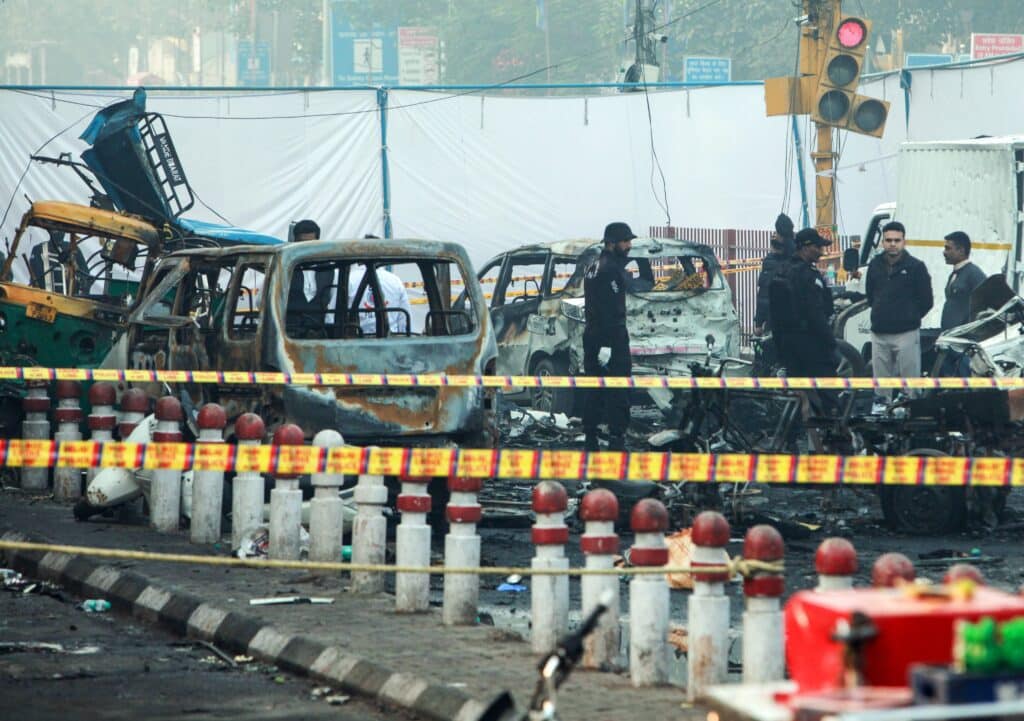
NEW DELHI — A devastating car bomb explosion near Delhi’s iconic Red Fort on Monday evening has claimed 13 lives and left over two dozen injured in what authorities are now confirming as a Jaish-e-Mohammad-orchestrated terror attack. The blast, which ripped through a crowded traffic junction during evening rush hour, has exposed a sprawling terror network spanning multiple states and international borders.
The Attack: Three Hours of Terror
At 6:52 p.m. on Monday, November 10, a white Hyundai i20 carrying ammonium nitrate explosives detonated near Gate No. 1 of the Red Fort Metro Station, creating a fireball that engulfed surrounding vehicles and sent shockwaves through the heart of India’s capital. The explosion occurred at a red light on Subhash Marg, one of Delhi’s busiest thoroughfares.
CCTV footage has revealed chilling details: the vehicle entered a parking area near Sunehri Masjid at 3:19 p.m. and remained stationary for three hours. The driver, identified by investigators as Dr. Umar Mohammad from Pulwama, reportedly stayed inside the vehicle throughout this period before departing at 6:48 p.m.—just minutes before the massive blast.
Eyewitnesses described scenes of horror. “We heard a big sound. Our windows shook,” one resident told media. “When we came near, we saw body parts scattered on the road. No one could figure out what happened.” An ambulance driver reported finding bodies in pieces, requiring emergency responders to collect remains from across the blast site.
The Suspected Bomber: Dr. Umar Mohammad
Investigators have identified Dr. Umar Mohammad, a 36-year-old physician from Pulwama employed at Al-Falah Medical College in Faridabad, as the suspected suicide bomber. Born on February 24, 1989, Mohammad was allegedly part of a sophisticated “white-collar” terror module linked to Jaish-e-Mohammad.
According to police sources, Mohammad panicked after learning about the arrest of his associates earlier that day and executed what authorities believe was a fidayeen-style suicide attack. Initial forensic analysis suggests he used Ammonium Nitrate Fuel Oil (ANFO) a powerful explosive compound combined with detonators to carry out the attack.
The vehicle’s ownership trail reveals a complex chain designed to mask its true purpose: originally registered to Mohammad Salman in Gurugram, the car passed through multiple hands-Devender, Royal Car Zone in Faridabad, plumber Aamir Rashid Mir, and security guard Tariq Malik before reaching Dr. Mohammad. DNA testing is currently underway on remains recovered from the vehicle to confirm the bomber’s identity.
The Faridabad Connection: Bust of Major Terror Module
Hours before the Delhi blast, in what now appears to be a directly connected operation, Jammu & Kashmir Police in coordination with Haryana authorities dismantled a major interstate terror module in Faridabad. The operation resulted in eight arrests, including three medical professionals, and the seizure of approximately 2,923 kg of ammonium nitrate explosives, assault rifles, pistols, 91 live cartridges, multiple magazines, timers, walkie-talkies, and other bomb-making equipment.
Key arrests:
- Dr. Muzammil Ahmad Ganie (Pulwama), employed at Al-Falah Hospital, Faridabad
- Dr. Adil Ahmad Rather (Kulgam), formerly at Government Medical College, Anantnag, working at Famous Medicare Hospital, Saharanpur
- Dr. Shaheen Shahid (Lucknow), who allegedly provided logistical support
Intelligence sources have revealed that Dr. Shaheen Shahid played a pivotal role far beyond logistics. She is now identified as the leader of Jamaat-ul-Mominat– the women’s wing of Jaish-e-Mohammad in India. Employed at Al-Falah University, Dr. Shahid allegedly worked under the command of Sadia Azhar, sister of Jaish chief Masood Azhar, who oversees the wing from Pakistan.
During searches of Dr. Shahid’s vehicle, authorities recovered an assault rifle. Her arrest marks a major breakthrough, exposing JeM’s strategy of establishing female recruitment networks on Indian soila development that represents a significant tactical evolution for the Pakistan-based terror outfit.
Gujarat’s Ricin Plot: Parallel Terror Threat Neutralized
In a chilling development exposing the expanding scope of terror tactics, the Gujarat Anti-Terrorist Squad (ATS) arrested three men on November 7 for plotting a bioterror attack using ricin, one of the world’s deadliest toxins. The accused Dr. Ahmed Mohiyuddin Saiyed, a Hyderabad-based doctor, and Uttar Pradesh residents Azad Suleman Sheikh and Mohammad Suhail Mohammad Saleem — were caught near Adalaj in Gandhinagar. Authorities seized two Glock pistols, a Beretta pistol, 30 live cartridges, and four liters of castor oil, used to extract ricin.
ATS DIG Sunil Joshi said Dr. Saiyed had already begun the chemical process to synthesize the toxin and had conducted reconnaissance in Lucknow, Delhi, and Ahmedabad. Their handler, Abu Khadija, an ISKP operative based in Afghanistan, was reportedly coordinating with Pakistan-based contacts. The group planned to poison public water and temple offerings in Delhi and Lucknow, potentially killing hundreds. Investigators say the accused also received drone-delivered weapons from across the Pakistan border, marking a dangerous shift toward bio-terror tactics designed to cause mass panic.
Kashmir Crackdown: Pre-Emptive Strike Against Terror Networks
Just hours before the Delhi blast, the Jammu and Kashmir Police launched a major crackdown across nearly ten districts of the Valley, detaining over 100 people and raiding more than 70 locations over two days. The operation targeted Over Ground Workers (OGWs), relatives of militants residing in Pakistan or Pakistan-occupied Kashmir (PoK), former members of banned outfits, and suspected sympathizers of terror groups.
In Baramulla, police raided 23 OGW locations, searched 16 properties linked to Pakistan-based Kashmiris, and detained 31 individuals under preventive laws. Teams also inspected SIM card vendors to ensure proper verification during 32 simultaneous cordon-and-search operations.
In Budgam, officers searched the ancestral home of US-based Kashmiri leader Dr. Ghulam Nabi Fai, while in Shopian, raids targeted the network of UK-based terror handler Muzamil Ayoob. In Anantnag, security forces searched the homes of Pakistan-based militants, including senior Hizbul Mujahideen commander Ghulam Nabi Khan (Amir Khan), and in Kulgam, eight relatives of Jammu and Kashmir Nationals Operating from Pakistan (JKNOPs) were detained. Similar operations were also conducted in Ramban, Kishtwar, Doda, Kathua, Reasi, Poonch, and Rajouri districts.
A senior police officer described the crackdown as a “pre-emptive measure” to weaken militant support networks. The timing just hours before the Red Fort blast suggests that agencies had credible intelligence of a possible terror plot, though the attack could not be prevented.
Investigation and Response
The Delhi Police have invoked India’s primary counterterrorism law, registering a case under Sections 16 and 18 of the Unlawful Activities (Prevention) Act (UAPA) along with provisions of the Explosives Act, confirming that authorities are treating the explosion as an act of terrorism.
A massive investigative task force of over 500 personnel has been formed, comprising officers from the National Investigation Agency (NIA), National Security Guard (NSG), Intelligence Bureau (IB), Delhi Police Special Cell, and the Forensic Science Laboratory (FSL). Investigators have collected more than 100 CCTV recordings from nearby roads, toll plazas, and intersections to trace the vehicle’s complete route from Faridabad to Delhi via the Badarpur border.
Home Minister Amit Shah visited both the blast site and Lok Nayak Hospital, assuring a thorough and impartial investigation. He stated that “all possibilities are being examined, and those behind this heinous act will be brought to justice.”
Prime Minister’s Response
Speaking from Bhutan, where he is on an official visit, Prime Minister Narendra Modi vowed to bring those responsible to justice. “The horrific incident that took place in Delhi yesterday evening has deeply saddened everyone. I was in touch with all the agencies investigating this incident throughout last night. Our agencies will get to the bottom of this conspiracy. All those responsible will be brought to justice.”
Defence Minister Rajnath Singh echoed this sentiment: “The findings of the investigation will soon be made public. I want to firmly assure the nation that those responsible for this tragedy will be brought to justice and will not be spared under any circumstances.”
International Reactions and Security Measures
The blast triggered international concern, with the United States and United Kingdom issuing travel advisories and security alerts. Egypt extended condolences, while the U.S. embassy released a security alert stating: “On Nov. 10, a car exploded near the Lal Quila (Red Fort) metro station in central Delhi, India, with local media reporting multiple casualties.”
In response to the attack:
- The Red Fort monument has been closed until November 13
- Lal Qila Metro Station remains shut
- Security forces have been placed on high alert across Delhi, Mumbai, and neighboring states
- Uttar Pradesh has been placed on red alert, with the DGP directing all districts to tighten security at religious sites, sensitive areas, and state borders
- Massive search operations were conducted across hotels in Paharganj, Daryaganj, and nearby areas, with four individuals taken into custody for questioning
Casualties and Impact
The death toll currently stands at 13, with over 25 individuals injured, many in critical condition. Among the deceased is Ashok Kumar, a DTC bus conductor from Uttar Pradesh’s Amroha, who was the sole breadwinner for his family and was returning home after finishing his duty.
The blast site, located in a densely populated area of Old Delhi near the historic Red Fort, is a major tourist hub known for crowded bazaars and street vendors. The area serves as a critical intersection linking the Red Fort with the bustling Chandni Chowk Market, where the impact was felt extensively.


Very well explained!