

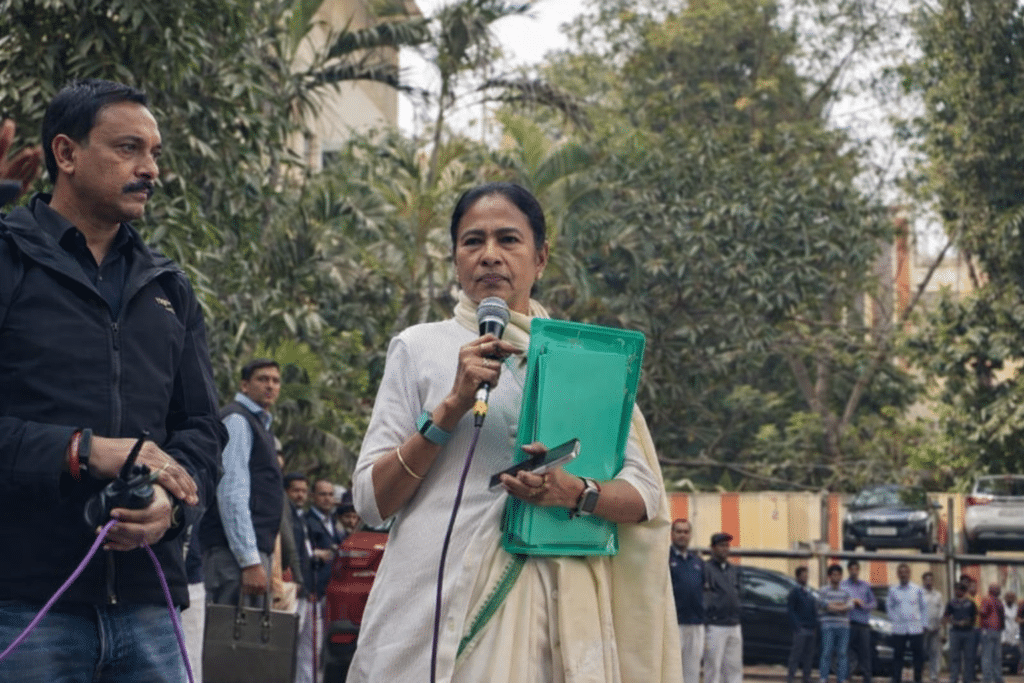
The Enforcement Directorate has found itself at the centre of a sharp political and legal confrontation in West Bengal after conducting a series of searches linked to a long-running coal smuggling investigation, prompting an unusual public intervention by Chief Minister Mamata Banerjee.
The episode escalated rapidly after Banerjee accused the agency of attempting to seize her party’s internal election material, describing the Union Home Minister as a “nasty, naughty Home Minister who cannot protect the country”. The remarks, made during an ongoing search operation, have deepened tensions between the Centre and the state government and pushed the dispute into the courts.
Searches Linked to Coal Smuggling Case
The Enforcement Directorate carried out searches at 10 locations on Thursday, including in Kolkata and Delhi, as part of a money laundering investigation linked to an alleged coal smuggling syndicate. Officials said the probe stems from a case first registered in 2020, involving the illegal extraction and transportation of coal and the laundering of proceeds through a network of intermediaries.
According to the agency, the searches were conducted under the Prevention of Money Laundering Act, with officers seeking to recover documents, electronic devices and financial records relevant to tracing money flows connected to the alleged syndicate.
I-PAC and Pratik Jain Under Scrutiny
Among the premises searched were the Kolkata office of the Indian Political Action Committee (I-PAC) and the residence of Pratik Jain, a director associated with the political consultancy firm. I-PAC is known for providing campaign strategy, voter outreach planning and data analytics services to political parties across India, including the ruling Trinamool Congress.
ED officials said entities linked to Jain came under scrutiny due to suspected financial links with individuals already under investigation in the coal smuggling case. The agency is examining whether corporate or consultancy structures were used to route or conceal proceeds of crime.
I-PAC has denied any wrongdoing, stating that it operates as a professional consultancy with lawful contracts and audited accounts.
Chief Minister’s Intervention During Search
The investigation took a dramatic turn when Mamata Banerjee arrived at Pratik Jain’s residence while ED officers were conducting searches. She was accompanied by senior state police officials and administrative officers.
Video footage showed the chief minister questioning ED officials about the scope of the search and examining documents. She later visited the I-PAC office, reiterating her objections to the agency’s actions. Such direct intervention by a sitting chief minister during an ongoing central investigation is rare and immediately drew national attention.
Controversial Remark and Political Fallout
During the confrontation, Banerjee accused the Centre of misusing investigative agencies for political purposes. Referring to the Union Home Minister, she said the “nasty, naughty Home Minister who cannot protect the country” was attempting to take away her party’s documents through the ED.
She questioned whether it was the role of the Home Ministry to collect opposition party data, hard disks and internal election material, asserting that the operation had no connection to coal smuggling or money laundering. The remark quickly circulated on social media and news platforms, intensifying the political row.
Allegations of Seizure of Party Data
Banerjee alleged that ED officers attempted to take away Trinamool Congress voter databases, booth-level planning documents, campaign strategy papers, hard disks and electronic devices. She said these were internal party documents and not evidence related to any financial crime.
According to the chief minister, the action amounted to an attempt to undermine her party’s organisational preparedness ahead of the 2026 West Bengal Assembly elections. She accused the Centre of using investigative agencies to interfere in democratic competition.
ED Rejects Claims, Cites Obstruction
The Enforcement Directorate has rejected the allegations, stating that all materials identified during the searches were relevant to the investigation. The agency denied targeting political strategy documents and said its officers acted strictly within the law.
The ED further alleged that its officers were obstructed during the search, claiming that documents and devices identified as evidence were taken away following the chief minister’s intervention. The agency described the incident as obstruction under provisions of the money laundering law.
Matter Moves to High Court
Following the incident, the ED approached the Calcutta High Court, seeking judicial protection for its officers and clarity on whether such interference could be permitted during central investigations.
Both the ED and the state side have since filed complaints, turning the political standoff into a legal battle. The High Court is expected to examine the agency’s allegations and the state government’s response, a move that could have wider implications for the functioning of central agencies in opposition-ruled states.
Political Reactions Sharpen
The Trinamool Congress has defended Banerjee’s actions, describing the searches as politically motivated and timed to disrupt election preparations. Party leaders said the chief minister intervened to protect democratic processes and party autonomy, not to shield individuals under investigation.
The Bharatiya Janata Party accused Banerjee of interfering in a lawful investigation. BJP national spokesperson Gopal Krishna Agarwal said the chief minister had stood with people engaging in criminal activities and was unwilling to acknowledge or support constitutional institutions.
The BJP rejected claims of political vendetta, stating that the coal smuggling investigation has been underway for several years and is based on financial evidence.
Background of the Coal Smuggling Probe
The coal smuggling case centres on allegations of illegal mining and transportation of coal, particularly from areas linked to Eastern Coalfields, with profits allegedly siphoned off through intermediaries and shell companies. Several individuals have been questioned or arrested in earlier phases of the investigation.
The ED’s role focuses on money laundering offences, including tracing illicit financial flows and identifying beneficiaries of the alleged illegal operations.
Election Context and Wider Implications
The controversy has unfolded as political parties begin preparing for the 2026 Assembly elections, with data-driven campaign planning playing an increasingly central role in modern politics. I-PAC’s involvement in election strategy has made the searches especially sensitive.
Beyond immediate political exchanges, the episode raises broader questions about federal relations, investigative autonomy and the handling of political data during criminal probes. Supporters of the chief minister view the action as institutional overreach, while critics argue that political authority should not intervene in investigative processes.
As the High Court considers the competing claims, the confrontation remains a significant test of institutional boundaries, with implications that extend beyond West Bengal’s immediate political landscape.


