

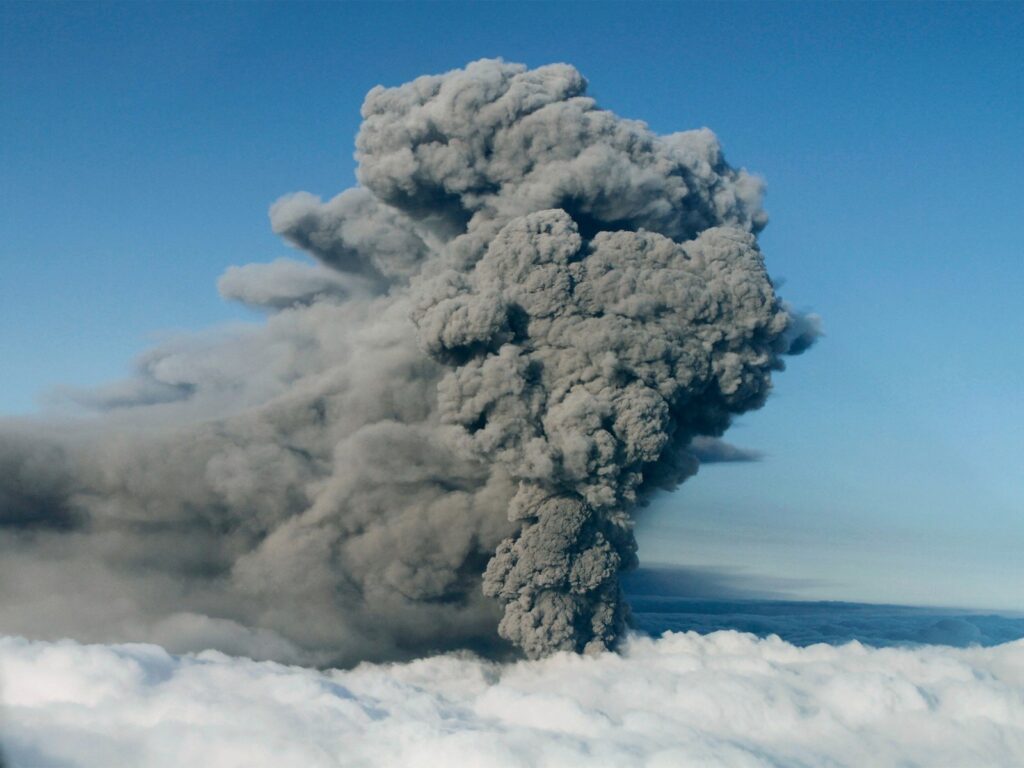
Ethiopia has witnessed a massive volcanic eruption after nearly 12,000 years of silence, as the Hayli Gubbi volcano in the country’s remote Afar region erupted explosively, sending a vast ash and sulphur dioxide plume thousands of kilometres across continents and directly into Indian airspace. The rare geological event has led to widespread aviation disruptions in India, including flight cancellations, delays, and rerouting, as authorities act to protect passenger safety and aircraft engines from damaging volcanic ash particles.
A Historic Eruption in the Afar Rift
The eruption of the Hayli Gubbi volcano in the Afar Depression holds major geological and scientific significance. The region is one of the world’s most active tectonic environments where three major tectonic plates the Arabian Plate, Nubian Plate and Somali Plate are gradually pulling apart. This triple junction rift zone is considered a birthplace of newly forming ocean basins.
After lying dormant for nearly 12 millennia, the volcano erupted with tremendous force and launched a vertical ash column rising approximately 14 to 15 kilometres or nearly 45,000 feet into the upper atmosphere. Residents living near the eruption site in Ethiopia reported strong ground tremors, loud explosive sounds and ashfall covering nearby areas, although no casualties have been confirmed so far.
Ash Cloud Travels Across Continents and Reaches India
Upper atmospheric winds carried the volcanic ash plume at speeds of nearly 100 to 120 kilometres per hour. The cloud travelled across multiple regions in sequence: Ethiopia to the Red Sea to Yemen to Oman to the Arabian Sea to Pakistan and eventually into northwest India.
By Monday evening, the ash cloud entered Indian airspace over Rajasthan and Gujarat and later spread across Delhi NCR, Haryana, Punjab and Maharashtra. Weather agencies tracked the plume at very high altitudes and reported hazy skies and visible upper air diffusion across parts of northern India.
Forecast models suggest the plume will continue drifting eastward and gradually weaken as it moves towards East and Southeast Asia.
Major Impact on Indian Aviation
The most significant effect in India is seen in the aviation sector. Volcanic ash is extremely dangerous for aircraft, as microscopic glass-like particles can melt inside jet engines, damage turbine blades, scratch cockpit windows, interfere with navigation sensors and potentially cause engine failure during flight.
The Directorate General of Civil Aviation (DGCA) issued urgent safety notifications to airlines and airports. Carriers were instructed to avoid volcanic ash contaminated air routes, monitor satellite and meteorological guidance, conduct emergency inspections on aircraft engines and filters and report any suspected ash exposure immediately.
As a result of these precautionary measures:
- Air India cancelled several long haul services between the United States and Delhi
- Flights connecting India to locations including Jeddah, Kuwait and Abu Dhabi were cancelled or diverted
- Passengers experienced delays and rescheduling at major hubs including Delhi, Mumbai, Ahmedabad and Amritsar
Airlines shifted routes to avoid high altitude ash layers and prioritised engine safety evaluations.
Effect on India’s Air Quality and Weather
Questions were raised regarding whether the Ethiopia ash cloud might worsen already sensitive air quality conditions in Delhi NCR. Meteorologists and environmental experts have clarified that the plume is located at high altitudes above 10 kilometres and is therefore unlikely to affect ground level air quality in a significant manner.
The plume contains sulphur dioxide or SO2 and while some elevation of aerosol presence can occur at high altitudes, levels are expected to remain below public health advisory thresholds. For most Indian residents on the ground, the effect is expected to be slight haze and diffused sunlight rather than harmful ash deposition.
Some regions may experience more vibrant sunrises and sunsets due to aerosol scattering, a common phenomenon following volcanic events.
Why This Matters for India
The eruption of the Hayli Gubbi volcano and the arrival of its ash cloud over Indian airspace highlights how closely connected global atmospheric systems are. A volcanic event that occurred in East Africa quickly affected aviation operations, air routes and sky visibility across several parts of India, demonstrating that natural disasters can have immediate cross-continental impact.
For India, this situation reinforces the need for real time satellite tracking, accurate forecasting and strong coordination between the DGCA and meteorological agencies. The quick response by aviation authorities shows the importance of rapid safety decisions, as volcanic ash can severely damage aircraft engines and instruments even when it remains at high altitudes.
For Indian passengers and airlines, the event is a reminder that air travel is highly sensitive to natural changes and requires constant preparedness. Travellers should monitor flight updates, remain flexible with schedules and expect temporary disruptions until the ash cloud fully disperses.
Key Takeaway
The massive eruption of Ethiopia’s Hayli Gubbi volcano has shown how a geological event thousands of kilometres away can create immediate consequences for India. Within hours, the ash cloud drifting into Indian airspace caused flight disruptions, diversions and hazy skies across northern India, proving that modern nations cannot view natural events in isolation.
Despite these aviation challenges, public health and ground-level air quality remain largely unaffected because the ash plume is positioned at very high altitudes. The incident highlights the importance of rapid coordination between Indian aviation authorities and meteorological agencies, ensuring aircraft safety while scientists monitor the movement of atmospheric aerosols.
The Ethiopia volcanic eruption is a powerful reminder that natural events respect no borders. What begins in Africa can reshape India’s skies within hours, demanding preparedness and global coordination!


