

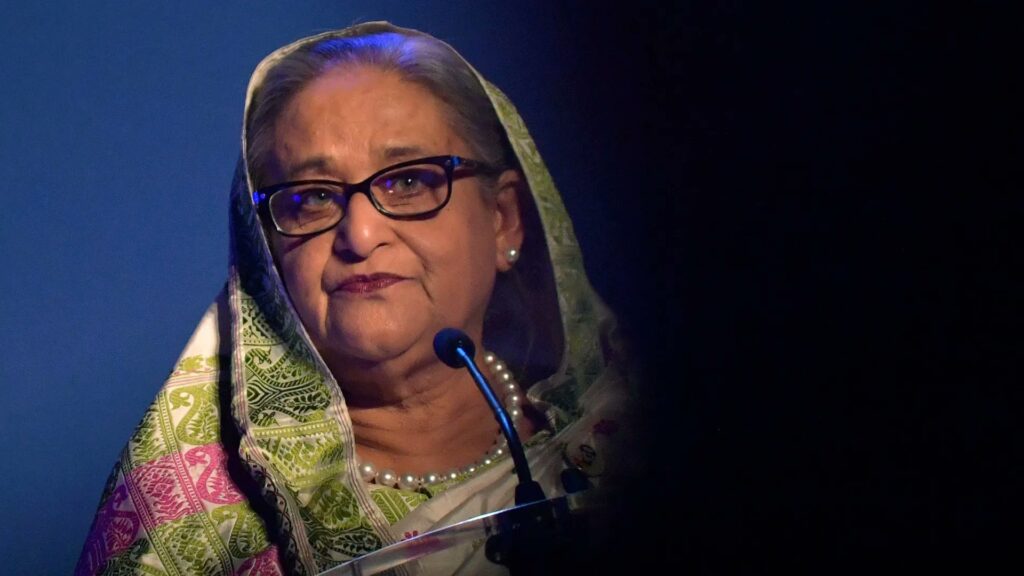
Ex-PM Sheikh Hasina has been sentenced to death in absentia by a Dhaka special tribunal, a ruling that has plunged Bangladesh into violent unrest and intensified political polarisation ahead of the 2026 elections. The International Crimes Tribunal found her guilty of crimes against humanity for allegedly authorising the deadly 2024 crackdown on student protesters that killed up to 1,400 people. The decision has sparked nationwide turmoil, while Hasina, currently in exile in India, has denounced the judgment as politically motivated.
Unrest Erupts Across Bangladesh After Verdict
Violence broke out within hours of the verdict. Thousands of Awami League supporters flooded the streets of Dhaka, Chittagong, Sylhet and Rajshahi, torching buses, vandalising police posts and attacking government buildings. Authorities reported at least 14 deaths during the clashes, while hospitals treated dozens of burn victims and gunshot injuries.
Police imposed curfews in high-risk areas and set up multiple checkpoints around Dhaka. Security forces and the Rapid Action Battalion were deployed throughout the night. Officers in key districts were instructed to shoot on sight to prevent further arson attacks and mob violence. Public transportation came to a near standstill and businesses shuttered as fear of escalation gripped the capital.
‘Trial Was Politically Motivated,’ Says Hasina From India
From her residence in India, Sheikh Hasina strongly rejected the ruling, calling it “politically motivated” and insisting she had been denied a fair trial. She alleged that the interim administration led by Nobel laureate Muhammad Yunus used the tribunal as a tool to dismantle the Awami League before the 2026 elections.
Hasina claimed the prosecution relied on selective evidence, coerced witness statements and pre-engineered conclusions. Her son, Sajeeb Wazed, declared that the Awami League would not participate in any election under what he described as a climate of state persecution. Senior party members labelled the tribunal a “show trial”, alleging that the proceedings were designed to eliminate the party’s leadership.
How Bangladesh Reached This Point
Years of Centralised Power and Public Frustration
Sheikh Hasina’s uninterrupted rule from 2009 to 2024 reshaped Bangladesh’s political landscape. Her tenure saw rapid infrastructure development and economic expansion, but also growing criticism over shrinking democratic space. Opposition parties faced legal pressure, journalists were arrested under digital laws and civil society accused the government of authoritarian tendencies.
Public dissatisfaction intensified among young Bangladeshis who confronted unemployment, rising costs of living and distrust in the electoral process.
The 2024 Student Uprising
The spark came in early 2024 when students launched protests demanding reform of the civil-service quota system. What began as a limited policy demand quickly expanded into a nationwide movement calling for transparency, jobs, electoral reforms and protection of academic independence.
Tens of thousands marched across university campuses and city centres. The movement soon grew into the largest youth-led mobilisation since Bangladesh’s independence.
The Deadly Crackdown and Collapse of the Government
The Hasina government responded with a sweeping and violent operation. Security forces used tear gas, rubber bullets and in multiple documented cases, live ammunition. Drones were deployed for surveillance and helicopters were used during crowd-control operations. Raids on dormitories led to mass detentions and widespread injuries.
Human-rights groups estimate the death toll at up to 1,400, a figure central to the tribunal’s findings.
The violence fractured Hasina’s political support and caused divisions within the state apparatus. By August 2024, Dhaka was paralysed and the government’s grip weakened dramatically. Hasina fled to India and an interim government led by Muhammad Yunus was appointed with a mandate to stabilise the country and pursue accountability.
The Tribunal’s Basis for the Death Sentence
The tribunal concluded that:
• Hasina exercised direct command responsibility during the crackdown
• the state actions constituted crimes against humanity
• the scale of fatality justified the maximum sentence
• her refusal to appear in court supported the verdict in absentia
The death sentence marks one of the most consequential legal outcomes in Bangladesh’s history.
India’s Role: Extradition Pressure and Legal Leverage
Sheikh Hasina’s presence in India places New Delhi under significant diplomatic scrutiny. Bangladesh has formally requested her extradition, but India is not obligated to comply.
Under the India–Bangladesh Extradition Treaty, India can lawfully refuse surrender if:
• the charges are considered political in nature
• the accused risks persecution, unfair trial or inhumane treatment
• the prosecution appears not in good faith
• the case involves capital punishment, which requires additional safeguards
Analysts note that India will weigh regional stability, domestic political implications, humanitarian concerns and long-term bilateral relations. New Delhi has so far maintained a cautious silence, suggesting it will not rush into a decision that could reshape South Asian geopolitics.
A Nation on Edge Before 2026 Elections
Bangladesh now faces one of its most turbulent transitions in decades. The interim government insists it is pursuing justice for the victims of 2024. The Awami League accuses it of political engineering. With curfews in place, protests spreading and the election season approaching, the country stands at a sensitive crossroads.
How Bangladesh navigates the balance between justice, political reconciliation and stability will determine its direction in the years ahead.


