

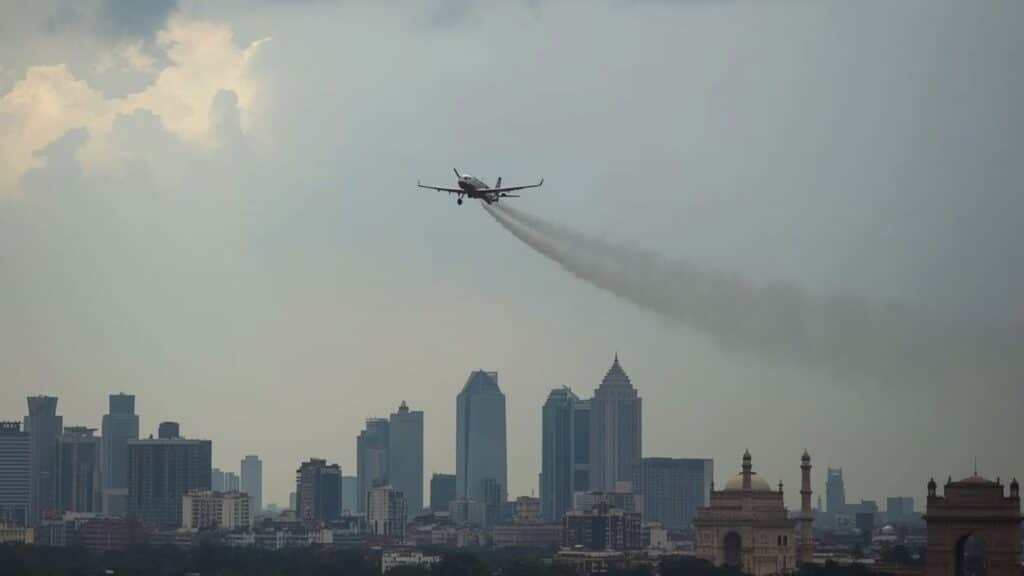
Fail cloud seeding in Delhi has become one of the most talked-about environmental misadventures of the year. The much-publicized effort, backed by IIT Kanpur and the Delhi government, was supposed to be the capital’s quick fix against toxic smog. Instead, it ended up as an expensive lesson on how not to fight pollution and a new flashpoint in Delhi’s charged political arena.
Delhi’s Artificial Rain Dream Turns into a Dust Storm
The plan was grand. Aircraft loaded with chemicals such as silver iodide and sodium chloride would fly over Delhi’s polluted skies, “seeding” clouds to trigger rainfall. The goal was simple, let the rain wash away the city’s thick blanket of smog.
But after three sorties, not even a drizzle came down. Scientists later explained the skies simply did not have enough moisture for seeding to work. No moisture, no rain- no matter how many crores are spent.
What was projected as a cutting-edge solution ended up exposing the limits of quick-fix climate engineering.
The Cost of a Failed Experiment — ₹3.2 Crore and Counting
The Delhi cloud-seeding mission wasn’t just a technical flop; it was a costly one. According to official figures, the first trial phase cost around ₹1.9 crore, and when logistics, aircraft rental, and material costs are combined, the final expenditure touched nearly ₹3.2 crore.
Experts estimate that a full-scale cloud-seeding campaign for the entire winter could easily reach ₹20–30 crore, with no guaranteed outcome. That’s taxpayers’ money literally scattered into the clouds — with little more than a few data charts to show for it.
Politics in the Air: From Pollution Battle to Blame Game
The political fallout was swift. Opposition leaders slammed the Delhi government, calling the exercise “a publicity stunt gone wrong.” Questions are now being raised over how such a project was cleared without solid meteorological assurance.
Government representatives, meanwhile, defended the move as an “experimental step” toward innovative pollution control. They argued that IIT Kanpur’s involvement gave the project credibility and scientific depth. But the optics tell a different story — crores spent, no rain, and no relief for Delhi’s 2 crore residents still gasping in toxic air.
The timing, too, is politically sensitive. With elections nearing, the opposition has seized the narrative, portraying the “failed cloud seeding” as proof of mismanagement and misplaced priorities.
Science Says: Cloud Seeding Isn’t a Magic Wand
Experts have long warned that cloud seeding works only under favorable atmospheric conditions. Without clouds rich in moisture, even the best technology cannot produce rain.
The Delhi trials coincided with an unusually dry spell, and scientists admitted that the weather simply wasn’t cooperative. The IIT Kanpur team insisted the effort still yielded useful meteorological data, but the failure reignited public skepticism over high-cost scientific interventions that promise fast results without tackling root causes.
Delhi’s Pollution Problem Needs Policy, Not Experiments
While the artificial rain failed, the air in Delhi continues to choke millions. Pollution levels have crossed “severe” limits multiple times this October, forcing schools to shut and construction to halt.
Experts argue that cloud seeding is a distraction, not a solution. The real answer lies in stronger emission controls, curbing stubble burning, promoting clean energy, and enforcing public transport reforms. Without these, no rain — natural or artificial — can save Delhi from its recurring pollution nightmare.
Political Optics vs Public Health — The Real Storm
Beyond the failed flights, the biggest fallout is political. The opposition has accused the government of “playing science for headlines” instead of implementing long-term solutions. The government, on the other hand, blames neighboring states for unchecked crop-burning.
As Delhi chokes again, the capital is left with one bitter truth — the sky was seeded with chemicals, but it’s the political landscape that’s truly clouded.


