

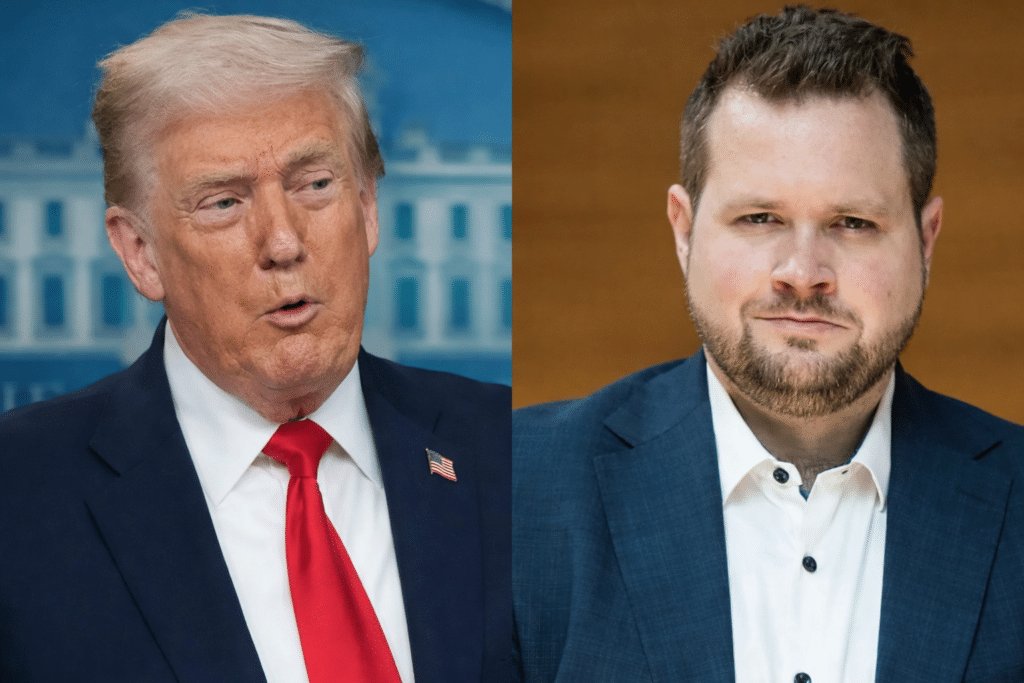
A diplomatic dispute over Greenland’s sovereignty escalated sharply in Brussels after a Danish lawmaker used explicit language to condemn US President Donald Trump during a European Parliament debate, exposing widening geopolitical tensions between Washington and its European allies over Arctic strategy and territorial integrity.
The remarks, delivered by Danish Member of the European Parliament Anders Vistisen, followed a series of statements and actions by President Trump asserting that Greenland is vital to US national security and should fall under American control. The exchange has intensified scrutiny of US policy in the Arctic and raised concerns about alliance cohesion at a critical moment in global geopolitics.
Confrontation in Brussels
The incident occurred during a plenary session of the European Parliament addressing foreign policy and security developments in the Arctic region. Taking the floor, Vistisen criticised what he described as growing pressure from the United States on Denmark and Greenland.
Ending his speech, Vistisen said: “Let me put this in words you might understand: Mr President, f*** off.”
The presiding officer immediately intervened, ruling the language a breach of parliamentary standards and formally reprimanding the Danish lawmaker. The session resumed shortly afterwards, but the remark quickly drew international attention.
In a statement following the debate, a European Parliament spokesperson said that while members are free to express political opposition, “the use of offensive language is not compatible with the values or rules of the institution.”
Trump’s Renewed Focus on Greenland
President Trump has in recent weeks renewed and sharpened his rhetoric on Greenland, describing the Arctic territory as strategically indispensable to the United States.
Speaking publicly, Trump has argued that increased military and economic activity by Russia and China in the Arctic requires stronger American control over key geographic locations. He has repeatedly stated that Greenland’s current status leaves it exposed to rival powers.
In one statement, Trump said the United States“cannot afford to lose the Arctic” and warned that allowing competitors to expand their presence near North America would pose “a direct threat to global security.”
The controversy deepened after Trump shared AI-generated images depicting Greenland as US territory and suggested that allies opposing American plans could face economic consequences, including trade measures.
European officials privately described the move as provocative and destabilising.
Denmark Pushes Back
Denmark responded swiftly, rejecting any suggestion that Greenland’s status could be negotiated.
Danish Prime Minister Mette Frederiksen reiterated that “Greenland belongs to the Greenlandic people” and said decisions about its future “will not be made in Washington.”
Speaking to Danish media, Frederiksen said cooperation with the United States remained important but warned that “pressure and threats are not the basis of alliances.”
Officials in Copenhagen stressed that Denmark already works closely with Washington on Arctic security and defence, including through NATO, and that existing arrangements address legitimate security concerns.
Greenland’s Position
Greenland’s leadership has also taken a firm stance.
Greenlandic Prime Minister Jens-Frederik Nielsen said the territory “will not become American” and described Trump’s rhetoric as disrespectful to Greenland’s right to self-determination.
“Greenland is open to cooperation, not ownership,” Nielsen said, adding that any future political changes would require the clear consent of Greenland’s population.
Greenland is a self-governing territory within the Kingdom of Denmark, managing domestic affairs while Denmark retains responsibility for defence and foreign policy.
Who Is Anders Vistisen
Anders Vistisen represents Denmark in the European Parliament as a member of the Danish People’s Party. He is known for his outspoken positions on sovereignty, defence, and national interest.
While Danish government officials distanced themselves from the language used in Brussels, several acknowledged that the frustration expressed reflected wider political sentiment in Denmark.
In a brief response, Vistisen defended his remarks as an expression of political anger, saying that Greenland’s sovereignty was “not a matter for negotiation or intimidation.”
Why Greenland Is Strategically Critical
Greenland’s importance lies at the heart of the dispute.
Located between North America and Europe, Greenland plays a central role in Arctic defence and surveillance. The United States has maintained a military presence on the island for decades, including early-warning radar systems critical to missile defence.
The Arctic is also emerging as a major strategic theatre. Melting ice has opened new shipping routes, while the region is believed to contain vast reserves of rare earth minerals and other natural resources essential to modern industries.
For Washington, securing Greenland would significantly expand its Arctic reach. For European governments, such ambitions raise concerns about precedent, sovereignty, and balance of power among allies.
European Reaction
The incident triggered a strong response across the European Union.
Several EU lawmakers said Trump’s statements challenged core principles of international law, particularly respect for territorial integrity. Others warned that using economic pressure against allies risked weakening NATO unity at a time of heightened global instability.
European Parliament Vice President Nicolae Ștefănuță, who chaired the session, later said that while political tensions are real, “the European Parliament must remain a place of firm but respectful debate.”
EU diplomats stressed that the bloc remains committed to dialogue with Washington, even as disagreements over Greenland persist.
Arctic Geopolitics in Focus
The dispute highlights a broader struggle for influence in the Arctic.
Russia has expanded military infrastructure across its northern territories, while China has declared itself a “near-Arctic state” and increased investment in polar research and logistics.
Western governments agree on the need to counter these developments, but European officials argue that this must be done through cooperation rather than unilateral pressure.
Security analysts warn that aggressive rhetoric risks turning the Arctic into a zone of confrontation rather than managed competition.
Diplomatic Consequences
The Brussels exchange has added strain to already sensitive transatlantic relations.
Danish diplomats are now working to contain fallout while reinforcing Denmark’s position on Greenland. European officials say the issue is likely to feature prominently in upcoming NATO and EU-US discussions.
There is concern that public disputes of this nature could be exploited by rival powers seeking to highlight divisions within the Western alliance.
A Clear Signal
Despite the attention drawn by the language used, diplomats emphasise that the episode is significant primarily for what it reveals about underlying tensions.
The Greenland dispute has become a symbol of shifting power dynamics, alliance expectations, and the growing strategic importance of the Arctic. What unfolded in the European Parliament was not an isolated outburst but a reflection of deeper geopolitical strain.


