

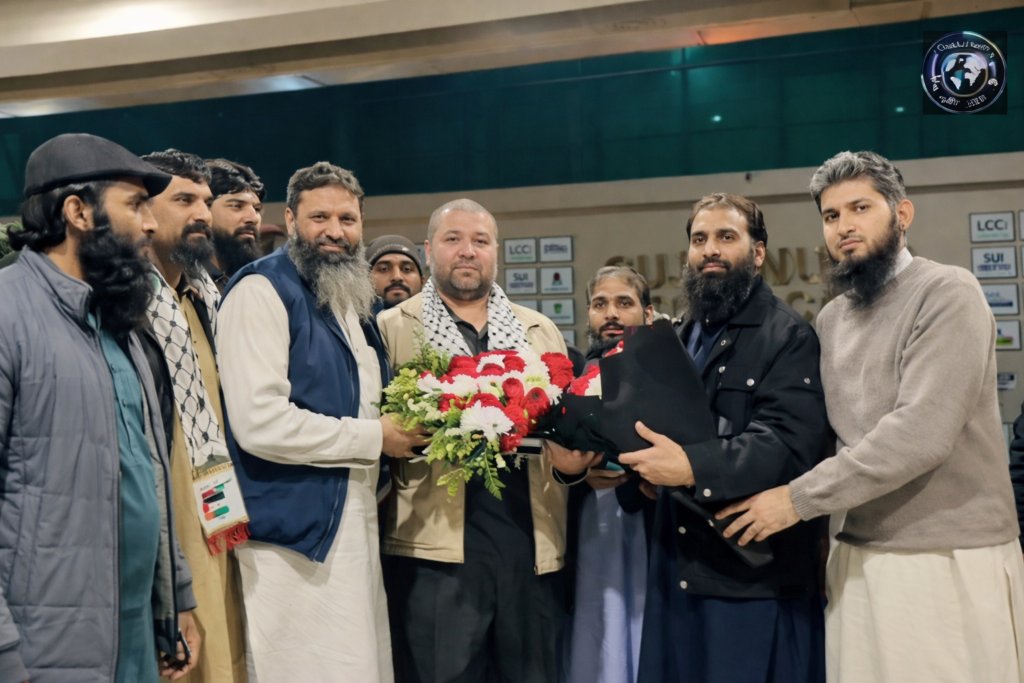
Pakistan has come under renewed international scrutiny after senior figures linked to Hamas and Lashkar-e-Taiba appeared together at a public event in Punjab, raising fresh questions about the country’s handling of militant networks operating within its borders.
The meeting, held in the city of Gujranwala, involved Naji Zaheer, identified by multiple intelligence and media assessments as a Hamas representative, alongside figures associated with Lashkar-e-Taiba, a Pakistan-based militant organisation designated as a terrorist group by several countries. Video footage from the event, which circulated widely across regional media, showed the participants sharing a stage at a gathering organised by a group widely regarded as a Lashkar political front.
For Pakistan, the episode has revived long-standing concerns about the persistence of militant ecosystems within the country and the gap between official counterterrorism commitments and visible ground realities.
What happened in Gujranwala
The event took place in Gujranwala, an industrial city in Pakistan’s Punjab province. Video clips show Naji Zaheer seated on a dais alongside individuals identified by Indian and regional security agencies as senior Lashkar-e-Taiba figures. The gathering was reportedly organised by Pakistan Markazi Muslim League, an entity often described by analysts as a political and social front linked to Lashkar.
The event was not conducted in secrecy. It was held in a public setting, attended by supporters, and recorded on video. No official agenda, guest list, or transcript of speeches has been released, and neither Hamas nor Lashkar-e-Taiba has issued a formal statement outlining the purpose of the meeting.
The visibility of the event, rather than any declared outcome, has become the central concern for international observers.
Who is Naji Zaheer
Naji Zaheer is regarded as a significant Hamas figure responsible for outreach beyond the Middle East. He is widely described as Hamas’s representative to Pakistan and operates under the political leadership of Khaled Mashaal, a senior Hamas leader based outside Gaza.
Since late 2023, Zaheer has made repeated appearances across Pakistan. He has been seen at press clubs, legal associations, and religious gatherings in major cities including Karachi and Islamabad. He has also visited Pakistan-administered Kashmir, where he addressed Islamist events attended by figures linked to Pakistan-based militant organisations.
Security analysts say these appearances reflect a sustained and structured effort by Hamas to cultivate political and ideological links in South Asia, with Pakistan serving as the primary platform for that outreach.
Lashkar-e-Taiba’s role
Lashkar-e-Taiba has long been one of the most prominent militant organisations operating from Pakistan. It has been linked to multiple attacks in India, including the 2008 Mumbai attacks, and remains a central concern for Indian and international counterterrorism agencies.
Despite being formally banned, Lashkar has maintained influence through a network of charitable, religious, and political fronts. These organisations operate in legal grey areas, allowing public engagement while distancing themselves from overt militant activity.
The ability of Lashkar-linked entities to host a Hamas representative at a public event has highlighted the durability of these networks and the challenges Pakistan faces in enforcing restrictions consistently.
Pakistan’s security and governance challenge
Pakistan has repeatedly stated that it does not allow its territory to be used for terrorism and that it has taken decisive action against extremist groups. Military operations, arrests, and financial restrictions have been cited by successive governments as evidence of progress.
However, critics argue that enforcement has been uneven. While some groups have been targeted aggressively, others continue to operate through rebranded fronts or under political and social cover.
The Gujranwala event has sharpened focus on this contradiction. For many international observers, the issue is not whether Pakistan has laws on the books, but whether those laws are applied uniformly.
Why Pakistan is central to the story
Although the meeting involved Hamas and Lashkar-e-Taiba, Pakistan has emerged as the central focus of international concern. Hamas is not a Pakistan-based organisation, yet its representative was able to appear publicly alongside a Pakistan-origin militant group.
Pakistan’s strategic geography, large population, and complex political landscape make it a critical arena for global security calculations. When militant actors find space to interact openly within its borders, the implications extend well beyond South Asia.
This is why the episode has been framed internationally not as a bilateral issue between India and Pakistan or Israel and Hamas, but as a test of Pakistan’s internal controls and governance.
Regional reactions
In India, the meeting has reinforced long-standing concerns about Pakistan-based militant infrastructure. Lashkar-e-Taiba remains one of the principal threats identified by Indian security agencies, and any sign of expanded international linkage is treated with seriousness.
Indian officials and analysts have pointed to the Gujranwala footage as evidence that militant ecosystems in Pakistan remain active despite years of international pressure.
Israeli security analysts have also taken note. Hamas’s outreach in Pakistan is being viewed as part of a broader strategy to diversify support networks and maintain international relevance amid sustained military pressure in Gaza.
Pakistan’s international standing
Pakistan’s international image has been shaped for decades by its association with militant groups. While Islamabad has sought to reposition itself as a responsible regional actor, episodes such as this risk undermining those efforts.
Western governments, Gulf states, and multilateral institutions have closely watched how Pakistan responds to similar incidents in the past. In many cases, international pressure has led to short-term measures, followed by long-term ambiguity.
The absence of an immediate official response to the Gujranwala meeting has been noted by diplomatic observers.
Official silence and its implications
As of now, Pakistan’s government has not publicly acknowledged the meeting. There has been no official confirmation of the identities involved, no clarification regarding visas or travel permissions, and no announcement of an investigation.
In previous cases involving militant-linked activity, Pakistan has often issued statements reiterating its commitment to counterterrorism or announcing inquiries. The lack of such messaging in this instance has added to international unease.
Analysts caution against reading too much into silence alone, but note that in matters of counterterrorism, perception often carries strategic weight.
A broader militant trend
The Gujranwala meeting fits into a wider pattern observed by security agencies worldwide. Militant organisations facing pressure in their primary theatres increasingly seek ideological reinforcement and logistical resilience through international networking.
Such engagements are often symbolic at first, focusing on shared narratives rather than operational planning. However, intelligence agencies treat these early-stage interactions seriously, as they can lower barriers between networks over time.
Pakistan’s role in this equation is particularly sensitive given its history and geopolitical position.
What intelligence agencies are watching
Security agencies in South Asia and beyond are now focused on follow-up indicators rather than the event itself. These include potential repeat meetings, travel movements, financial flows, and communication patterns.
Even if the Gujranwala gathering remains symbolic, analysts say it has already expanded ideological space and normalised cross-group visibility within Pakistan.
A familiar crossroads
For many observers, the episode reflects a recurring dilemma for Pakistan. Similar moments in the past have triggered international alarm, followed by assurances, partial action, and lingering doubts.
What distinguishes the current situation is the internationalisation of the actors involved, linking Pakistan more directly to conflicts beyond its immediate region.
Why the Episode Matters
The appearance of Hamas and Lashkar-linked figures together in Pakistan has reopened unresolved questions about the country’s internal security framework and its role in an increasingly interconnected militant landscape.
Whether this episode remains a symbolic gesture or evolves into something more consequential will depend on actions taken beyond public view. What is already clear is that Pakistan’s response, or lack of one, will shape international perceptions in the months ahead.
When Pakistan becomes the meeting ground for global militancy, the world does not just watch, it recalculates!


