

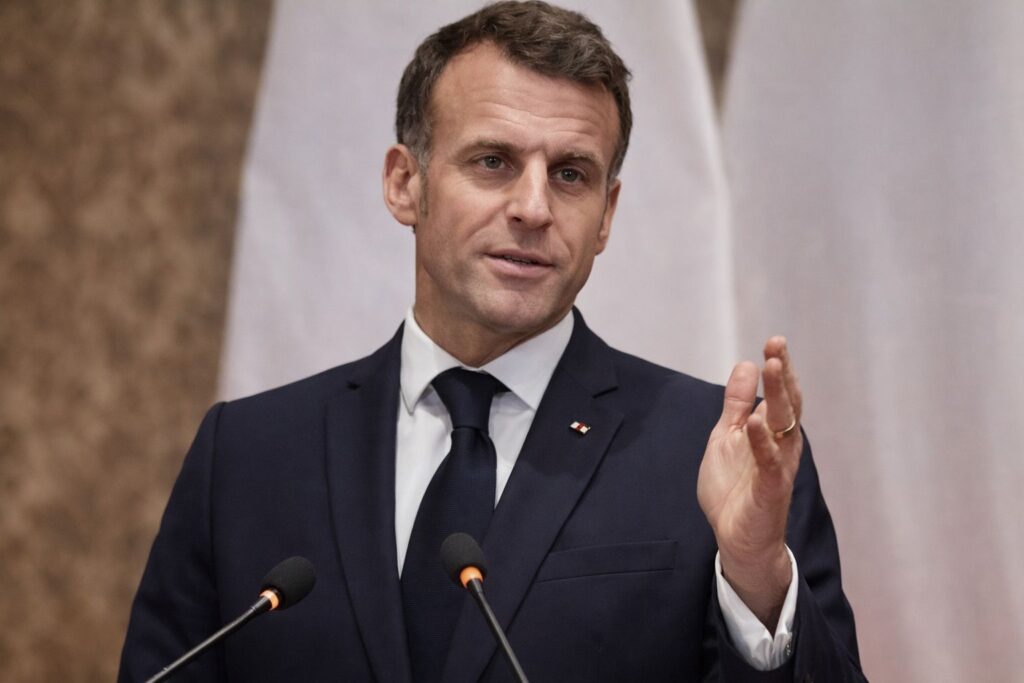
The India AI Impact Summit 2026 moved beyond policy discussion into a defining geopolitical statement on Day 3, as world leaders and technology executives gathered in New Delhi to debate the future of artificial intelligence. Hosted at Bharat Mandapam, the summit has positioned India not merely as a participant in the AI revolution, but as a central architect of its direction.
With Prime Minister Narendra Modi and French President Emmanuel Macron sharing the stage, the message was clear: artificial intelligence is now a strategic pillar of diplomacy, economic policy and global influence.
Leadership on Display
In one of the most widely noted interventions of the summit, President Macron delivered a pointed tribute to India’s global technological footprint.
“The CEO of Alphabet is Indian, the CEO of Microsoft is Indian, the CEO of IBM is Indian, the CEO of Adobe is Indian, the CEO of Palo Alto Networks is Indian, the CEO of Novartis is Indian,” he said.
“And the CEO of Chanel, one of the most iconic houses in France, is Leena Nair from Kolhapur, right here in this state.”
He concluded with a line that drew sustained applause: “India does not just participate in global innovation, India leads it. From Silicon Valley to the Champs-Elysees and from technology to culture.”
The remarks referenced leadership at Alphabet Inc., Microsoft, IBM, Adobe, Palo Alto Networks, and Novartis, as well as Leena Nair, chief executive of Chanel.
Macron’s intervention was more than praise. It framed India as a global talent powerhouse whose influence extends across Silicon Valley boardrooms and European cultural institutions alike. Diplomatically, it underscored the expanding Indo-French partnership in emerging technologies, including artificial intelligence, digital public infrastructure and health innovation.
Strategic AI Diplomacy
Prime Minister Modi used his address to reinforce India’s vision of human-centric AI. He called for systems that expand opportunity, strengthen democratic institutions and reflect diverse linguistic and cultural contexts.
Officials emphasised that AI governance must evolve alongside innovation. India’s regulatory approach, they said, aims to balance rapid technological deployment with safeguards against misuse, including misinformation and synthetic media manipulation.
The summit’s composition reflected that ambition. Delegations from across Europe, Asia, Africa and Latin America participated in sessions on sovereign AI infrastructure, cross-border standards and ethical frameworks. India’s role as host signalled its intention to shape, rather than simply adopt, emerging global norms.
Infrastructure Push
Beyond speeches, the summit delivered tangible industry commitments.
Engineering conglomerate Larsen & Toubro outlined plans to expand large-scale AI computing infrastructure under the national AI mission. The initiative is designed to strengthen domestic capacity in high-performance computing and reduce reliance on overseas technology ecosystems.
Executives described the move as foundational. Without sufficient compute power and data infrastructure, India’s AI ambitions would remain constrained. With it, the country could support research, startups and enterprise adoption at scale.
Technology firms across sectors signalled deeper AI integration into financial services, mobility platforms and enterprise software. The emphasis was practical rather than speculative: automation, predictive analytics and generative systems are increasingly embedded in everyday economic activity.
Commerce and Automation
A major demonstration at the summit highlighted the evolution of agent-driven commerce. Payments giant Mastercard showcased an authenticated AI-powered transaction capable of completing secure purchases with minimal human intervention.
Such systems represent a shift from AI as advisory software to AI as operational agent. While efficiency gains are evident, policymakers acknowledged parallel concerns over accountability, transparency and consumer protection.
Governance and Guardrails
India’s message on regulation was firm. Officials reiterated that global technology platforms must comply with domestic legal standards and respond swiftly to unlawful content.
The discussion extended to emerging risks such as deepfakes and algorithmic bias. Participants stressed that trust will determine the long-term legitimacy of AI systems. Without credible governance, adoption could stall under public backlash or geopolitical fragmentation.
A Global Talent Signal
Macron’s remarks about Indian-origin corporate leaders resonated beyond symbolism. They reinforced a broader narrative: India’s influence in AI and digital transformation is not limited to domestic initiatives. It is embedded in global corporate leadership.
From boardrooms in California to fashion houses in Paris, Indian executives are shaping strategic decisions in some of the world’s most influential companies. That diaspora footprint strengthens India’s diplomatic leverage in technology partnerships and innovation alliances.
The summit capitalised on this narrative, presenting India not just as a fast-growing market, but as a talent exporter and standards-setter.
Challenges and Expectations
The event’s scale also exposed logistical strains, including crowd management issues during early sessions. Organisers responded by expanding access and adjusting arrangements, reflecting the intense public and industry interest in AI engagement.
For policymakers, however, the larger challenge lies ahead. Announcements and rhetoric must translate into sustained institutional reform, research funding and international coordination.
The Defining Question
The India AI Impact Summit 2026 has elevated artificial intelligence from a technical conversation to a strategic doctrine. It blended diplomacy, commerce and governance into a single platform, projecting confidence in India’s role as a central AI stakeholder.
President Macron’s assertion that India leads global innovation encapsulated the summit’s tone. The claim now faces the test of execution. If infrastructure commitments mature, regulatory frameworks stabilise and partnerships deepen, the summit may be remembered as a turning point in global AI leadership.
For now, New Delhi has delivered a clear signal: the future of artificial intelligence will not be shaped in isolation. It will be negotiated across capitals, industries and cultures. And India intends to be at the centre of that negotiation.


