

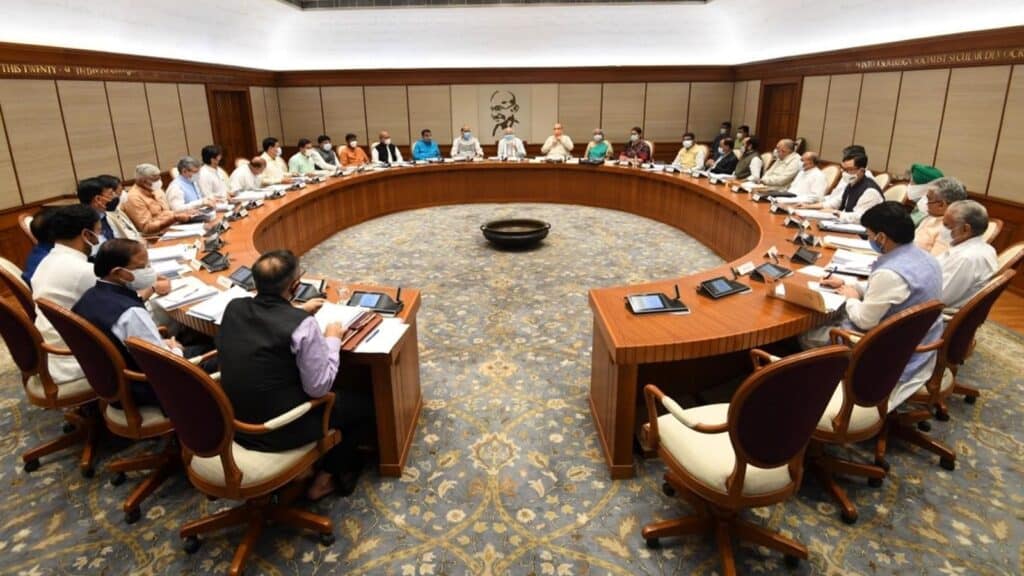
India ruled out any mediatory role in the escalating West Asia crisis during an all-party meeting chaired by Rajnath Singh, focusing on security risks, energy supply and citizen safety.
The closed-door meeting brought together senior ministers including External Affairs Minister S. Jaishankar, Home Minister Amit Shah, Finance Minister Nirmala Sitharaman and Petroleum Minister Hardeep Singh Puri, along with leaders from opposition parties. Foreign Secretary Vikram Misri also briefed participants on the evolving situation.
The meeting followed remarks by Prime Minister Narendra Modi in Parliament, where he cautioned about the wider implications of the crisis. “Be prepared for every challenge,” Modi said, signalling the need for sustained vigilance as tensions continue to rise.
Officials described the meeting as a comprehensive briefing covering military developments, maritime risks, energy exposure and contingency planning.
Security Assessment
Rajnath Singh began the meeting with a detailed overview of the conflict, placing it within the broader context of global security and economic stability. He outlined how the evolving situation in West Asia has the potential to disrupt regional peace while also affecting critical global trade routes and supply chains that India depends on.
“The situation in West Asia is a matter of serious concern for global peace and stability,” Singh said, setting the tone for a discussion centred on risk evaluation and preparedness.
He emphasised that the government is maintaining continuous monitoring through coordinated efforts across ministries, intelligence agencies and diplomatic channels. “The government is fully alert and taking all necessary steps to safeguard India’s interests and ensure the safety of our citizens abroad,” he added.
Foreign Secretary Vikram Misri followed with a structured presentation that provided leaders with a comprehensive situational update. This included assessments of military escalation, the status of maritime routes and possible disruption scenarios, particularly around key chokepoints that could impact global shipping and trade flows.
Diplomatic Position
External Affairs Minister S. Jaishankar used the meeting to clearly define India’s diplomatic posture, drawing a firm line against any suggestion of a mediatory role. His remarks reflected continuity in India’s approach of maintaining engagement without direct involvement in conflict resolution.
“India is not a broker nation. We do not mediate between other countries,” he said.
He added that India would continue to remain engaged with all stakeholders while ensuring that decisions are guided by national priorities. “We engage with all sides, but our decisions are guided by national interest,” Jaishankar said.
Addressing regional narratives, he also stated, “We are not a dalaal nation,” reinforcing India’s position against being seen as an intermediary.
Alongside this, the government briefed leaders on Prime Minister Narendra Modi’s diplomatic outreach, including conversations with global figures such as former US President Donald Trump. According to officials, these engagements focused on de-escalation. “This conflict is in no one’s interest and must end at the earliest,” Modi conveyed.
Energy and Shipping
Energy security and maritime logistics formed a central part of the discussions, given India’s reliance on imports from the Middle East. Officials outlined how disruptions in the region, especially around the Strait of Hormuz, could have immediate consequences for oil supplies and pricing.
The government informed leaders that India had been able to maintain movement of vessels through the Strait despite heightened tensions. “While most countries are blocked, India has been able to do that,” officials said, indicating continued access to critical shipping routes.
They added that more India-bound ships are expected to pass through the corridor, suggesting that supply chains are holding despite the situation. The briefing also highlighted domestic mitigation efforts. “Production has risen significantly to 60 per cent from 28 per cent,” officials said, referring to increased domestic gas output.
At the same time, the government said it was closely monitoring global supply conditions. “We are closely monitoring supply chains and have adequate reserves to handle short term disruptions,” officials told the meeting.
Political Response
Parliamentary Affairs Minister Kiren Rijiju said the meeting reflected broad political alignment on national priorities. “All parties expressed support for the government’s steps and agreed that national interest must come first,” he said.
At the same time, opposition leaders sought greater clarity on aspects of the government’s approach, including diplomatic positioning and preparedness. Congress leader Rahul Gandhi did not attend the meeting, informing authorities in advance.
Congress president Mallikarjun Kharge called for a detailed discussion in Parliament, while other leaders raised concerns regarding transparency and communication.
Karti Chidambaram said the government should clearly explain its position, and Dimple Yadav flagged concerns about the economic impact, particularly on fuel costs.
A BJP member described the purpose of the meeting as clarificatory. “The purpose was to clarify what exactly is happening,” the member said.
Citizen Safety
The safety of Indian nationals in West Asia was discussed in detail, with the government outlining preparedness measures and coordination mechanisms. Officials said monitoring systems are in place to track developments and respond quickly if required.
“Our people are the primary objective and the diaspora is our priority,” officials said, highlighting the focus on citizen welfare.
Rajnath Singh reiterated that evacuation plans are being kept ready as a precautionary step. “The safety of Indians abroad remains our top priority, and evacuation plans are being kept ready,” he said.
Indian missions in the region are maintaining contact with citizens and coordinating with local authorities, ensuring readiness for any emergency response if the situation escalates further.
Outlook
The all-party meeting reflected a structured and institution-led response centred on assessment, coordination and preparedness rather than immediate policy changes.
India’s position combines diplomatic engagement with operational readiness, supported by continued communication with global stakeholders and internal contingency planning. The discussions also reflected political convergence on core national priorities, alongside ongoing scrutiny within the parliamentary framework.
The government’s approach remains focused on managing external risks while maintaining stability across key domestic sectors as the situation continues to evolve.


