

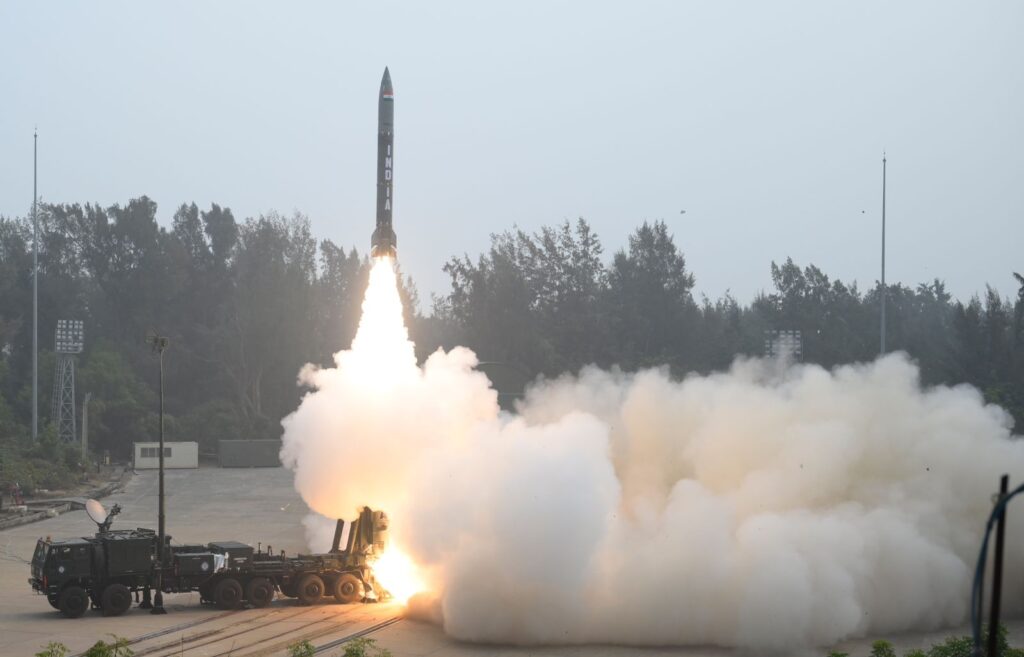
India significantly strengthened its conventional strike posture on Wednesday as the Defence Research and Development Organisation (DRDO) successfully test-fired two Pralay short-range surface-to-surface missiles in a rapid salvo from the Integrated Test Range (ITR), Chandipur, off the Odisha coast. The back-to-back launches from the same mobile launcher, conducted around 10:30 am IST, marked a crucial milestone in the missile’s journey towards frontline induction into the Indian Army and Indian Air Force.
The tests were carried out as part of user evaluation trials, the final and most critical phase before operational deployment. According to officials, both solid-fuel missiles met all mission objectives, confirming their accuracy, reliability and readiness for combat roles.
Rapid Salvo Launch Demonstrates Strike Readiness
The successful firing of two Pralay missiles in quick succession demonstrated India’s growing capability for rapid, high-precision conventional strikes. Defence officials said the salvo launch validated the missile system’s ability to engage targets swiftly and effectively under near-operational conditions.
Data from range tracking instruments, radars and telemetry systems deployed on ships near the designated impact zones confirmed that both missiles followed their planned trajectories. The test highlighted India’s ability to compress response time, a key factor in modern conflict scenarios where speed and accuracy are decisive.
Pralay Missile and Its Core Capabilities
The Pralay missile is an indigenously developed, solid-propellant, quasi-ballistic surface-to-surface weapon designed for conventional battlefield use. Developed by DRDO’s Research Centre Imarat (RCI), Hyderabad, in collaboration with multiple DRDO laboratories, the missile represents a major advance in India’s tactical strike arsenal.
Key specifications include:
- Range between 150 km and 500 km
- Payload capacity of 500 kg to 1,000 kg
- Advanced guidance and navigation system for high precision
- Manoeuvrable trajectory to evade enemy air defence systems
- Road-mobile, canisterised launcher enabling rapid deployment
Defence experts note that Pralay bridges a crucial gap between long-range strategic missiles and conventional artillery systems.
Designed for High-Value Military Targets
Pralay is designed to conduct precision strikes against critical enemy assets, including command centres, radar installations, airbases and logistics hubs. Its quasi-ballistic flight profile and manoeuvrability make interception difficult, enhancing its effectiveness against layered air defence networks.
Military planners see the missile as a key component in strengthening India’s conventional deterrence, particularly in scenarios that demand swift and proportionate response without escalation to strategic weapons.
Senior Military and Industry Presence at Trials
The user evaluation trials were observed by senior DRDO officials, along with representatives from the Indian Army and Indian Air Force, highlighting the missile’s advanced stage of readiness. Officials from defence industry partners, including Bharat Dynamics Limited (BDL) and Bharat Electronics Limited (BEL), were also present.
Their involvement reflects the transition of the Pralay system from development to production and deployment, with industry playing a central role in scaling up manufacturing.
Leadership Applauds Successful Test
Defence Minister Rajnath Singh congratulated DRDO, the armed forces and industry partners, stating that the successful salvo launch established the reliability of the Pralay missile system and underscored India’s progress in indigenous defence capabilities.
DRDO Chairman and Secretary, Department of Defence R&D, Dr. Samir V. Kamat, said the test results indicated the missile’s imminent readiness for induction, noting that Pralay has consistently met performance benchmarks across a series of trials conducted this year.
A Year of Consistent Success for Pralay
Wednesday’s test follows multiple successful Pralay launches over the past year, including consecutive trials that validated range, accuracy and guidance systems. Officials said the missile has now cleared critical operational parameters, making it one of the most mature indigenous tactical missile systems currently under evaluation.
The steady progress reflects years of development and refinement aimed at delivering a reliable, high-precision conventional strike weapon tailored to India’s security requirements.
Path to Induction and Strategic Impact
With the latest salvo tests validating technical performance, operational usability and battlefield reliability, attention now turns to production, deployment and integration of the Pralay missile into frontline service. Defence officials view the system as a vital addition to India’s tactical missile forces, offering commanders a fast, precise and dependable conventional strike option across multiple theatres. More than a routine trial, the successful rapid launch signals India’s readiness to field a powerful indigenous weapon system designed for modern warfare, significantly strengthening deterrence, strike flexibility and national security preparedness.
Boost to Atmanirbhar Defence Push
The Pralay programme aligns with India’s broader Atmanirbhar Bharat vision in defence manufacturing. The missile incorporates a high proportion of indigenously developed components, reducing reliance on imports and strengthening domestic defence industry capabilities.
Officials believe the success of Pralay will pave the way for future upgrades and variants, ensuring adaptability to evolving battlefield requirements.
Regional and Global Significance
The successful rapid salvo launch sends a clear strategic signal beyond India’s borders. Analysts say Pralay enhances India’s standing as a defence power capable of deploying advanced conventional missile systems with precision and speed.
As regional security challenges continue to evolve, the induction of Pralay is expected to play a key role in reinforcing India’s conventional deterrence architecture.


