

Parliament Showdown
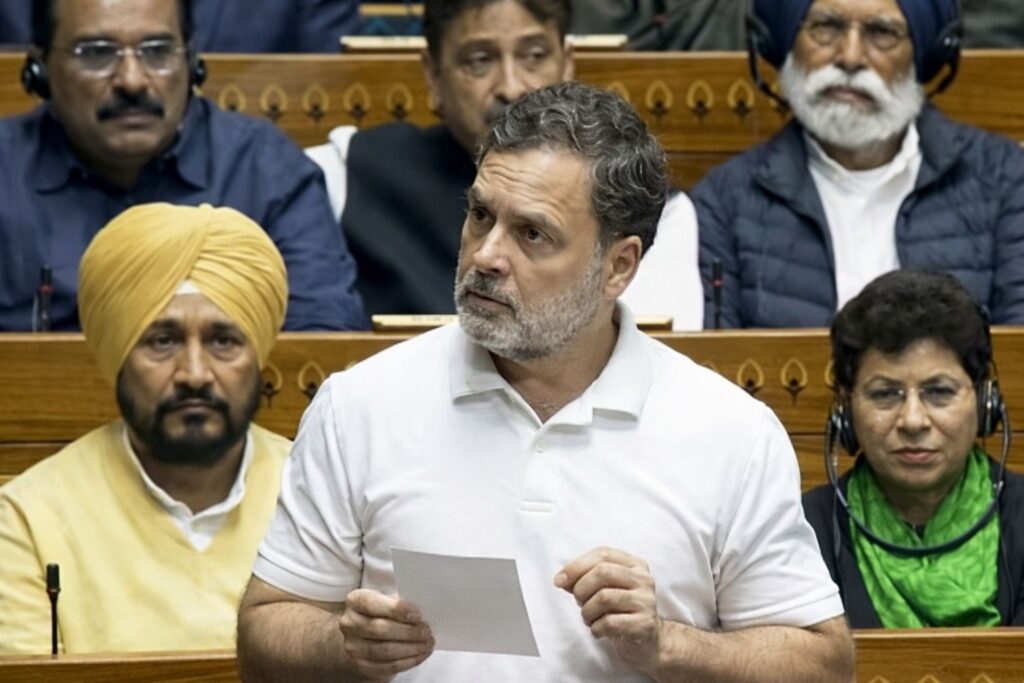
India’s Lok Sabha witnessed a stormy confrontation on February 11 as Leader of the Opposition Rahul Gandhi accused the Narendra Modi government of compromising national interests in an interim trade agreement with the United States, declaring in the House: “You have sold Bharat Mata. Have you no shame?”
The remark triggered immediate uproar from Treasury benches, with BJP members protesting what they called an inflammatory and misleading allegation. Parliamentary Affairs Minister Kiren Rijiju objected strongly, saying India cannot be “sold” and accusing Gandhi of making baseless claims. Government sources indicated that a privilege motion could be pursued if the Congress leader failed to substantiate his charges with documentary evidence.
Gandhi doubled down during his speech, describing the agreement as a “complete surrender” to Washington. “This is not a trade deal,” he said. “This is a surrender of India’s interests.” He framed the issue as one of sovereignty, arguing that economic negotiations should not weaken domestic producers or strategic autonomy.
The exchange briefly disrupted proceedings and cast a shadow over the ongoing Budget session, underlining how foreign trade policy has become a flashpoint in domestic politics.
Tariffs at the Core
At the centre of Gandhi’s criticism are tariff adjustments and market access provisions in the interim deal. He told the House that Indian exporters, particularly in labour-intensive sectors, face serious disadvantages under the current framework.
“Our tariffs have gone from around 3 per cent to 18 per cent in certain areas,” Gandhi said, alleging that the burden on Indian goods has increased while concessions have been extended to US exports. He warned that sectors such as textiles could lose competitiveness in global markets if tariff disparities persist.
He also raised concerns about agriculture, stating that the agreement could expose Indian farmers to unfair competition. “You are opening India’s markets to American agriculture,” he said. “How will our small farmers compete with mechanised US farming?”
The government has rejected that interpretation. Officials maintain that the interim arrangement is a stabilising measure designed to prevent wider tariff escalation amid shifting US trade policy. According to ministers, the framework preserves India’s interests while negotiations continue toward a more comprehensive agreement.
They argue that without such an understanding, Indian exporters risked facing harsher trade barriers. Government representatives also insist that safeguards remain in place to protect sensitive sectors, including agriculture and small-scale manufacturing.
Industry observers note that textiles and agricultural goods are politically sensitive sectors due to their employment footprint. Even marginal changes in tariff structures can affect order flows, pricing, and competitiveness. Gandhi’s intervention has therefore resonated beyond Parliament, drawing attention from trade bodies and farmer groups alike.
Digital and Energy Flashpoints
Gandhi’s attack extended beyond goods and tariffs into digital trade and energy cooperation. He alleged that the agreement dilutes India’s control over its data governance framework. “You are handing over our data,” he said in Parliament, arguing that provisions on cross-border data flows and regulatory standards could constrain future policy choices.
The government disputes this claim. Ministers say that digital trade clauses are standard components of modern agreements and that regulatory clarity benefits Indian service exporters and technology firms seeking global expansion. They emphasise that India retains full authority over its domestic digital policies.
Energy procurement also entered the debate. Gandhi suggested that elements of the deal could allow external scrutiny over India’s oil purchasing decisions. “Are we now going to ask Washington before we buy oil?” he asked, framing the issue as one of national sovereignty.
Officials responded that India’s energy strategy remains independent and that cooperation frameworks do not translate into oversight or approval mechanisms. They stressed that India continues to pursue diversified sourcing to ensure affordability and security.
The digital and energy dimensions illustrate how contemporary trade negotiations increasingly touch on regulatory and strategic issues. What might once have been confined to tariff schedules now spans data flows, standards, and geopolitical alignment, amplifying domestic sensitivities.
Political Stakes Rise
Gandhi framed the controversy as part of a broader question about leadership and accountability. “Prime Minister Modi has surrendered before the United States,” he said, arguing that the agreement reflects weakness rather than strength in negotiation. He accused the government of protecting select corporate interests while exposing ordinary Indians to economic risk.
BJP leaders countered that the remarks were irresponsible and politically motivated. They defended the Prime Minister’s record on economic diplomacy and said India’s global standing has strengthened under his leadership. According to the government, engagement with the United States is critical for expanding market access, securing technology partnerships, and reinforcing strategic cooperation.
The confrontation comes at a politically charged moment, with national elections approaching and economic performance under scrutiny. Trade agreements, once technical matters negotiated largely outside public view, have moved to the forefront of partisan debate.
Analysts say the row reflects broader structural pressures. Global trade is increasingly shaped by geopolitical considerations, supply chain realignments, and regulatory standards in areas such as technology and energy. Countries like India must balance the need for market access with domestic political expectations and strategic autonomy.
The interim deal is widely seen as a stopgap arrangement while both sides work toward a comprehensive trade framework. Whether it ultimately benefits Indian exporters or becomes a symbol of political contention may depend on the final contours of that broader agreement.
For now, the episode has sharpened the lines of political contestation. Gandhi’s declaration that the government has “sold Bharat Mata” has set the tone for an intense debate that blends economics with nationalism. The government’s forceful rebuttal signals it will defend both the substance of the agreement and its political narrative.
As Parliament resumes its work, the trade deal remains more than a diplomatic document. It has become a test of how India navigates global economic engagement while managing the pressures of domestic politics.


