

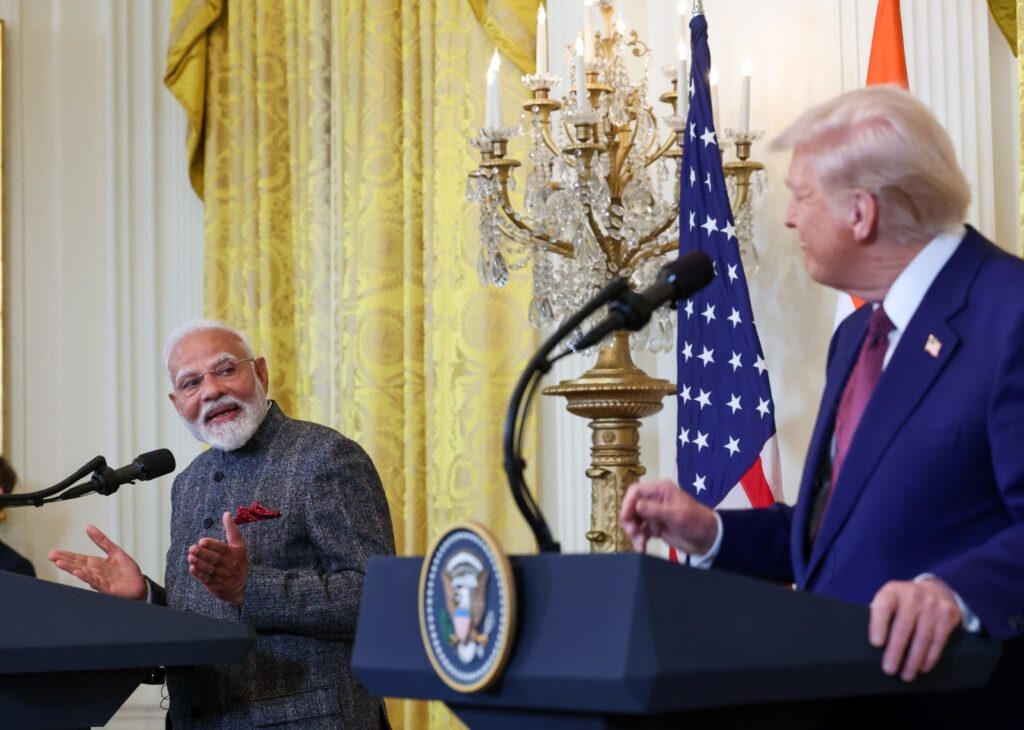
India and the United States are facing one of their sharpest trade disputes in recent years, with negotiations for a long-anticipated trade agreement breaking down amid rising tariffs, conflicting official claims and mounting geopolitical pressure. What began as a disagreement over the circumstances under which talks stalled has widened into a broader contest over trade policy, energy security and strategic alignment at a time of global uncertainty.
At the centre of the controversy is a claim by US Commerce Secretary Howard Lutnick, who said a near-final trade deal failed because Prime Minister Narendra Modi did not make a decisive phone call to then US President Donald Trump. India has rejected that account, saying leader-level engagement was frequent and that unresolved policy differences, not diplomatic protocol, stalled the agreement.
The dispute has unfolded as the United States imposed steep tariffs on Indian goods, sending ripples through markets and raising questions about the future direction of India-US economic and strategic ties.
Lutnick’s remarks
The row became public after Howard Lutnick spoke on the All-In Podcast, where he described what he called the Trump administration’s step-by-step trade strategy. Lutnick said countries that moved quickly to close deals were offered better tariff terms, while delays resulted in harsher outcomes.
Referring to India, Lutnick said, “We were very close to a deal. The final step was a call between Prime Minister Modi and President Trump. That call did not happen, and once that window passed, we moved on.”
He added that following the stalled talks, tariffs on Indian exports were raised significantly, with duties in some cases nearing 50 percent. The remarks were widely interpreted as placing responsibility for the breakdown on India’s leadership.
India’s response
New Delhi rejected Lutnick’s account within hours. The Ministry of External Affairs described the version presented by the US official as inaccurate. Spokesperson Randhir Jaiswal said that communication between the two leaders had been regular and substantive.
“The Prime Minister and President Trump spoke several times during 2025, including at least eight documented conversations,” Jaiswal said. “It is incorrect to suggest that trade discussions stalled due to the absence of leader-level communication.”
Indian officials said negotiations continued throughout the year at multiple levels, including between trade officials, ministers and technical teams. According to the government, talks slowed because several key issues remained unresolved and required detailed policy alignment.
India also said that both sides remain in contact and that discussions have not been formally abandoned.
Tariff escalation
The dispute has coincided with a sharp escalation in US tariffs on Indian goods. By the latter half of 2025, Washington had raised duties on a range of Indian exports, with some tariff rates approaching 50 percent.
The increases followed earlier trade actions, including a decision by the Trump administration to double tariffs on Indian imports in August 2025. US officials have linked some of these measures to broader trade imbalances and strategic concerns.
Indian exporters say the higher tariffs have reduced competitiveness in the US market, particularly for labour-intensive sectors such as textiles, garments, leather goods and gems and jewellery. Industry representatives have warned of order cancellations and pressure on employment if the tariffs remain in place.
Energy and geopolitics
Beyond trade mechanics, geopolitics has played an increasingly prominent role in shaping the dispute. India’s continued purchase of Russian crude oil has been a sensitive issue in Washington, especially amid the ongoing war in Ukraine and Western efforts to limit Russia’s energy revenues.
India has defended its oil imports, arguing that energy security and price stability are national priorities. Indian officials have said purchases are conducted within existing international frameworks and should not be conflated with trade negotiations.
In the United States, however, several lawmakers have argued for tougher action. Draft legislative proposals have included the possibility of imposing extremely high tariffs on countries that continue to import Russian oil. While such proposals have not yet been enacted, they have heightened uncertainty around India-US trade relations.
President Trump has previously taken a hard line on trade and energy issues, saying, “We will use tariffs where necessary to protect American interests.” The statement has been widely cited as an indication that trade measures may increasingly be used as geopolitical tools.
Market reaction
Financial markets have reacted cautiously to the developments. Indian benchmark indices have seen bouts of volatility following reports of higher tariffs and public disagreement between the two governments.
Export-oriented companies have faced particular scrutiny from investors, while broader indices have been supported by domestic consumption and government spending. Market analysts say prolonged uncertainty over tariffs could weigh on sentiment, even if India’s long-term growth prospects remain intact.
Some analysts have also pointed to the broader global context, noting that trade disputes between major economies have contributed to volatility in global markets and disrupted supply chains.
Policy disputes
Trade experts say the focus on a missed phone call obscures deeper policy disagreements that have long complicated India-US trade talks. Agricultural market access has been one of the most contentious issues.
The United States has pressed for greater access for American agricultural products, including dairy and farm goods. India has resisted, citing concerns over farmer livelihoods and domestic political sensitivities. Agriculture remains a politically sensitive sector in India, employing a significant portion of the population.
Tariff reciprocity has also been a sticking point. India has sought protections for labour-intensive industries, while the United States has pushed for broader market opening and reduced tariffs across sectors.
A senior Indian official familiar with the negotiations said, “These issues are structural. They cannot be resolved through symbolic gestures or last-minute calls. They require detailed negotiation and political consensus.”
Leadership engagement
Both sides agree that leader-level engagement can play an important role in advancing negotiations, but they differ on its significance in this case.
Lutnick argued that direct calls between leaders are often used to remove final political obstacles in trade deals. Indian officials counter that such engagement did occur and that unresolved policy gaps, not communication failures, ultimately prevented the deal from being concluded.
Prime Minister Modi has previously described India-US relations as a defining partnership of the 21st century, while emphasising that trade agreements must align with domestic economic priorities.
Domestic political pressures
Domestic politics have shaped the dispute in both countries. In the United States, trade policy has become closely linked to political debate over manufacturing, jobs and trade deficits. Tariffs have been framed as tools to protect domestic industry and appeal to key voter groups.
In India, trade agreements are scrutinised for their impact on farmers, small businesses and employment. Any perception of conceding under external pressure carries political risks for the government.
These domestic constraints have limited flexibility on both sides, even as officials acknowledge the strategic importance of the bilateral relationship.
Strategic implications
India and the United States continue to cooperate closely on defence, technology and regional security, particularly in the Indo-Pacific. Both countries have described each other as key partners in maintaining regional stability.
However, unresolved trade tensions have complicated the relationship. Diplomats say persistent tariff disputes risk undermining trust and could spill over into other areas of cooperation if not managed carefully.
At a time when global supply chains are being reconfigured and geopolitical competition is intensifying, the breakdown of the trade talks highlights the challenges facing even close strategic partners.
Current status
As of now, no comprehensive trade agreement has been finalised. US tariffs on Indian goods remain in place, and discussions continue at the technical level.
Indian officials say they remain open to negotiations based on mutual benefit. US officials have said any future deal will depend on policy alignment, timing and political commitment.
The breakdown of the talks underscores how trade, energy policy and geopolitics have become increasingly intertwined, shaping the future of India-US relations in an uncertain global order.


