

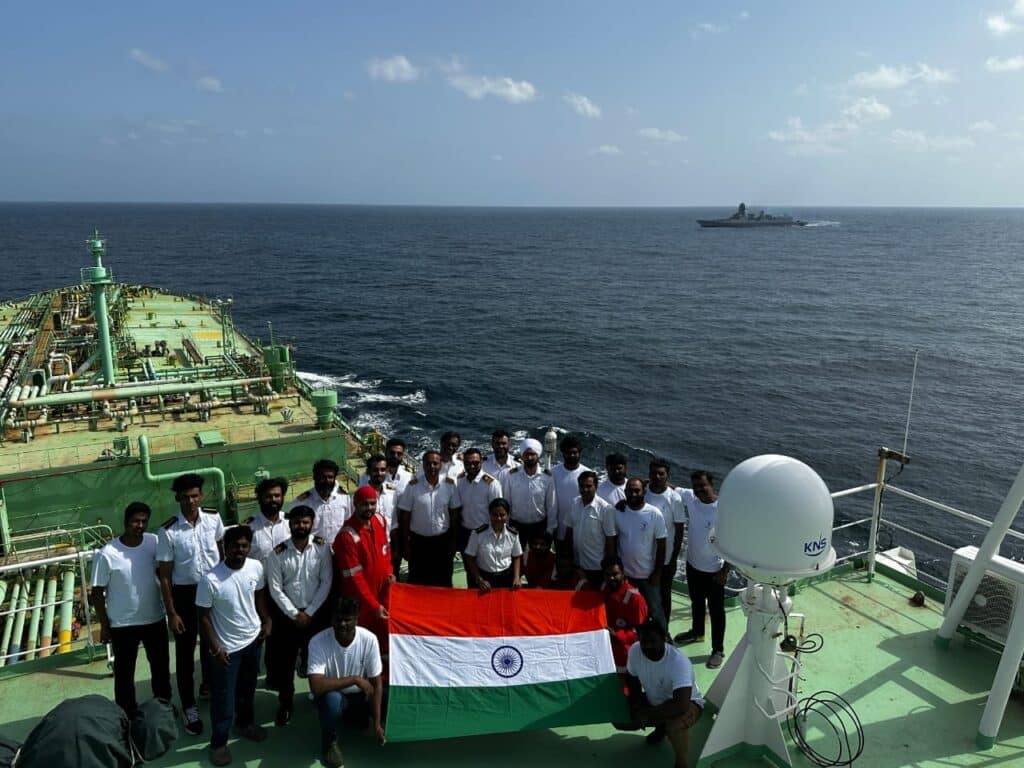
India-bound LPG tankers have resumed movement through the Strait of Hormuz, marking a carefully managed breakthrough in a crisis that has disrupted one of the world’s most critical energy corridors. The development comes after weeks of near paralysis in tanker traffic, driven by escalating tensions in West Asia that exposed the vulnerability of global fuel supply chains.
Officials in New Delhi have described the crossings as “significant but cautious progress,” underlining that while immediate supply pressure may ease, the broader situation remains fragile and subject to rapid change.
Transit Breakthrough
Two LPG carriers, BW Elm and BW Tyr, have successfully crossed the Strait of Hormuz carrying approximately 94,000 tonnes of cooking gas, with expected arrivals at Indian ports scheduled between March 31 and April 1. Their movement follows a series of earlier transits by other India-linked vessels, indicating that a limited shipping corridor has reopened after weeks of disruption.
Shipping data and government officials confirm that these vessels had been loaded well in advance but were forced to wait in Gulf waters due to security risks. Their eventual passage reflects a narrow operational window rather than a full restoration of normal maritime activity.
A senior official familiar with the situation said, “These transits are being closely coordinated and monitored at multiple levels. Each movement is assessed in real time based on security conditions in the strait.”
The successful crossings are being treated as a test case for subsequent shipments, with authorities evaluating whether similar movements can continue without incident.
Diplomatic Passage
The reopening of tanker movement has been enabled largely through diplomatic channels rather than military intervention. Iran has indicated that vessels from what it considers “non-hostile” or friendly nations are being permitted to transit the strait, provided they adhere to strict identification protocols.
This has created a selective access framework in which geopolitical alignment plays a direct role in maritime mobility. Indian vessels have been explicitly signalling their nationality and cargo type while transiting, a measure seen as critical to avoiding miscalculation in a high-risk environment.
Officials have confirmed that ships are maintaining continuous communication and broadcasting identification signals throughout their passage. At the same time, certain operational details such as final destination data are being handled cautiously to minimise exposure.
A government source said, “The priority is safe passage. Ships are complying with all necessary protocols while maintaining operational discretion where required.”
The approach reflects a balance between transparency and security, shaped by the realities of navigating a conflict-affected maritime zone.
Stranded Fleet Risk
Despite the recent progress, a significant number of Indian-linked vessels remain in the region, highlighting the scale of the disruption. Around 18 ships, including LPG carriers, crude tankers, container vessels and bulk carriers, are still positioned in the western Gulf, awaiting clearance to move.
These vessels carry approximately 485 Indian seafarers, placing human safety at the forefront of the crisis. Maritime authorities are in constant contact with ship operators and crew, monitoring conditions and coordinating next steps.
Families of seafarers have been closely following developments, with the movement of some vessels offering cautious relief but not resolution. Industry officials acknowledge that prolonged delays increase both operational and psychological strain.
A shipping executive said, “The situation is manageable but tense. Every successful crossing reduces pressure, but until all vessels are out, the risk remains.”
The presence of a mixed fleet, including energy carriers and commercial cargo ships, also underscores the broader economic implications of the disruption beyond LPG supply alone.
India’s Response
India has implemented a series of contingency measures to manage the impact of reduced tanker movement. Authorities have prioritised household LPG supply, ensuring that domestic consumption remains stable despite logistical constraints.
One of the key strategies has been the use of empty vessels already present in the Gulf. Instead of waiting for new shipments, these ships are being loaded locally with LPG, allowing faster turnaround and partial restoration of supply flow.
Officials have also adjusted distribution mechanisms within the country, including the use of alternative fuels such as kerosene in specific segments to reduce pressure on LPG demand.
A senior official involved in the response said, “We are using every available lever to maintain supply continuity. The objective is to ensure there is no visible disruption at the consumer level.”
In parallel, the Indian Navy has increased its operational readiness in nearby waters, particularly in the Gulf of Oman, to support maritime security beyond the immediate chokepoint.
Fragile Energy Outlook
The Strait of Hormuz remains a critical vulnerability in the global energy system, and the recent tanker movements do not signal a return to normalcy. Shipping activity continues under heightened risk, with insurance costs elevated and routes subject to sudden disruption.
The crisis has already triggered volatility in global energy markets, with reduced tanker flows affecting supply expectations across Asia. For India, which depends heavily on Middle Eastern LPG imports, the situation has reinforced the need for both immediate crisis management and long-term strategic planning.
Experts note that the current arrangement depends heavily on continued diplomatic understanding and the absence of escalation in the region. Any shift in the security environment could once again halt tanker movement.
An energy analyst said, “What we are seeing is a controlled reopening, not stability. The system is functioning, but under stress.”
The episode is likely to accelerate policy discussions around diversification of supply sources, expansion of strategic reserves and strengthening of maritime logistics resilience.
The movement of Indian LPG tankers through the Strait of Hormuz represents a narrowly secured lifeline rather than a lasting solution. While the immediate pressure on supplies may ease, the underlying risks remain firmly in place, leaving India’s energy security closely tied to developments in one of the world’s most volatile regions.


