

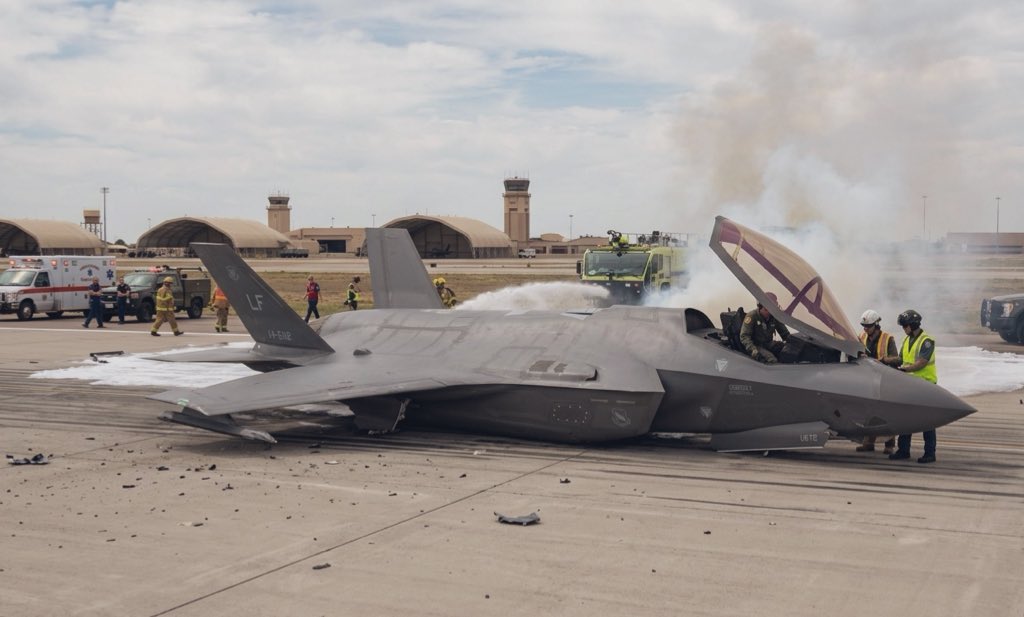
An incident involving a United States F-35 stealth fighter during a mission over Iran has triggered a sharp divide between confirmed facts and competing claims, drawing global attention to the fragile balance between advanced airpower and evolving air defence systems. While Iran has asserted that it struck the aircraft, the United States has confirmed only that the jet made an emergency landing after completing its operation.
The episode is now being closely examined not only for what happened on the battlefield, but also for what it could reveal about the limits of stealth technology, the reliability of early wartime claims, and the growing complexity of modern aerial engagements in contested regions.
What is confirmed
The United States military has acknowledged that an F-35 was involved in a combat mission over Iran and subsequently made an emergency landing at a base in the region.
“The aircraft landed safely and the pilot is in stable condition. This incident is under investigation,” a US Central Command spokesperson said.
There has been no official confirmation from the United States that the aircraft was hit by Iranian fire. The cause of the incident remains under investigation. Additional official details have not yet been released, and authorities have not specified the nature of the threat encountered during the mission.
These details represent the only fully verified account of the event at present, forming the basis of all confirmed reporting so far.
Iran’s claim
Iran’s Islamic Revolutionary Guard Corps has presented a sharply different version of events, stating that it successfully targeted the F-35 during its mission over Iranian territory.
“The fate of the fighter jet is unclear and the likelihood of its crash is very high,” the IRGC said.
Iranian officials have framed the incident as a significant military development, suggesting it reflects growing capability in countering advanced aircraft. However, no independently verified evidence has been released to confirm that the aircraft was shot down or destroyed.
These claims remain part of Iran’s official narrative, but they have not been substantiated by external verification or supporting material.
Key distinction
At the centre of the disagreement is a critical military distinction that defines how such incidents are interpreted in operational terms.
A “shot down” aircraft refers to one that is destroyed or forced out of the sky. A jet that sustains damage but returns safely is not considered a loss within standard military definitions.
At present, the only confirmed outcome is that the aircraft landed safely. Any claim beyond that remains unverified and should be treated with caution until supported by official findings.
What remains unclear
Several aspects of the incident are still unresolved, and these uncertainties continue to shape the broader understanding of what may have occurred during the mission.
There is no official confirmation that the aircraft was struck by a missile or any specific form of Iranian fire. The nature of the threat encountered has not been disclosed by US authorities.
Reports suggesting additional aircraft involvement or a broader operational impact have not been confirmed. As a result, the precise cause of the emergency landing remains unknown at this stage.
Operational context
The incident has drawn heightened attention because it comes amid rising tensions and increased aerial operations across the region involving multiple actors.
Recent reporting had suggested that US and allied aircraft were operating with a high degree of freedom in contested airspace. The current episode introduces new uncertainty into that assessment, even without confirmed evidence of a successful strike.
This shift in perception highlights the evolving risks of operating in heavily monitored and contested environments, where conditions can change rapidly.
Analytical view
While the cause remains unconfirmed, defence analysts have begun examining how such an incident could occur under current battlefield conditions and technological constraints.
Some assessments suggest that modern air defence systems may not rely solely on traditional radar. Alternative tracking methods, including systems that detect heat signatures, are often discussed in this context.
Stealth aircraft like the F-35 are designed primarily to reduce detection by radar systems. Analysts frequently note that stealth does not make an aircraft invisible, but instead reduces detection probability under specific operational conditions.
However, there has been no official confirmation that any particular detection method or weapon system was used in this case.
First of its kind?
The incident is also being discussed in terms of its potential historical significance, particularly given the advanced capabilities associated with the F-35 platform.
If it is eventually confirmed that the aircraft was hit by enemy fire, it could represent the first known instance of a US F-35 being struck during active combat operations.
At present, this remains a possibility rather than a confirmed fact, and any definitive conclusion will depend on the outcome of the ongoing investigation.
Airpower and perception
The F-35 is central to US and allied airpower strategy, designed to operate effectively in contested environments while reducing exposure to detection and engagement.
Any suggestion that such an aircraft may have been successfully engaged carries strategic implications, even if the extent of the damage remains unclear.
At the same time, the aircraft’s reported safe landing underscores its resilience and the ability to withstand operational stress, reinforcing confidence in its design.
Narrative divide
The gap between the Iranian and US accounts reflects a broader pattern often seen in conflict reporting, where competing narratives emerge alongside limited verified information.
Iran has presented the incident as evidence of its ability to challenge advanced Western systems. The United States has limited its statements to confirmed facts, avoiding conclusions about the cause of the incident.
This divergence highlights the role of strategic messaging, which often shapes early interpretations before full details become available.
What comes next
The United States has stated that the incident is under investigation, and further details are expected as assessments continue and more information becomes available.
Until more information is released, the event remains defined by a narrow set of confirmed facts and a wider field of competing claims that have yet to be verified.
A US F-35 conducted a mission over Iran and made an emergency landing. The pilot survived. The cause of the incident has not yet been established, and further clarity will depend on official findings.
Everything beyond that remains subject to verification as the situation continues to develop.


