

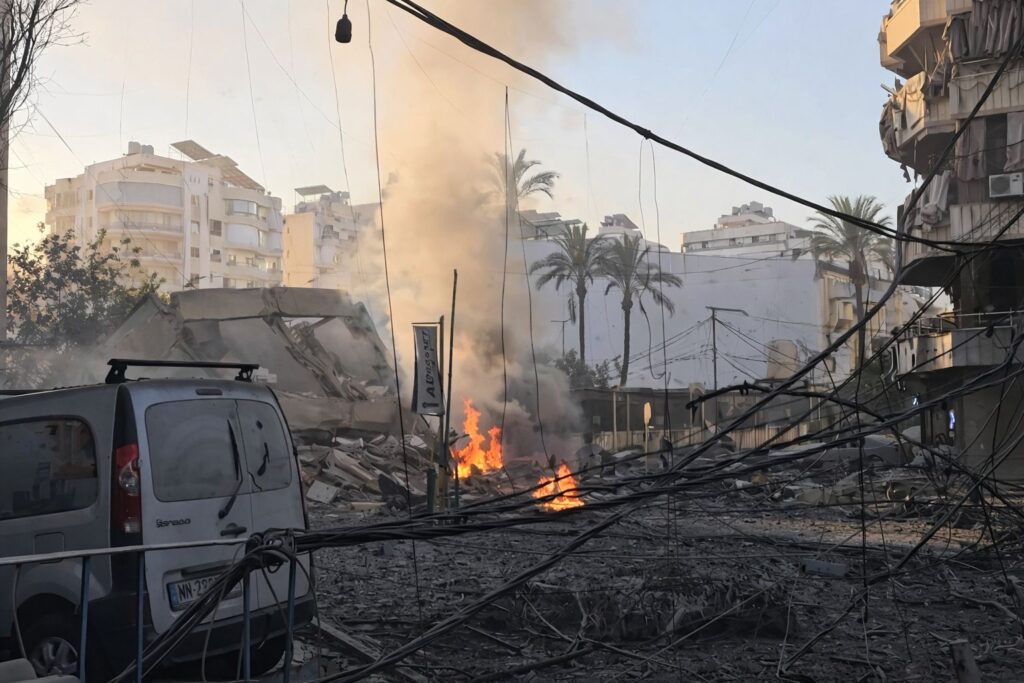
The Iran Israel war has intensified sharply following coordinated United States and Israeli strikes on Tehran, triggering sustained Iranian missile retaliation across Israel and the Gulf. In the most significant escalation so far, six US service members were confirmed killed in an Iranian missile strike on a base in Kuwait, while missile exchanges continue across multiple fronts. Airspace disruptions, rising civilian casualties and emergency diplomatic efforts now define a conflict that has entered its most volatile phase.
Live updates from international broadcasters indicate that military operations remain active, with neither side signalling immediate de-escalation .
Strike on Tehran
US and Israeli forces conducted precision air and missile strikes targeting Iranian military command centres, ballistic missile facilities and leadership compounds in Tehran. Iranian state authorities confirmed that Supreme Leader Ali Khamenei was killed during the operation, along with senior Revolutionary Guard commanders.
US President Donald Trump described the strike as a defensive action against what he called “an imminent and growing threat,” stating that operations would continue if necessary to protect American forces and regional allies .
Israeli Prime Minister Benjamin Netanyahu said the action removed “a strategic threat to Israel’s survival” and warned that Israel would respond decisively to any further aggression .
Iran condemned the strike as an act of war and vowed sustained retaliation.
Iranian Missile Barrage
Within hours of the Tehran strike, Iran launched multiple waves of ballistic missiles and armed drones toward Israeli territory. Air defence systems intercepted many projectiles, but several impacts were confirmed in residential areas, resulting in civilian deaths and injuries .
Iranian military officials stated that retaliation would continue until what they described as “full accountability” is achieved.
Missile and drone trajectories were also detected over Bahrain, Qatar, Kuwait, Saudi Arabia and the United Arab Emirates, prompting emergency air defence activations and temporary airspace closures across parts of the Gulf .
Six US Soldiers Killed
US Central Command confirmed that six American service members were killed in an Iranian missile strike on a US tactical operations centre in Kuwait . Two additional personnel were initially missing but later confirmed among the fatalities.
The Pentagon stated that the strike directly targeted US military infrastructure during Iran’s retaliatory campaign. Officials described the incident as the deadliest single attack on US forces in the conflict to date.
President Trump said the United States “will honour their sacrifice” and warned that further attacks on American personnel would bring additional consequences.
US Jets Downed in Kuwait
In a separate incident reflecting the intensity of the battlespace, three US F-15E fighter jets were shot down over Kuwait in what officials described as a friendly fire incident during heightened defensive operations . All crew members ejected safely.
US defence officials confirmed that the aircraft were not hit by Iranian fire but were mistakenly engaged by allied air defence systems operating under extreme threat conditions.
The episode underscores the complexity of simultaneous missile, drone and aircraft activity across multiple national airspaces.
Lebanon Front Expands
The conflict broadened when Hezbollah launched rockets from southern Lebanon toward northern Israel, declaring solidarity with Iran. Israeli forces responded with targeted airstrikes against Hezbollah positions near the Lebanese border and in Beirut’s southern districts .
Lebanese authorities warned against further escalation, as civilian displacement increases in southern regions.
Gulf on High Alert
Governments across the Gulf remain on heightened military alert. The United Arab Emirates reported intercepting several drones and missiles, though debris caused limited property damage. Saudi Arabia reinforced security around key energy facilities.
Oil markets reacted immediately, with prices rising amid fears of potential disruption to shipping through the Strait of Hormuz . Maritime insurers have raised premiums as naval patrols intensify.
Commercial airlines suspended or rerouted flights across sections of Middle Eastern airspace, affecting global travel networks.
UN Emergency Session
The United Nations Security Council convened emergency meetings to address the escalating crisis. Secretary-General António Guterres warned that the region stands “on the brink of a broader war” and urged all parties to exercise maximum restraint .
Iran’s ambassador described the US and Israeli strikes as violations of international law, while US representatives defended the operation as lawful self-defence against credible threats.
The International Atomic Energy Agency called for strict protection of nuclear facilities amid concerns about potential escalation near sensitive sites.
Civilian Casualties Rising
Casualty figures continue to increase in both Iran and Israel. Iranian authorities reported significant fatalities following the Tehran strike and subsequent exchanges. Israeli officials confirmed civilian deaths from missile impacts in urban centres.
Hospitals across affected areas are operating under emergency conditions. Rescue teams continue search operations in damaged residential buildings.
Human rights organisations have called for independent investigations into reported strikes affecting civilian infrastructure.
Political and Strategic Fallout
The killing of Iran’s Supreme Leader has created uncertainty within the country’s political structure. Analysts note that while succession mechanisms exist, the loss of the country’s highest authority introduces strategic unpredictability.
Israeli authorities have declared a national emergency and mobilised reservists. The United States has reinforced its regional military presence while signalling that operations remain limited to strategic objectives.
European leaders have urged immediate de-escalation and the reopening of diplomatic channels. China and Russia called for restraint and warned against actions that could destabilise the broader region .
Outlook
With six US soldiers confirmed dead, continued missile exchanges and expanding regional involvement, the Iran Israel war has become the defining geopolitical crisis of 2026. Live reporting indicates ongoing strikes and defensive operations, suggesting that the confrontation remains active and fluid .
Diplomatic engagement continues behind the scenes, but no ceasefire has been announced. The trajectory of the conflict will depend on whether further retaliation widens the theatre of operations or whether international pressure succeeds in halting escalation.
For now, missile alerts, military mobilisations and emergency diplomacy dominate the region, as the Middle East confronts one of its most dangerous moments in recent history.


