

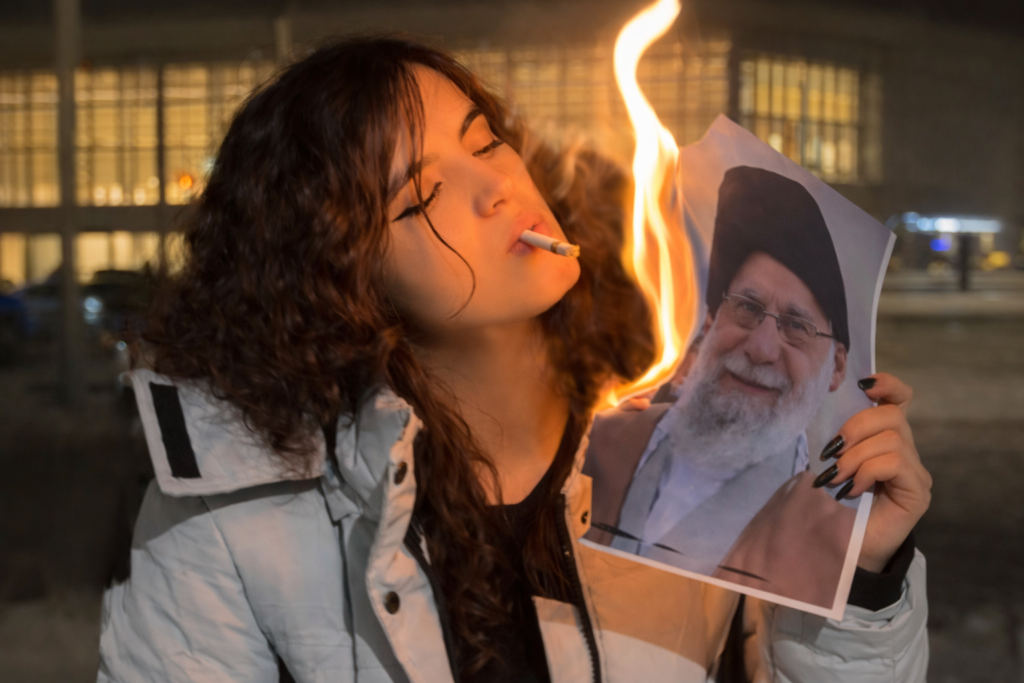
A brief video showing an Iranian woman lighting a cigarette with a burning photograph of the country’s Supreme Leader has become one of the most arresting images to emerge from Iran’s latest wave of unrest. Filmed without slogans or sound, the act has nonetheless sent a message that is unmistakable inside the Islamic Republic: fear around power is eroding.
Circulated online in early January, the footage has been widely shared and replicated by other women, despite the serious legal risks involved. As protests driven by economic hardship, electricity blackouts and political frustration spread across parts of Iran, the image has come to symbolise not just anger at living conditions, but a deeper rejection of authority.
At the centre of the act is the image of Ayatollah Ali Khamenei, a figure whose portrait is omnipresent in public institutions and whose authority is legally protected from insult. Burning that image in public, and using it to light a cigarette, represents a rare and deliberate challenge to the foundations of the system.
The Viral Video
The video first appeared on social media on January 9 and spread rapidly across platforms including X, Instagram and Telegram. Within hours, it was being reposted by journalists, activists and Iranian diaspora accounts. Soon after, similar images began to surface, showing women burning or tearing photographs of the Supreme Leader and sharing the footage online.
Most of the posts were anonymous, and in many cases the exact location could not be independently confirmed. However, the repetition of the same act across multiple clips suggested a growing trend rather than an isolated incident. The images were later combined into collages, reinforcing the sense that a shared form of protest was taking shape.
Unlike large demonstrations, these acts required no coordination, no crowds and no public chants. Their power lay in their clarity and their ability to travel quickly across digital platforms.
The Message Behind the Act
For protesters, the act conveys several messages at once. First, it signals open contempt for a political authority that many Iranians now hold responsible for economic collapse and social repression. By burning the Supreme Leader’s image, protesters are not appealing for reform but expressing rejection.
Second, the cigarette itself carries meaning. Smoking, particularly by women in public, is frowned upon and socially policed. Using the Supreme Leader’s image as a disposable tool to light a cigarette reduces a powerful symbol of the state to something temporary and consumable. Activists describe this as an assertion that authority is no longer sacred or permanent.
Third, the silence of the act matters. There are no slogans or banners. The message is visual and direct, designed to be understood instantly and shared easily. In an environment where speech is restricted, imagery has become a substitute for words.
Together, these elements communicate a clear sentiment emerging from the protests: anger has moved beyond demands for relief and into a challenge to legitimacy.
Why the Risk Is High
Under Iranian law, insulting or defacing the image of the Supreme Leader is a serious criminal offence. Past cases show that such acts can lead to arrest, imprisonment and harsh punishment. The image of the Supreme Leader is treated as a core symbol of the state and its ideology.
Women who participate in these acts face additional scrutiny. Female behaviour in public spaces is closely regulated, and women have historically been among the first targets during crackdowns on protest movements. Appearing on video while committing a political offence significantly increases personal risk.
Human rights organisations have documented cases in which individuals were identified through social media footage months after protests subsided. Activists warn that the absence of immediate arrests does not mean participants are safe.
Women and Protest
Women have played a central role in Iran’s protest movements over the past decade. From opposition to compulsory dress codes to nationwide unrest following the death of Mahsa Amini, women-led acts have often defined the tone and imagery of dissent.
The cigarette video continues this pattern but reflects a change in method. Rather than mass street protests, the focus here is on individual, symbolic defiance. Each act stands alone but gains strength through repetition and circulation.
Analysts say this reflects both adaptation and exhaustion. After years of crackdowns, many protesters have turned to forms of resistance that minimise coordination while maximising visibility.
Iran’s Economic Pressure
The spread of these images coincides with renewed protests across Iran triggered by worsening economic conditions. In recent weeks, demonstrations have been reported in several cities over prolonged electricity blackouts, rising food prices, unemployment and fuel shortages.
Iran’s economy has been under sustained pressure from inflation, currency depreciation and sanctions. Rolling power cuts during winter have disrupted households and businesses, intensifying public frustration. Many protesters argue that daily hardships are no longer temporary problems but symptoms of deeper mismanagement.
The cigarette videos have emerged as a visual response to these conditions. Rather than listing grievances, they express a broader sentiment that the system is failing its people.
A Shift in Protest Language
Earlier protest waves often focused on specific demands such as wage increases, fuel prices or social freedoms. The current imagery suggests a shift toward symbolic confrontation with the state itself.
Burning the image of the Supreme Leader crosses a line that many Iranians once considered untouchable. Its growing visibility suggests that the psychological barrier of fear is weakening, even if political change remains uncertain.
This does not indicate a single organised movement or ideology. Instead, it points to a shared mood in which direct challenges to authority are no longer unthinkable.
Digital Circulation
Despite repeated efforts by Iranian authorities to restrict internet access during unrest, videos and images continue to circulate. Content is often uploaded after delays or shared through encrypted messaging services and diaspora networks.
The cigarette footage illustrates how short clips can evade suppression. Even when original posts are removed, copies persist. Each repost extends the life of the image and widens its audience.
This decentralised flow of protest material has become a defining feature of dissent in Iran, allowing individual acts to reach national and international audiences.
Voices Outside Iran
Iranian activists abroad have amplified the footage, framing it as evidence of growing boldness inside the country. Journalist and women’s rights advocate Masih Alinejad described the act as fearless, presenting it as part of a broader challenge to repression.
Such amplification has drawn global media attention, while Iranian officials have previously accused exiled activists of fuelling unrest. Those accusations are often used domestically to justify arrests and restrictions.
The government has not issued a specific response to the cigarette videos, but past patterns suggest that symbolic acts targeting the Supreme Leader are treated seriously.
Political Undercurrents
Alongside spontaneous acts of defiance, broader opposition narratives continue to surface. Supporters of Reza Pahlavi, the exiled son of Iran’s last monarch, have used protest imagery to promote alternative political visions.
There is no evidence of a unified opposition leadership inside Iran. Protesters include workers, students and women responding to different pressures. What connects them is a growing willingness to express dissent openly and visually.
The burning of the Supreme Leader’s image reflects this widening scope of protest, moving beyond policy criticism to symbolic rejection.
A Protest Image That Speaks
The woman in the original video remains unidentified, and authorities have not confirmed where the footage was recorded. Her anonymity has only strengthened the image’s impact, allowing it to represent a broader segment of society rather than a single individual.
As protests continue amid economic strain and infrastructure failures, the burning of the Supreme Leader’s portrait has emerged as one of the clearest visual statements of the current unrest. Silent and brief, the act conveys frustration with living conditions, anger at political leadership and a willingness to confront symbols of power directly.
In a system where symbolism is central to authority, the destruction of that symbolism has become a message in itself.


