

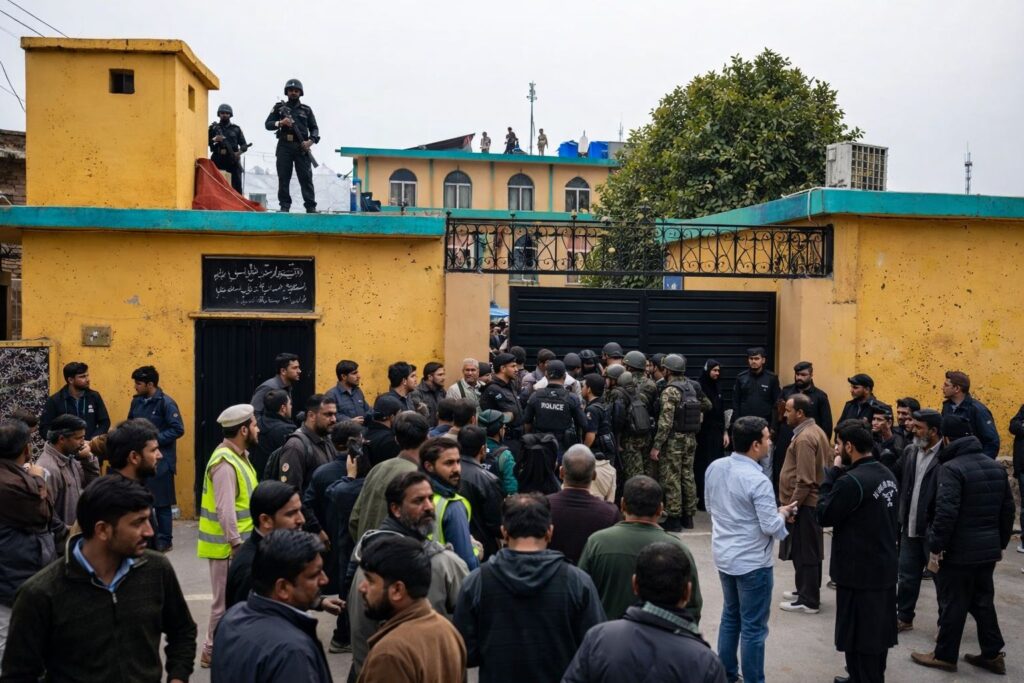
Islamic State has claimed responsibility for a suicide bombing at a Shiite mosque in Islamabad that killed at least 36 people and injured more than 170 others, Pakistani authorities said, marking one of the deadliest militant attacks in the capital in recent years.
The attack occurred on February 6 during Friday prayers at the Khadija Tul Kubra Imambargah in the Tarlai Kalan area on the southeastern outskirts of Islamabad, when hundreds of worshippers were gathered inside the mosque.
Security officials said the bomber detonated an explosive vest after being stopped at the mosque gate, triggering widespread casualties inside the prayer hall.
How the Attack Happened
According to police and security officials, the suicide bomber arrived at the mosque shortly after 1 pm local time. When security personnel attempted to stop him at the entrance, the attacker opened fire, injuring guards stationed at the gate.
The attacker then ran into the mosque compound and detonated an explosive vest inside the crowded prayer hall. The blast caused extensive damage to the interior of the mosque, with debris and shrapnel scattered across the hall.
Emergency responders said the timing of the explosion during peak prayer hours significantly increased the number of casualties.
Casualties and Medical Response
Hospital authorities later confirmed that the death toll had risen to 36, after several critically injured victims succumbed to their wounds. At least 169 people were injured, many suffering from blast trauma, shrapnel wounds, and internal injuries.
Medical officials said emergency wards at major hospitals in Islamabad were placed on high alert, with doctors performing emergency surgeries through the night. Several injured remained in critical condition.
Islamic State Claim
Islamic State claimed responsibility for the attack through its official communication channels, describing the bombing as a suicide operation targeting Shiite worshippers. The group released an image it said showed the attacker prior to the assault.
Security officials said the claim was consistent with the group’s previous attacks on religious minorities in Pakistan and aligned with its broader sectarian campaign.
Authorities said the claim was being assessed alongside forensic and intelligence findings.
Identity of the Attacker
Investigators identified the bomber as Yasir, a 32-year-old Pakistani national from Peshawar. Officials said the attacker was linked to an Islamic State affiliate operating in Pakistan.
Security officials said preliminary findings indicated Yasir had spent around five months in Afghanistan, where he allegedly received training in weapons handling and suicide attack tactics before returning to Pakistan.
Authorities said the attacker did not act alone and was part of a broader militant network.
Explosives and Forensic Findings
Police sources said the suicide vest contained between four and six kilograms of high-grade explosives. Investigators recovered ball bearings, metal fragments, and bullet casings from the scene.
Officials said the use of ball bearings indicated an intent to maximise casualties. Forensic teams continued to examine the explosive materials to trace their origin and manufacturing method.
Arrests and Security Operations
Pakistan’s military and intelligence agencies launched nationwide security operations following the bombing. Authorities said four suspects were arrested, including three alleged facilitators and one individual described as the mastermind behind the attack.
Raids were conducted in multiple locations, including Peshawar and Nowshera, based on intelligence gathered after the blast. Officials said further arrests were possible as investigations continued.
Security agencies said the facilitators provided logistical support, movement assistance, and safe communication channels to the attacker.
Pakistan’s Official Position
Pakistan’s government linked the Islamabad suicide bombing to cross border militancy, with senior officials alleging external involvement.
Minister of State for Interior and Narcotics Talal Chaudhry said the attack was sponsored by India and facilitated with support from Afghanistan, citing what he described as preliminary intelligence findings. He did not present evidence to substantiate the claims.
Pakistani officials also said the attacker had travelled across regions prior to the bombing and was part of a wider militant network. They added that investigations were continuing and that further details would be shared after security assessments were completed.
India’s Response
India rejected Pakistan’s allegations of involvement in the Islamabad attack. The Ministry of External Affairs described the claims as baseless and reiterated that India had no role in the bombing.
India condemned the attack and expressed condolences to the families of the victims, stating that Pakistan should address its internal security challenges rather than attributing blame externally.
Security Concerns in Islamabad
The bombing raised concerns over security in Islamabad, a city that has generally remained insulated from large scale militant attacks compared to other parts of Pakistan.
Security analysts said the ability of a suicide bomber to reach a crowded mosque during Friday prayers highlighted gaps in intelligence coordination and urban security measures. Authorities increased security at religious sites nationwide following the attack.
Sectarian Targeting
Shiite Muslims have been repeatedly targeted by extremist groups in Pakistan over the past two decades. Officials said the attack at the Islamabad mosque followed a pattern of sectarian violence aimed at religious minorities during large congregations.
Security agencies said preventing further sectarian attacks remained a priority as counterterrorism operations continued.
International Reaction
Governments and international organisations condemned the bombing, describing it as an attack on civilians and places of worship. Statements of condolence were issued by regional and global leaders.
Pakistan said it would continue counterterrorism operations against militant networks responsible for attacks on civilians.


