

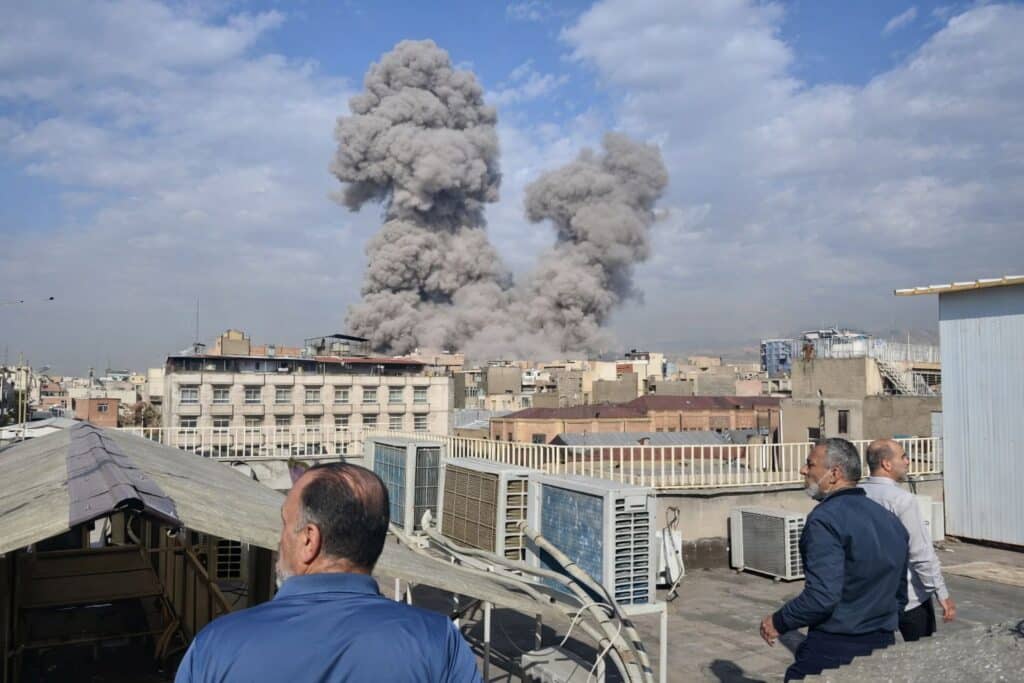
The United States and Israel launched coordinated airstrikes on Iran early Friday in a dramatic escalation that targeted key military and nuclear facilities, marking one of the most direct confrontations between the adversaries in years.
The operation, named “Operation Roaring Lion,” struck multiple sites across Tehran and other strategic locations. Explosions were reported near military command centers, suspected nuclear infrastructure and security compounds linked to Iran’s top leadership.
US President Donald Trump and Israeli Prime Minister Benjamin Netanyahu said the strikes were aimed at neutralizing what they described as an imminent nuclear threat and degrading Iran’s military capabilities.
Iran confirmed it had been attacked and vowed retaliation.
The Operation
According to US and Israeli officials, the strikes began before dawn, involving advanced fighter aircraft, precision-guided munitions and long-range strike capabilities. Israeli defense officials described the operation as “highly coordinated,” with US forces targeting key infrastructure while Israeli aircraft focused on military assets and command facilities.
Explosions were reported across Tehran, including areas believed to house senior leadership compounds. Iranian state media acknowledged strikes on military installations but did not immediately detail the extent of the damage.
Initial reports suggested a possible strike near a compound associated with Iran’s Supreme Leader Ali Khamenei. Iranian authorities have not confirmed his status, and there has been no public appearance from him since the attacks.
US officials said the operation targeted facilities tied to Iran’s nuclear development and military command structure. They described the strikes as precise and limited in scope, focused on strategic degradation rather than broad bombardment.
How It Began
Tensions had been building for months amid mounting accusations that Iran was advancing its nuclear capabilities beyond previously declared thresholds. Israeli officials repeatedly warned that Tehran was nearing a critical point in uranium enrichment.
The crisis intensified following unrest inside Iran in January 2026, when protests erupted over economic hardship and political repression. Iranian security forces responded with a sweeping crackdown, detaining hundreds and deploying heavy force in major cities.
In recent weeks, US intelligence assessments concluded that Iran had accelerated certain nuclear activities. Israeli leadership publicly signaled readiness to act, while Washington increased its military posture in the region.
Senior US officials said diplomatic channels had narrowed significantly in recent days, culminating in what they described as a decision to act “to prevent further escalation of nuclear capability.”
Trump’s Statement
President Trump addressed the nation hours after the strikes, framing the operation as both a security necessity and a message to Iran’s leadership.
“We acted tonight to stop a nuclear threat that should never have been allowed to grow,” Trump said from the White House. “The Iranian regime has pushed the world to the brink. That ends now.”
He described the operation as “decisive, precise and overwhelmingly successful,” adding that US forces “performed flawlessly.”
Trump also directed remarks toward the Iranian public.
“To the people of Iran, we see your courage,” he said. “You have suffered under a regime that has silenced you, jailed you and crushed your voices. Now is your moment. Rise up and reclaim your future.”
He continued: “This is not a war against the Iranian people. This is action against a regime that threatens peace, stability and its own citizens.”
The president warned Tehran against retaliation. “Any attack on American forces or interests will be met with a response far greater than what was witnessed tonight,” he said.
Netanyahu’s Position
Prime Minister Netanyahu called the operation a “historic and necessary action.”
“For years we have said that Iran’s nuclear ambitions pose an existential threat,” Netanyahu said in a televised address. “Tonight we acted to remove that threat.”
He praised coordination with Washington, saying the United States and Israel were “fully aligned in preventing a nuclear-armed Iran.”
Israeli defense officials stated that the strikes targeted facilities believed to be central to Iran’s weapons development and military planning.
Iran Responds
Within hours of the airstrikes, Iran launched missiles toward Israel and at least one US military installation in the region, according to defense officials.
Air defense systems were activated in Israel as sirens sounded in multiple areas. The US military confirmed incoming missile activity near one of its bases but did not immediately report casualties.
Iran’s Revolutionary Guard described the retaliation as “the beginning of a crushing response.” State media broadcast images of missile launches and explosions in the night sky.
Tehran condemned the joint operation as “aggression” and accused Washington and Tel Aviv of violating international law.
Strikes on Key Sites
Military analysts say the targeted facilities appear to include suspected enrichment-related infrastructure and command centers linked to Iran’s defense apparatus.
Satellite imagery circulating after the strikes showed smoke rising from areas near known military compounds in Tehran. Iranian officials have not provided a full damage assessment.
US officials maintained that the objective was to disrupt nuclear progression and degrade command capacity, not to initiate a prolonged conflict.
Defense sources described the planning as months in the making, involving intelligence coordination and strategic positioning across the region.
Situation on the Ground
Iranian authorities imposed tighter security measures across major cities following the attacks. Internet disruptions were reported in parts of Tehran.
Videos circulating online showed mixed reactions. Some footage appeared to show groups gathering in defiance of the government, while other scenes reflected anger over the foreign strikes.
There was no immediate confirmation of civilian casualties. Hospitals in Tehran were reportedly placed on emergency footing as a precaution.
A Direct Confrontation
The joint strikes represent one of the most overt military actions taken by the United States and Israel against Iranian territory in recent years.
Washington described the action as limited and targeted. Tehran characterized it as a declaration of hostility.
As missile exchanges continued and military forces remained on alert, both sides signaled readiness for further escalation if attacked again.
President Trump reiterated his stance in closing remarks: “We will not allow Iran to obtain a nuclear weapon. Not now. Not ever.”
The situation remains fluid, with both governments monitoring developments and military assets on high readiness across the region.


