

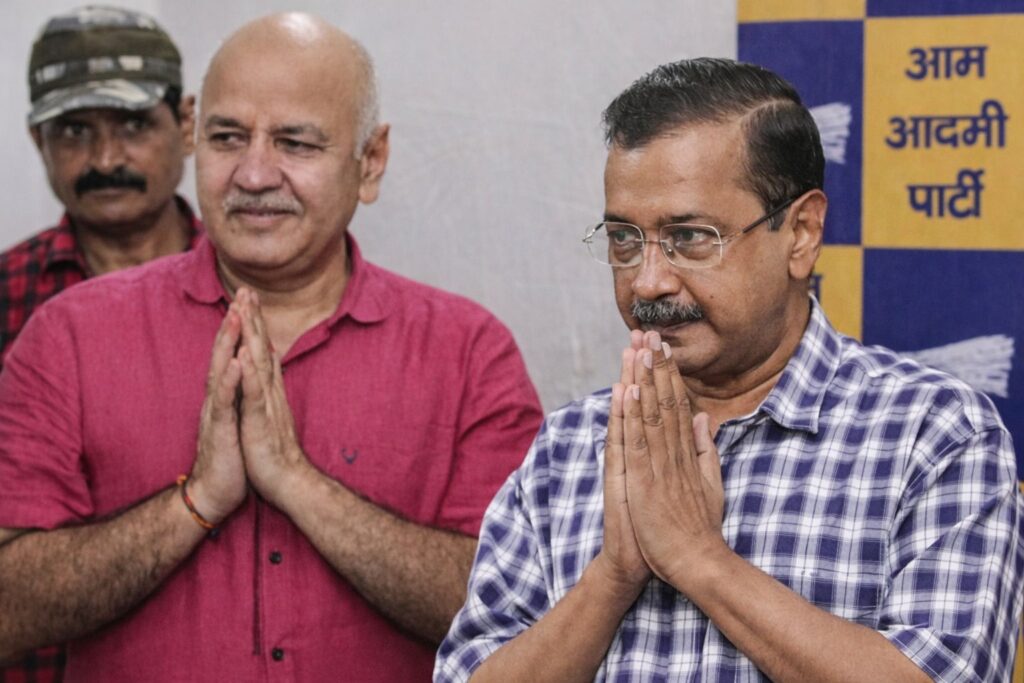
Delhi court on Thursday discharged former Chief Minister Arvind Kejriwal and former Deputy Chief Minister Manish Sisodia in the Central Bureau of Investigation case linked to the scrapped 2021–22 excise policy, ruling that there was no prima facie evidence of criminal conspiracy, corruption or unlawful intent.
Special Judge Jitendra Singh of the Rouse Avenue Court held that the prosecution failed to place sufficient material on record to justify framing charges. The court also discharged 21 other accused.
The order marks a decisive judicial setback for the CBI in one of the most politically consequential investigations in the capital in recent years.
No Overarching Conspiracy
In a detailed ruling, the court said there was no material to support the allegation of an overarching criminal conspiracy behind the excise policy.
The judge observed that policy decisions, even if later withdrawn or controversial, cannot be criminalised in the absence of demonstrable evidence of illegal gain or intent. Suspicion, however strong, cannot substitute proof.
The prosecution had alleged that changes in the excise regime were designed to favour select licensees and that kickbacks were exchanged. The court found no evidence establishing a meeting of minds among the accused or any direct trail of unlawful benefit attributable to Kejriwal or Sisodia.
Chargesheet Under Scrutiny
The court was particularly critical of the manner in which the prosecution built its case.
It noted that the chargesheet relied heavily on inferences, selective statements and narrative reconstruction rather than independent corroboration. Several allegations, the judge said, were not supported by documentary evidence or consistent witness testimony.
Importantly, the court scrutinised the prosecution’s dependence on approver statements. It observed that the statements of cooperating witnesses appeared to fill gaps in the investigative narrative rather than being supported by independent material evidence. The judge cautioned that approver testimony, by itself, cannot form the foundation of criminal prosecution unless corroborated by credible and substantive proof.
The order emphasised that criminal law demands a clear evidentiary chain linking the accused to the alleged offence. In this case, the court concluded that the threshold required to proceed to trial was not met.
Background of the Policy
The controversy dates back to the Delhi government’s 2021–22 excise policy, introduced as a structural reform of the capital’s liquor trade.
The policy ended the government’s direct role in retail liquor sales and shifted to a fully privatised model. The administration had argued that the reform would increase revenue, reduce cartelisation and improve consumer experience.
In 2022, the Lieutenant Governor recommended a CBI probe citing alleged procedural irregularities and potential losses to the exchequer. The policy was subsequently withdrawn.
The CBI registered a corruption case alleging that certain provisions were altered to benefit specific distributors and that kickbacks were routed through intermediaries. The Enforcement Directorate initiated a parallel money laundering investigation.
Arrests and Detention
The case led to the arrest of Manish Sisodia in February 2023. He remained in custody for approximately 530 days before being granted bail. Arvind Kejriwal was arrested later and spent about 156 days in jail before securing relief.
Their incarceration dominated political discourse in Delhi and beyond, triggering protests and sharp exchanges between the Aam Aadmi Party and the Bharatiya Janata Party.
Following the court’s ruling, Sisodia said, “For 530 days, I was in jail. I kept asking where the evidence was. Today the court has answered that question.”
Kejriwal’s Response
Addressing supporters after the order, Kejriwal described the ruling as a vindication.
“I am not corrupt. Today the court has said what we have been saying from the beginning. There was no scam,” he said.
He framed the verdict in constitutional terms, stating, “This is not just our victory. This is a victory of truth and democracy. False allegations cannot silence an elected government.”
Referring to his time in custody, he added that his family and colleagues endured hardship but did not waver. “If standing for honesty means facing jail, we are ready,” he said.
Sisodia’s Statement
Sisodia adopted a restrained but pointed tone. “No chargesheet, however bulky, can substitute for proof,” he said, adding that the judgment reaffirmed faith in due process.
He thanked supporters and said the outcome demonstrated that allegations must be tested against legal standards rather than political narratives.
His “530 days” remark quickly became symbolic of the case’s trajectory, underscoring the contrast between prolonged detention and the court’s finding of insufficient evidence.
Political Implications
The discharge order comes after the Aam Aadmi Party faced setbacks in the 2025 Delhi Assembly elections, where the excise case featured prominently in campaign rhetoric.
For the party, the ruling provides an opportunity to argue that its leadership was subjected to a flawed prosecution. Party leaders described the verdict as confirmation that the allegations lacked substance.
Opposition figures maintained that the investigative process was initiated based on serious complaints and that the CBI is expected to challenge the ruling before a higher court.
Legal Significance
A discharge is distinct from an acquittal. An acquittal follows a full trial and a finding of not guilty. A discharge means the court has determined that the material presented does not justify proceeding to trial.
Legal experts note that conspiracy charges require proof of agreement and intent, supported by a consistent evidentiary chain. The court’s emphasis on the absence of corroborated material, particularly regarding approver statements, underscores the judiciary’s insistence on rigorous standards in corruption cases.
The Central Bureau of Investigation is expected to file an appeal before the Delhi High Court. Until then, the order stands as one of the most consequential judicial developments in recent Delhi politics.
The Broader Message
The excise policy case reshaped Delhi’s political narrative, led to high profile arrests and triggered institutional confrontation between the elected government and central agencies.
With the court concluding that there was no prima facie case of conspiracy or criminal intent, the narrative has shifted sharply.
Whether appellate courts revisit the matter remains to be seen. For now, the ruling sends a clear signal: in criminal law, allegations must rest on demonstrable evidence. In its absence, even the most politically charged cases cannot proceed.


