

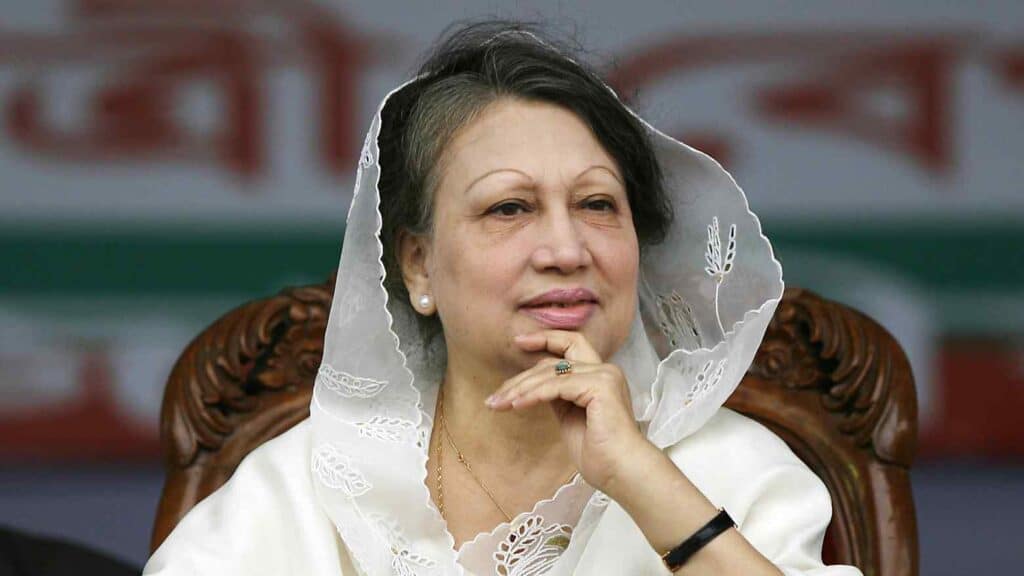
Bangladesh is in mourning following the death of Khaleda Zia, the country’s first female Prime Minister and a central figure in shaping its modern political landscape. She passed away on 30 December 2025 at the age of 80 after a prolonged illness that had kept her under intensive medical care for weeks. Widely regarded as one of the most influential and polarising leaders in Bangladesh’s history, Khaleda Zia’s political career spanned more than four decades, encompassing landmark reforms, fierce electoral battles, and a rivalry with Awami League leader Sheikh Hasina that defined the nation’s politics.
Her tenure was marked by both significant achievements, including the restoration of parliamentary democracy and social development initiatives, and controversies that sparked debates over governance and accountability. Khaleda Zia’s passing represents not just the end of a personal journey but the closure of a pivotal chapter in Bangladesh’s political history, leaving a lasting imprint on the country’s democratic evolution, party politics, and role in regional diplomacy.
Death Confirmed
Khaleda Zia died at 6:00 AM at Evercare Hospital in Dhaka, where she had been receiving treatment for multiple health complications. She suffered from advanced liver cirrhosis, diabetes, arthritis, heart and chest infections, and pneumonia. Despite intensive medical care, her condition worsened in the weeks preceding her death.
Authorities had arranged for a potential transfer abroad, including via a Qatari air ambulance, but her fragile health made it too risky. The Bangladesh Nationalist Party (BNP) confirmed her death and appealed to the public to pray for her soul.
National Mourning and Tributes
The government declared three days of state mourning following Khaleda Zia’s death. Flags flew at half-mast across government offices and public institutions. Sporting events, including cricket matches and other national competitions, were suspended as a mark of respect.
Tributes crossed political divides. Citizens gathered near hospitals, party offices, and public spaces to honor her life and contributions. PM Narendra Modi expressed deep sadness, offering condolences to her family and the people of Bangladesh. He remembered her contributions to India-Bangladesh relations, recalling their 2015 meeting in Dhaka, and emphasized that her vision and legacy would continue to guide bilateral cooperation.
Khaleda Zia’s son, Tarique Rahman, shared a deeply personal tribute, describing her as the Mother of Democracy. He highlighted her resilience, sacrifices, and enduring commitment to the nation, emphasizing that despite personal losses, arrests, and persecution, she remained a loving mother and a guiding presence for the country.
Political Rivalry With Sheikh Hasina
Khaleda Zia’s political career was defined by her long-standing rivalry with Sheikh Hasina, leader of the Awami League. Over three decades, the two women alternated in power, shaping Bangladesh’s political landscape. Their rivalry, often referred to as the “Battle of the Begums”, resulted in protests, election boycotts, and legal disputes, influencing governance, party politics, and voter alignment.
Early Life and Political Rise
Born on 15 August 1945 in Jalpaiguri, then part of undivided Bengal, Khaleda Zia had no early political ambitions. Her entry into politics followed the assassination of her husband, President Ziaur Rahman, in 1981. She stepped into the political arena to preserve his legacy and joined the Bangladesh Nationalist Party (BNP), quickly rising through the ranks.
By 1984, she became the chairperson of the BNP, consolidating her position in a male-dominated political environment. Her leadership combined charisma, strategic acumen, and resilience, allowing her to navigate challenges in Bangladesh’s complex political landscape.
Prime Ministerial Tenure
Khaleda Zia served two terms as Prime Minister, from 1991 to 1996 and 2001 to 2006. Her first term came after the restoration of parliamentary democracy, following years of military rule. She focused on institutional reforms, democratic strengthening, and governance stabilization.
During her second term, she promoted economic growth, social welfare, and educational reforms, including increased primary education access, particularly for girls. She was among the first women in a Muslim-majority country to lead a democratically elected government, following pioneers like Benazir Bhutto.
Controversies and Legal Challenges
Khaleda Zia’s political life included legal challenges and corruption allegations. In 2018, she was convicted in a case involving an orphanage trust, which her party described as politically motivated. She spent years under house arrest or imprisonment, restricting her political engagement.
In January 2025, the Supreme Court of Bangladesh acquitted Khaleda Zia, allowing her to resume full political activity. Her son, Tarique Rahman, who led the BNP during her illness, recently returned from 17 years in self-exile, marking a pivotal moment for the party’s future.
Foreign Policy and India Relations
Khaleda Zia emphasized national sovereignty in her foreign policy, particularly toward India. While relations improved later in her career, she often linked cooperation to strategic gains. Her approach shaped decades of regional diplomacy, trade, and security cooperation, influencing Bangladesh’s foreign policy direction.
Democratic Reforms and Governance
Khaleda Zia played a key role in Bangladesh’s democratic transition, overseeing the shift from military to civilian rule. She championed the caretaker government system, which became central to ensuring free and fair elections.
Her policies promoted education, women’s empowerment, and economic development, though her tenure also drew criticism for political polarization and corruption allegations. Her reforms, however, left a lasting impact on Bangladesh’s institutional framework.
Legacy, BNP, and Elections
As the first female Prime Minister, Khaleda Zia became a symbol of women’s empowerment in South Asia. Her leadership inspired generations of women to participate in politics. She strengthened the BNP’s position and shaped national discourse, leaving a legacy of resilience, sacrifice, and democratic advocacy.
Her death comes just weeks before the general elections scheduled for February 2026. With Tarique Rahman now leading the BNP, the party faces critical challenges in consolidating support and maintaining its electoral strength. Khaleda Zia’s legacy continues to shape the party’s strategies and voter engagement, ensuring her influence endures in Bangladesh’s political arena.
Global leaders expressed condolences and paid tribute to Khaleda Zia. PM Narendra Modi highlighted her contributions to India-Bangladesh relations and her historic role as a female leader. Diplomatic missions worldwide recognized her influence on Bangladesh’s political and economic trajectory, reflecting her status as a significant regional stateswoman.
End of an Era
Khaleda Zia’s death marks the conclusion of a transformative chapter in Bangladesh’s history. She broke gender barriers, navigated intense political rivalries, and implemented reforms that continue to influence governance. Her legacy, celebrated and debated, will remain central to Bangladesh’s political discourse and democratic evolution for decades to come.


