

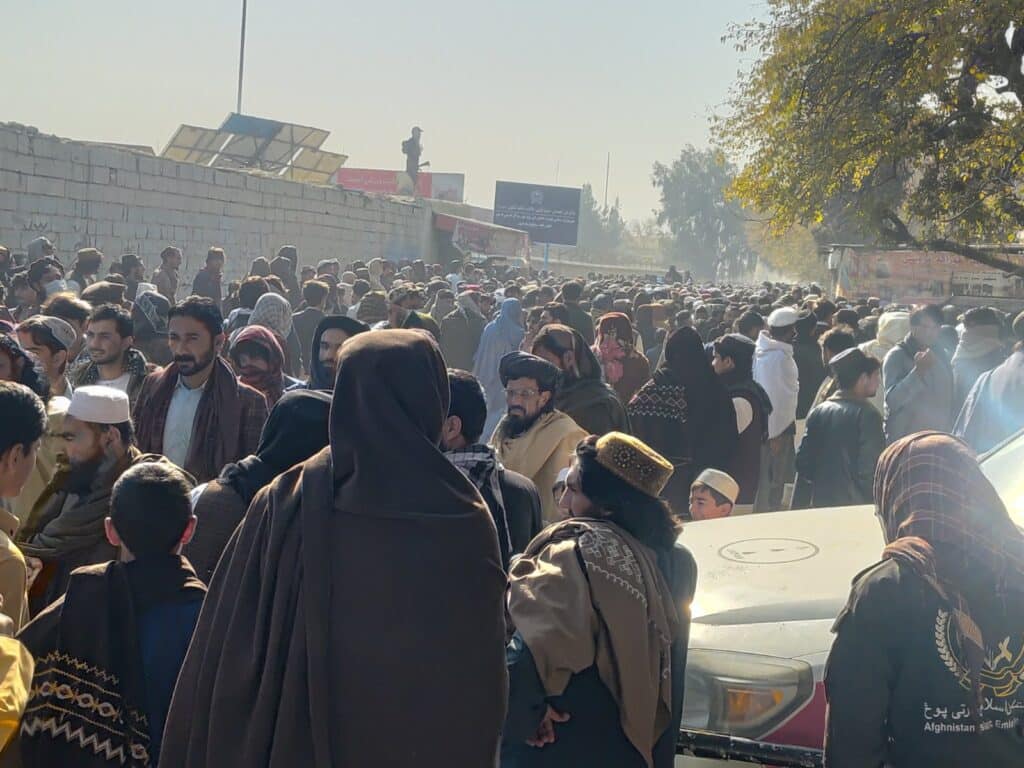
Khost Stadium became the centre of international attention on Tuesday after a 13-year-old Afghan boy executed a man convicted of murdering 13 members of his family. Taliban authorities described the act as Qisas under Sharia law. The event, which drew an estimated 80,000 spectators, has renewed global concern about the Taliban’s growing reliance on public punishments and the troubling involvement of minors in acts of retributive justice.
The gathering was one of the largest seen in eastern Afghanistan since the Taliban’s return to power in 2021. Crowds filled the stands from early morning as officials converted the sports arena into the site of a highly publicised execution. Videos circulating on local networks showed a visibly packed stadium with people crowding stairways and terraces, underscoring both the scale of public mobilisation and the Taliban’s intent to reinforce authority through orchestrated displays of justice.
Conviction and Sentencing of the Accused
Taliban judicial authorities identified the executed man as Mangal, who was convicted of killing 13 members of an extended family, including children, several months earlier. Court officials stated that the case proceeded through the lower courts, the appellate system and the Supreme Court before the sentence was approved by the Taliban’s supreme leader.
Under Sharia, the family of the victims is permitted to choose between forgiveness, financial compensation or Qisas, which allows them to carry out retributive justice. In this case, the family rejected all offers of reconciliation and insisted on enforcing Qisas. This decision led to the involvement of the 13-year-old boy, who authorities described as the rightful person to deliver the sentence.
Witnesses reported that Mangal was brought into the centre of the stadium surrounded by armed Taliban fighters. The boy stepped forward, raised a rifle and fired three shots, killing the convicted man instantly.
A Stadium Filled Beyond Capacity
Reports from local journalists suggested that nearly 80,000 people gathered inside Khost Stadium, with many more standing outside the gates. Although exact crowd numbers in Afghanistan cannot be independently verified, footage from the scene indicated an exceptionally large turnout.
Residents from several districts reportedly travelled long distances after authorities announced the execution publicly. Teams of Taliban security personnel were stationed throughout the venue to manage the crowd and maintain order. For many spectators, the execution served as a communal event rather than a legal proceeding, reflecting the degree to which public justice has become normalised under Taliban governance.
Official Narrative of Swift Justice
Taliban spokespersons described the execution as evidence of what they call an effective and uncompromising justice system. Officials said the handling of the case demonstrated the Taliban’s commitment to restoring security, and supporters claimed that crime has decreased significantly since 2021. For them, the execution represented swift Sharia justice.
Supporters also defended the boy’s involvement, calling it a symbolic act under Sharia. They argued that the family had the absolute right to seek Qisas and that the Taliban merely facilitated the legal framework for the sentence to be carried out.
Rights groups, however, have challenged these claims by pointing to the lack of independent legal safeguards and the opaque nature of Taliban trials.
International Reaction and Human-Rights Concerns
International condemnation was immediate. The United Nations Special Rapporteur on human rights in Afghanistan, Richard Bennett, described the event as a serious violation of international law, particularly because a minor was made to carry out the killing. Human-rights organisations expressed deep concern that involving children in executions could inflict lasting trauma and breaches global conventions on child protection.
Several rights groups reiterated that Taliban judicial proceedings lack transparency, legal representation and independent oversight. The resumption of public punishments, they argued, places Afghanistan increasingly out of step with international human-rights norms and weakens any prospects of global engagement or recognition.
A Troubling Trend of Public Punishments

The Khost Stadium execution is the latest in a series of public punishments carried out since the Taliban regained power. Media tallies indicate that this was at least the eleventh public execution in the past four years. Stadiums and open spaces have also been used for public floggings and amputations, reviving practices that were largely abandoned in the two decades before 2021.
Analysts say these events serve several strategic purposes. They consolidate internal authority, reinforce ideological legitimacy and send a clear message to domestic rivals. However, they also deepen Afghanistan’s diplomatic isolation and complicate efforts to secure international recognition or economic support.
The Involvement of a Child Raises Serious Questions
The participation of a 13-year-old boy remains one of the most disturbing aspects of the incident. International law strictly prohibits the involvement of minors in acts of state violence. Psychologists note that the emotional burden of carrying out an execution can leave lasting psychological scars, especially when combined with family pressure and communal expectation.
The Taliban have offered little explanation about how the boy was selected or the nature of consent obtained. This silence has intensified concerns among child-rights advocates who fear that similar incidents may arise if the trend of Qisas executions continues.
An Event That Reflects Afghanistan’s Uncertain Direction
The execution at Khost Stadium has become emblematic of the complex challenges Afghanistan faces today. While Taliban officials portray such events as expressions of justice and order, they simultaneously reveal deep ethical, legal and humanitarian dilemmas. For the boy who pulled the trigger and for the thousands who watched, the psychological and social consequences will unfold far beyond a single afternoon.
The incident stands as a stark reminder of the tension between traditional interpretations of justice and universally accepted human-rights standards, a conflict that is likely to define Afghanistan’s future path.


